Niagara-on-the-Lake in Niagara Region, Ontario — Central Canada (North America)
Our Western Home - British Home Children
Photographed by Kevin Westell, August 31, 2025
1. Plaque - Our Western Home
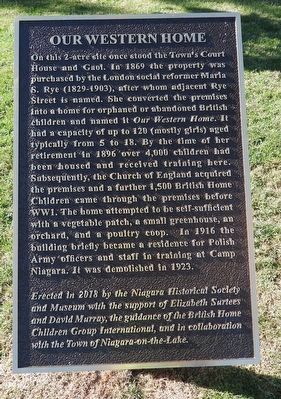
On this 2-acre site once stood the Town's Court House and Gaol. In 1869 the property was purchased by the London social reformer Maria S. Rye (1829-1903), after whom adjacent Rye Street is named. She converted the premises into a home for orphaned or abandoned British Children and named it Our Western Home. It had a capacity of up to 120 (mostly girls) aged typically from 5 to 18. By the time of her retirement in 1896 over 4,000 children had been housed and received training here. Subsequently, the Church of England acquired the premises and a further 1,500 British Home Children came through the premises before WW1. The home attempted to be self-sufficient with a vegetable patch, a small greenhouse, an orchard, and a poultry coop. In 1916 the building briefly became a residence for Polish Army officers and staff in training at Camp Niagara. It was demolished in 1923.
British Home Children
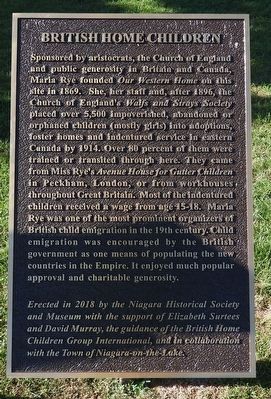
Sponsored by aristocrats, the Church of England and public generosity in Britain and Canada, Maria Rye founded Our Western Home on this site in 1869. She, her staff and, after 1896, the Church
this page online
Erected 2018 by Niagara Historical Society and Museum.
Topics. This historical marker is listed in these topic lists: Charity & Public Work • Education • Immigration. A significant historical year for this entry is 1869.
Location. 43° 14.58′ N, 79° 4.874′ W. Marker is in Niagara-on-the-Lake, Ontario, in Niagara Region. It can be reached from the intersection of Rye Street and Cottage Street, on
Photographed by Kevin Westell, August 31, 2025
2. Plaque - British Home Children

Regionally, this marker is on Ontario’s Golden Horseshoe and in Niagara Canada. It is also in Central Canada. Globally, it is in North America, on the Great Lakes, in the Western Hemisphere, in the Western World, and in the Anglosphere. Historically, it finds itself in what was once a British colony, the Viceroyalty of New France, the Haudenosaunee (Iroquois) Confederacy, and Rupert’s Land.
Other nearby markers. At least 8 other markers are within walking distance of this marker: The Solomon Moseby Affair 1837 (a few steps from this marker); The Cappon-Cash House 1840 (about 210 meters away, measured in a direct line); Upper Canada Heritage Trail (approx. 0.4 kilometers away); a different marker also named Upper Canada Heritage Trail (approx. 0.4 kilometers away); Our Carolinian Forest Zone
Photographed by Kevin Westell, August 31, 2025
3. Our Western Home - British Home Children - Marker in context
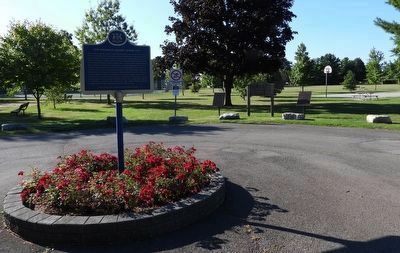
The two plaques (centre right, and right) are beside the dropoff circle, on each side of the sign, Rye Heritage Park.
Credits. This page was last revised on September 7, 2025. It was originally submitted on September 1, 2025, by Kevin Westell of St. Catharines, Ontario. This page has been viewed 69 times since then and 21 times this year. Photos: 1, 2, 3. submitted on September 1, 2025, by Kevin Westell of St. Catharines, Ontario. • Andrew Ruppenstein was the editor who published this page.
