Suffolk, Virginia — The American South (Mid-Atlantic)
Nansemond River Crossing
Battle of Providence Church Road
Photographed by Mike McKeown, February 28, 2025
1. Nansemond River Crossing Marker
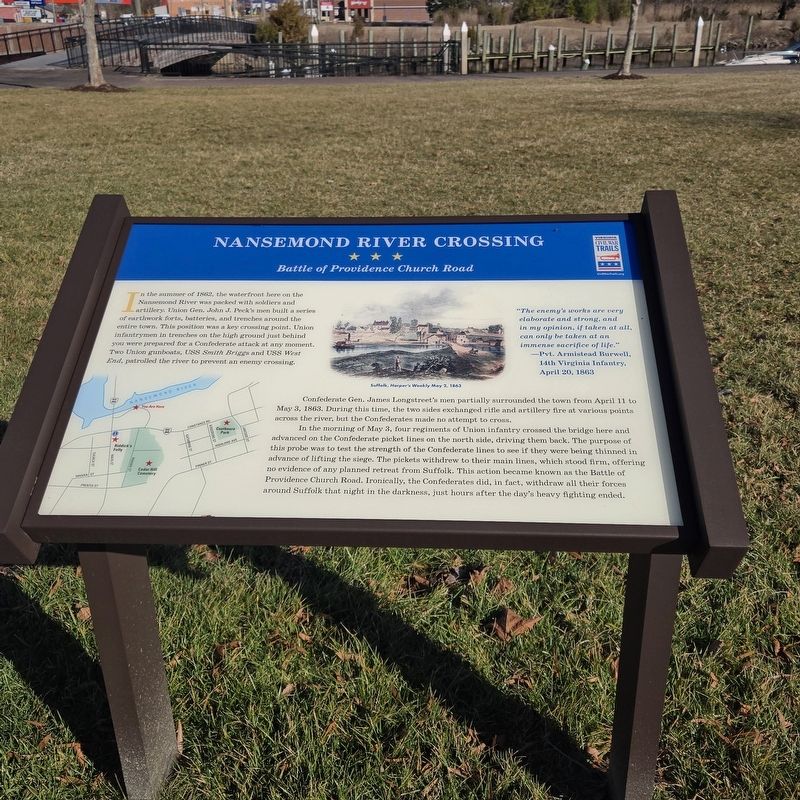
In the summer of 1862, the waterfront here on the Nansemond River was packed with soldiers and artillery: Union Gen. John J. Peck's men built a series of earthwork forts, batteries, and trenches around the entire town. This position was a key crossing point. Union infantrymen in trenches on the high ground just behind you were prepared for a Confederate attack at any moment. Two Union gunboats, USS Smith Briggs and USS West End, patrolled the river to prevent an enemy crossing.
Confederate Gen. James Longstreet's men partially surrounded the town from April 11 to May 3, 1863. During this time, the two sides exchanged rifle and artillery fire at various points across the river, but the Confederates made no attempt to cross.
In the morning of May 3, four regiments of Union infantry crossed the bridge here and advanced on the Confederate picket lines on the north side, driving them back. The purpose of this probe was to test the strength of the Confederate lines to see if they were being thinned in advance of lifting the siege. The pickets withdrew to their main lines, which stood firm, offering no evidence of any
this page online
"The enemy's works are very elaborate and strong, and in my opinion, if taken at all, can only be taken at an immense sacrifice of life." —Pvt. Armistead Burwell, 14th Virginia Infantry, April 20, 1863
Erected by Virgina Civil War Trails.
Topics and series. This historical marker is listed in these topic lists: War, US Civil • Waterways & Vessels. In addition, it is included in the Virginia Civil War Trails series list. A significant historical date for this entry is May 3, 1863.
Location. 36° 44.332′ N, 76° 34.95′ W. Marker is in Suffolk, Virginia. It is on North Main Street (Business U.S. 460) north of East Constance Road (Business U.S. 58), on the right when traveling north. Located in Constant's Wharf Public Park & Marina. Touch for map. Marker is at or near this postal address: 110 E Constance Rd, Suffolk VA 23434, United States of America. Touch for directions.

Regionally,
Photographed by Mike McKeown, February 28, 2025
2. Nansemond River Crossing Marker
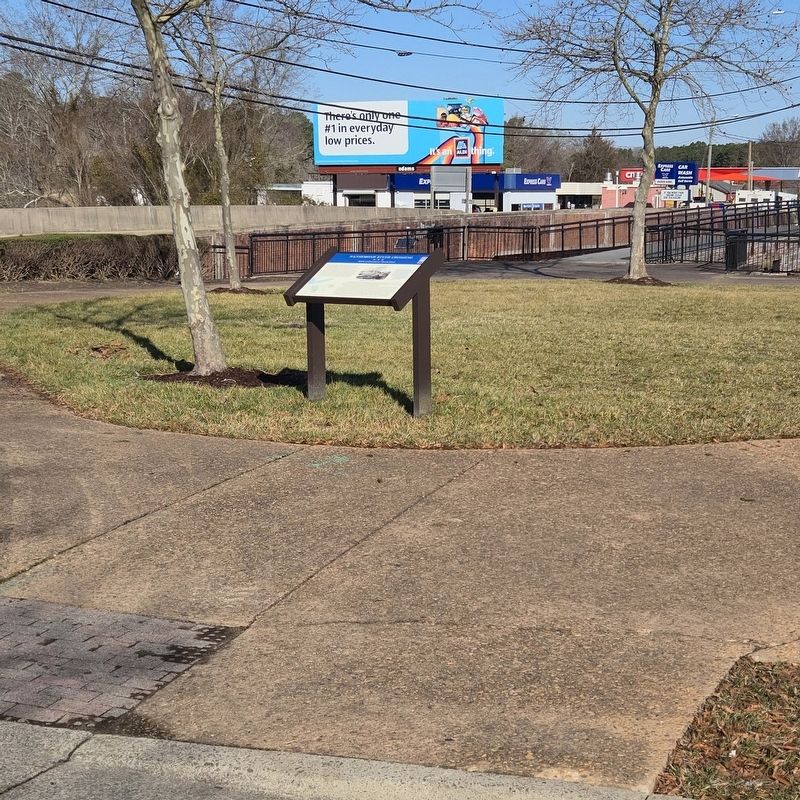
Marker at a distance
Other nearby markers. At least 8 other markers are within walking distance of this marker: Early History of Suffolk (a few steps from this marker); Lafayette’s Tour (about 500 feet away, measured in a direct line); a different marker also named Riddick's Folly (about 700 feet away); Cedar Hill Cemetery (about 700 feet away); First Suffolk Church (approx. 0.2 miles away); Site of the John Constant House (approx. 0.2 miles away); The Site of the First Church (approx. 0.2 miles away); World War I Monument (approx. 0.3 miles away). Touch for a list and map of all markers in Suffolk.
Another marker is no longer nearby. Riddick’s Folly (was about 700 feet away but has been replaced with another marker now near it).
Credits. This page was last revised on September 1, 2025. It was originally submitted on February 28, 2025, by Mike McKeown of Baltimore, Maryland. This page has been viewed 432 times since then and 58 times this year. Last updated on September 1, 2025, by Mark P. Brock-Cancellieri of Baltimore, Maryland. Photos: 1, 2. submitted on February 28, 2025, by Mike McKeown of Baltimore, Maryland. • Bernard Fisher was the editor who published this page.
