
St. Augustine Beach in St. Johns County, Florida — The American South (South Atlantic)
Time of Transition
St. Johns County Black Heritage Trail
Photographed by Brandon D Cross, September 1, 2025
1. Time of Transition Marker
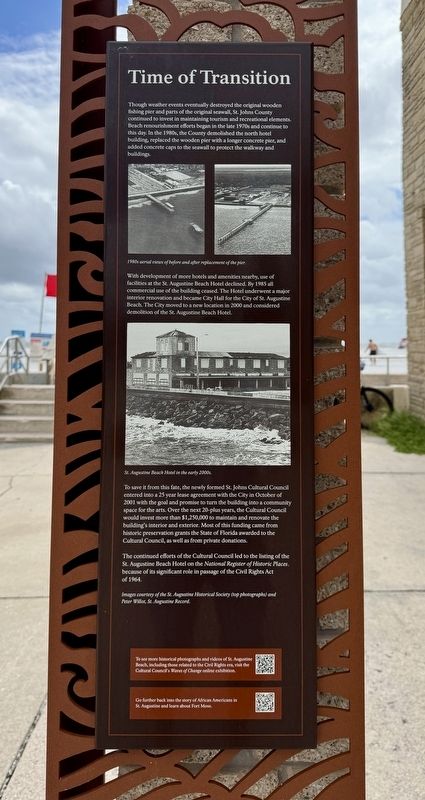
With development of more hotels and amenities nearby, use of facilities at the St. Augustine Beach Hotel declined. By 1985 all commercial use of the building ceased. The Hotel underwent a major interior renovation and became City Hall for the City of St. Augustine Beach. The City moved to a new location in 2000 and considered demolition of the St. Augustine Beach Hotel.
To save it from this fate, the newly formed St. Johns Cultural Council entered into a 25 year lease agreement with the City in October of 2001 with the goal and promise to turn the building into a community space for the arts. Over the next 20-plus years, the Cultural Council would invest more than $1,250,000 to maintain and renovate the building's interior and exterior. Most of this funding came from historic preservation grants the State of Florida awarded to the Cultural Council, as well as from private donations.
The continued efforts of the Cultural Council led to the listing of the St. Augustine Beach Hotel on the National Register of Historic Places because of its significant role in passage of the Civil Rights Act of 1964.
(captions)
1980s aerial views of before and after replacement of the pier.
St. Augustine Beach Hotel in the early 2000s.
Images courtesy of the St. Augustine Historical Society (top photographs) and Peter Willot, St. Augustine Record.
To see more historical photographs and videos of St. Augustine Beach, including those related to the Civil Rights era, visit the Cultural Council's Waves of Change online exhibition.
Go further back into the story of African Americans in St. Augustine and learn about Fort Mose.
Erected 2025
this page online
Topics. This historical marker is listed in these topic lists: African Americans • Civil Rights • Industry & Commerce • Notable Places • Parks & Recreational Areas. A significant historical year for this entry is 1973.
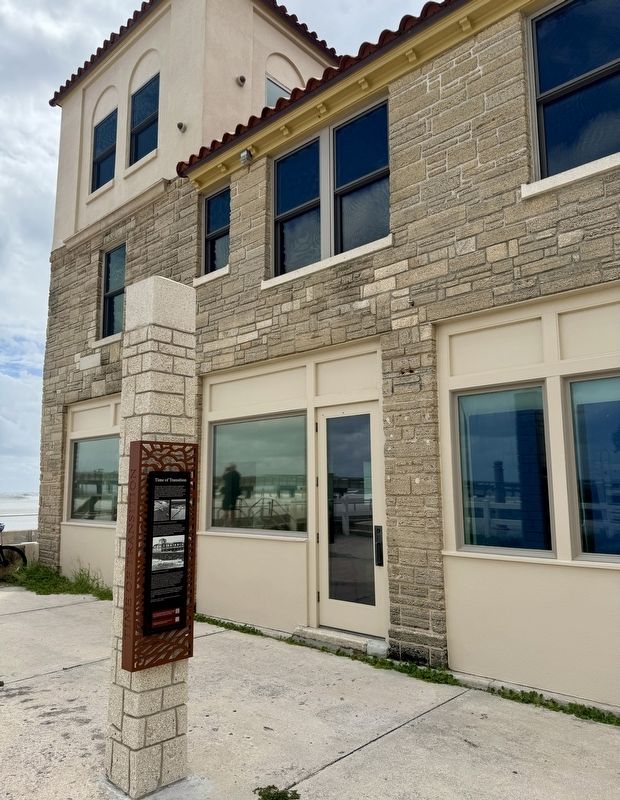
Location. 29° 51.396′ N, 81° 15.937′ W. Marker is in St. Augustine Beach, Florida, in St. Johns County. It is on A1A Beach Boulevard 0.1 miles north of 16th Street, on the left when traveling east. Located in front of the St. Augustine Beach Hotel. Touch for map. Marker is at or near this postal address: 350 A1A Beach Boulevard, Saint Augustine FL 32080, United States of America. Touch for directions.

Regionally, this marker is in First Coast and in Greater Jacksonville. It is also in the American South and on the Eastern Seaboard. Globally, it is in the North Atlantic Region, North America, a Gulf of Mexico state, the Western Hemisphere, the Western World, and the Anglosphere. Historically, it finds itself in what was once New Spain, the territory of the Mississippian Culture, one of the Confederate States of America, and the Antebellum South.
Photographed by Brandon D Cross, September 1, 2025
2. Time of Transition Marker
Other nearby markers. At least 8 other markers are within one mile of this marker, measured as the crow flies: Civil Rights (here, next to this marker); 21st Century (here, next to this marker); Recreation and Fun (a few steps from this marker); Waves of Change (a few steps from this marker); St. Johns County Black Heritage Trail (within shouting distance of this marker); St. Augustine Beach Wade-Ins (within shouting distance of this marker); Veterans Memorial (approx. 0.8 miles away); Old Spanish Chimney and Well (approx. one mile away). Touch for a list and map of all markers in St. Augustine Beach.
Also see . . .
1. Civil Rights & Butler Beach | St. Augustine & Ponte Vedra, FL. (Submitted on September 2, 2025, by Brandon D Cross of Flagler Beach, Florida.)
2. St. John’s County Black Heritage Trail. (Submitted on September 2, 2025, by Brandon D Cross of Flagler Beach, Florida.)
Credits. This page was last revised on September 6, 2025. It was originally submitted on September 2, 2025, by Brandon D Cross of Flagler Beach, Florida. This page has been viewed 70 times since then and 19 times this year. Photos: 1, 2. submitted on September 2, 2025, by Brandon D Cross of Flagler Beach, Florida. • Andrew Ruppenstein was the editor who published this page.
