San Frediano in Firenze in Città Metropolitana di Firenze, Tuscany, Italy — Southern and Western Europe (Mediterranean)
Camminatmento Sulle Mura e Stanza di Veduta di Porta Romana
Introducing the View-Room and the Pathway Along the Walls of Porta Romana
Photographed by Sean P. Flynn, July 30, 2025
1. Camminatmento Sulle Mura e Stanza di Veduta di Porta Romana Marker
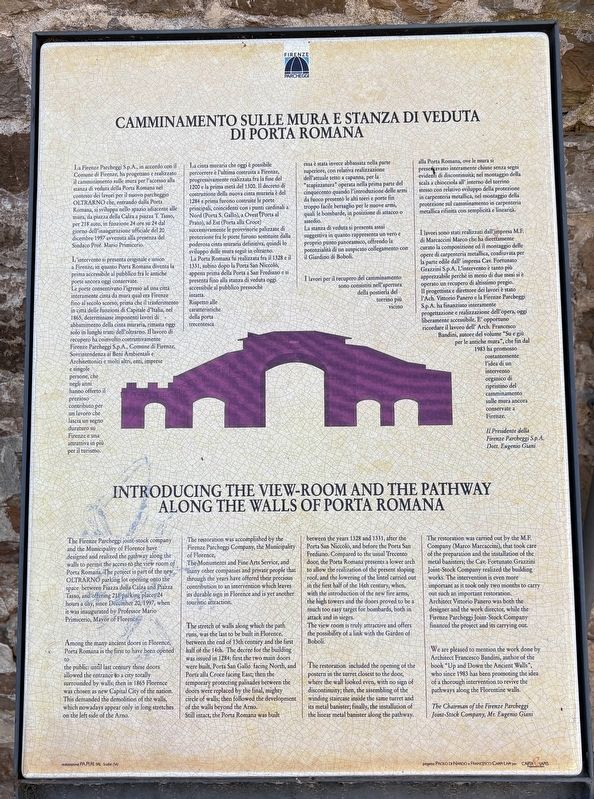
L'intervento si presenta originale e unico a Firenze, in quanto Porta Romana diventa la prima accessibile al pubblico fra le antiche porte ancora oggi conservate. Le porte consentivano l'igresso ad una città interamente cinta da mura qual era Firenze fino al secolo scorso, prima che il trasferimento in città delle funzioni di Capitale d'Italia, nel 1865, determinasse imponenti lavori di abbattimento della cinta muraria, rimasta oggi solo in lunghi tratti dell'oltrarno. Il lavoro di recupero ha coinvolto costruttivamente Firenze Parcheggi S.p.A., Comune di Firenze, Sovrintendenza ai Beni Ambientali e Architettonici e molti altri, enti, imprese e singole persone, che negli anni hanno offerto il prezioso contributo per un lavoro che lascia un segno duraturo su Firenze e una attrattiva in più per il turismo.
La cinta muraria che oggi è possibile percorrere è l'ultima costruita a Firenze, progressivamente realizzata fra la fine del 1200 e la prima metà del 1300. Il decreto di costruzione della nuova cinta muraria è del 1284 e prima furono costruite le porte principali, coincidenti con i punti cardinali a Nord (Porta S. Gallo), a Ovest (Porta al Prato), ad Est (Porta alla Croce)
this page online
I lavori per il recupero del camminamento sono consistiti nell'apertura della postierla del torrino più vicino alla Porta Romana, ove le mura si presentavano interamente chiuse senza segni evidenti di discontinuità; nel montaggio della. scala a chiocciola all'interno del torrino stesso con relativo sviluppo della protezione in carpenteria metallica, nel montaggio della protezione sul camminamento in carpenteria metallica rifinita con semplicità e lineariță.
I lavori sono stati realizzati dall'impresa M.F. di Marcaccini Marco che ha direttamente curato la composizione ed il montaggio delle opere di carpenteria metallica, coadiuvata per la parte edile dall' impresa Cav. Fortunato Grazzini S.p.A. L'intervento è tanto
Photographed by Sean P. Flynn, July 30, 2025
2. Camminatmento Sulle Mura e Stanza di Veduta di Porta Romana Marker
Il Presidente della Firenze Parcheggi S.p.A. Dott. Eugenio Giani
The Firenze Parcheggi joint-stock company and the Municipality of Florence have designed and realized the pathway along the walls to permit the access to the view room of Porta Romana. The project is part of the new OLTRARNO parking lot opening onto the space between Fiazza della Calza and Piazza Tasso, and offering 218 parking places 24 hours a day, since December 20, 1997, when it was inaugurated by Professor Mario Primicerio, Mavor of Florence.
Among the many ancient doors in Florence, Porta Romana is the first to have been opened to the public: until last century these doors allowed the entrance to a city totally surrounded by walls; then in 1865 Florence was chosen as new Capital City of the nation. This demanded the demolition of the walls, which nowadays appear only in long stretches on the left side of the Arno.
The restoration was accomplished by the Firenze Parcheggi Company, the Municipality of Florence, The Monuments and Fine Arts Service, and many other companies and private people that through the years have offered their precious contribution to an intervention
Photographed by Sean P. Flynn, July 30, 2025
3. Camminatmento Sulle Mura e Stanza di Veduta di Porta Romana Marker
The stretch of walls along which the path runs, was the last to be built in Florence, between the end of 13th century and the first half of the 14th. The decree for the building was issued in 1284: first the two main doors were built, Porta San Gallo facing North, and Porta alla Croce facing East, then the temporary protecting palisades between the doors were replaced by the final, mighty circle of walls; then followed the development of the walls beyond the Arno. Still intact, the Porta Romana was built between the years 1328 and 1331, after the Porta San Niccolo, and before the Porta San Frediano. Compared to the usual Trecento door, the Porta Romana presents a lower arch to allow the realization of the present sloping rood, and the lowering of the lintel carried out in the first half of the 16th century, when, with the introduction of the new fire arms, the high towers and the doors proved to be a much too easy target for bombards, both in attack and in sieges. The view room is truly attractive and offers the possibility of a link with the Garden of Boboli.
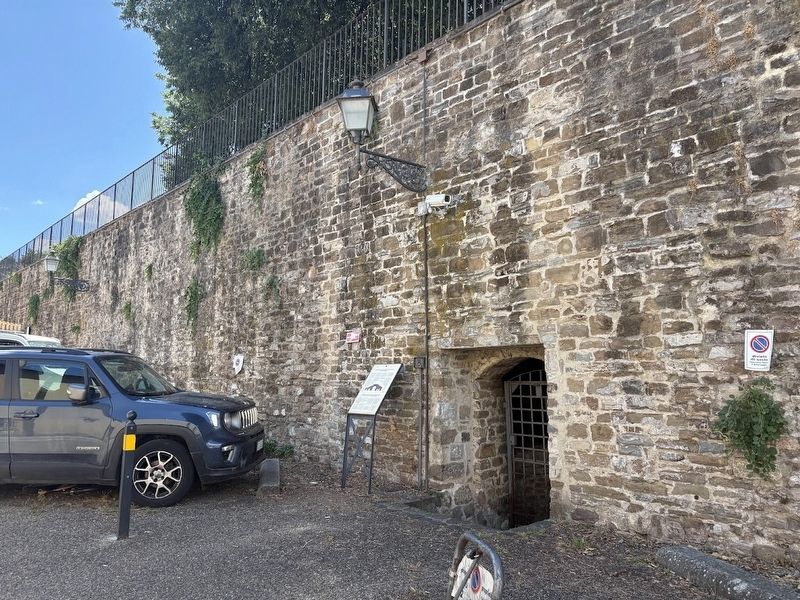
The restoration included the opening of the postern in the turret closest to the door, where the wall looked even, with no sign of discontinuity; then, the assembling of the winding staircase inside the same turret and its metal banister, finally, the installation of the linear metal banister along the pathway. The restoration was carried out by the M.F. Company (Marco Marcaccini), that took care of the preparation and the installation of the metal banisters, the Cav. Fortunato Grazzini Joint-Stock Company realized the building works. The intervention is even more important as it took only two months to carry out such an important restoration. Architect Vittorio Panero was both the designer and the work director, while the Firenze Parcheggi Joint-Stock Company financed the project and its carrying out.
We are pleased to mention the work done by Architect Francesco Bandini, author of the book "Up and Down the Ancient Walls", who since 1983 has been promoting the idea of a thorough intervention to revive the pathways along the Florentine walls.
The Chairman of the Firenze Parcheggi Joint-Stock Company, Mr. Eugenio Giani
Topics. This historical marker is listed in these topic lists: Forts and Castles • Roads & Vehicles • Waterways & Vessels. A significant historical year for this entry is 1284.
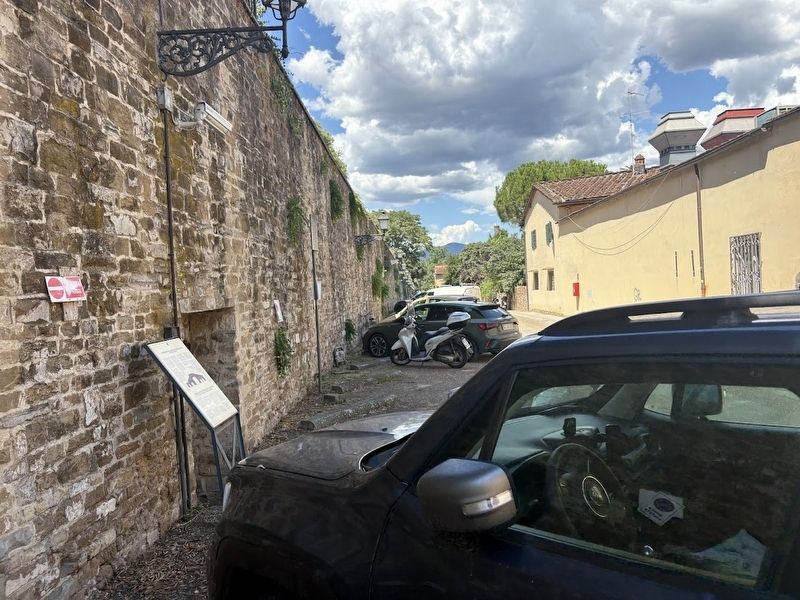
Location. 43° 45.708′ N, 11° 14.489′ E. Marker is in Firenze, Toscana (Tuscany), in Città Metropolitana di Firenze. It is in San Frediano. It can be reached from Viale Francesco Petrarca 0.1 kilometers north of Piazzale di Porta Romana, on the left. The marker is located within the parking lot that runs along the wall that runs north from the Porta Romana. Touch for map. Marker is at or near this postal address: Piazza della Calza 1, Firenze, Toscana 50124, Italy. Touch for directions.

Regionally, it is in Europe, the European Union, the Schengen Area, a coastal Mediterranean country, and the Western World. Historically, it finds itself in what was once the Roman Empire and specifically also the Holy Roman Empire.
Other nearby markers. At least 8 other markers are within walking distance of this marker: Alphonse de Lamartine (approx. 0.3 kilometers away); Nathaniel Hawthorne (approx. 0.3 kilometers away); Istituto Gould (approx. 0.6 kilometers away); Antonio Meucci (approx. 0.7 kilometers away); Chiesa Anglicana di Saint Mark (St. Mark's Church) (approx. 0.9 kilometers away); Italian Ministry of the Navy (approx. one kilometer away); Chiesa di San Jacopo Sopr'Arno (approx. one kilometer away); Holy Trinity Bridge Reconstructed (approx. one kilometer away). Touch for a list and map of all markers in Firenze.
Credits. This page was last revised on September 2, 2025. It was originally submitted on September 2, 2025, by Sean P. Flynn of Oak Park, Illinois. This page has been viewed 66 times since then and 13 times this year. Photos: 1, 2, 3. submitted on September 2, 2025, by Sean P. Flynn of Oak Park, Illinois.
