Near Goleta in Santa Barbara County, California — The American West (Pacific Coastal)
Tomol
Connecting the Chumash
Photographed by Craig Baker, August 1, 2025
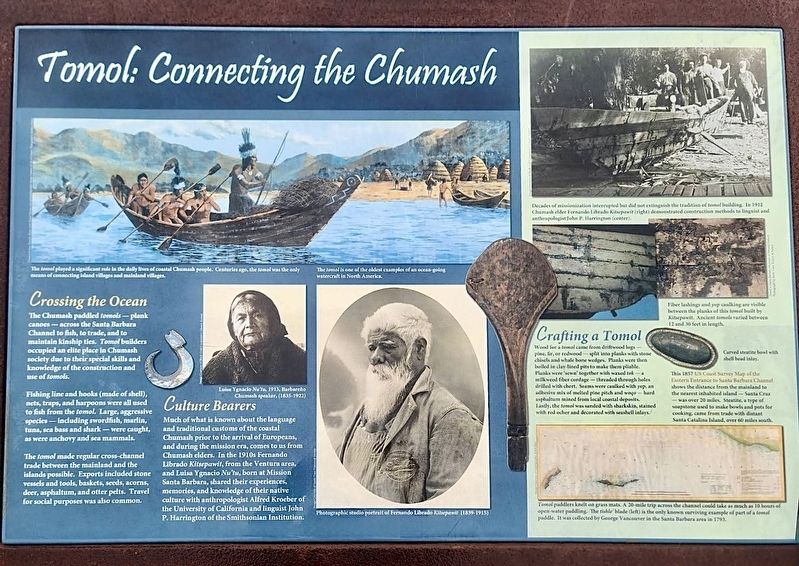
1. Tomol Marker
Crossing the Ocean
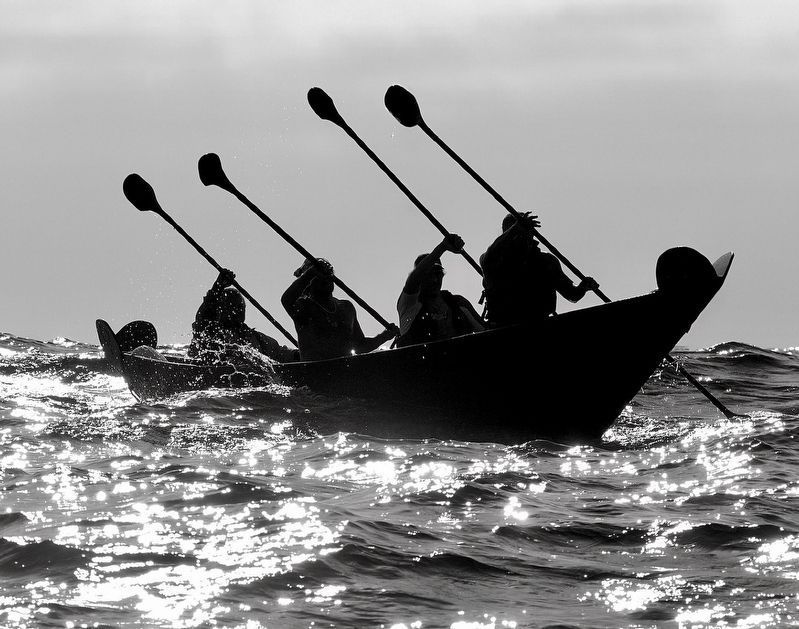
The Chumash paddled tomols - plank canoes - across the Santa Barbara Channel to fish, to trade, and to maintain kinship ties. Tomol builders occupied an elite place in Chumash society due to their special skills and knowledge of the construction and use of tomols.
Fishing line and hooks (made of shell), nets, traps, and harpoons were all used to fish from the tomol. Large, aggressive species - including swordfish, marlin, tuna, sea bass and shark — were caught, as were anchovy and sea mammals.
The tomol made regular cross-channel trade between the mainland and the islands possible. Exports included stone vessels and tools, baskets, seeds, acorns, deer, asphaltum, and otter pelts. Travel for social purposes was also common.
Culture Bearers
Much of what is known about the language and traditional customs of the coastal Chumash prior to the arrival of Europeans, and during the mission era, comes to us from Chumash elders. In the 1910s Fernando Librado Kitsepawit, from the Ventura area, and Luisa Ygnacio Nu'tu, born at Mission Santa Barbara, shared their experiences,
this page online
Crafting a Tomol
Wood for a tomol came from driftwood logs - pine, fir, or redwood — split into planks with stone chisels and whale bone wedges. Planks were then boiled in clay-lined pits to make them pliable. Planks were 'sewn' together with waxed tok — a milkweed fiber cordage — threaded through holes drilled with chert. Seams were caulked with yop, an adhesive mix of melted pine pitch and woqo - hard asphaltum mined from local coastal deposits. Lastly, the tomol was sanded with sharkskin, stained with red ocher and decorated with seashell inlays.
Topics. This historical marker is listed in these topic lists: Indigenous Peoples and Communities • Waterways & Vessels.
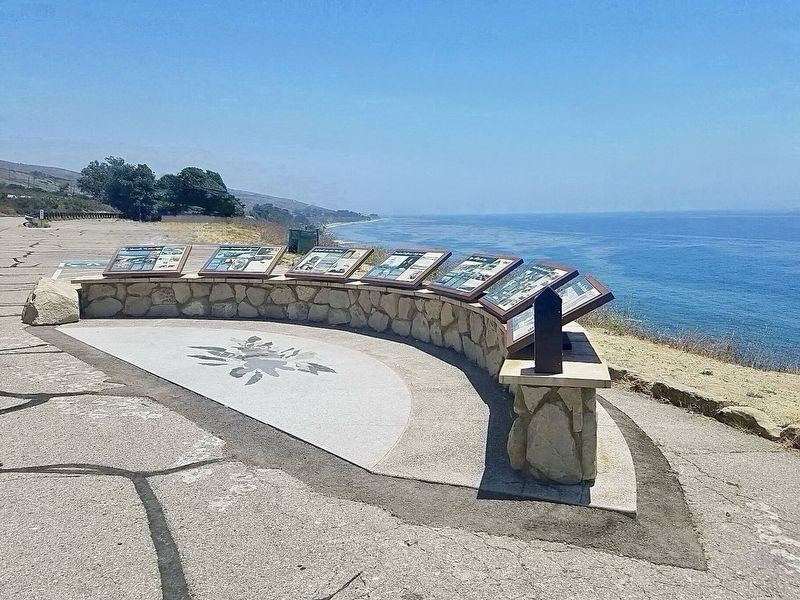
Location. 34° 28.439′ N, 120° 8.205′ W. Marker is near Goleta, California, in Santa Barbara County. It is on U.S. 101, on the right when traveling east. Located at Arroyo Hondo Vista Point, only accessible from the eastbound
Photographed by Craig Baker
2. Tomol Marker

Regionally, this marker is on the Central Coast, specifically on the Coast Ranges, and specifically in the Transverse Ranges. It is also on the American Pacific Coast. Globally, it is in North America, on the Ring of Fire, on the Pacific Rim, in the Western Hemisphere, in the Western World, and in the Anglosphere. Historically, it finds itself in what was once New Spain and also Mexico’s Alta California.
Other nearby markers. At least 8 other markers are within 6 miles of this marker, measured as the crow flies: Gaviota: Pass to the Seagull’s Coast (here, next to this marker); Sea Otter Hunting (a few steps from this marker); Mini-Mammoths (a few steps from this marker); Bouchard: California’s Only Pirate (a few steps from this marker); Rigs: Drilling the Deep (a few steps from this marker); Bicycling (a few steps from this marker); Arroyo Hondo Fish Passage & Upstream Habitat Restoration (approx. 0.2 miles away); Gaviota Timeline: 7) Highways and Byways (approx. 5.3 miles away). Touch for a list and map
courtesy NPS/Public Domain
3. Tomol
Credits. This page was last revised on September 3, 2025. It was originally submitted on September 3, 2025, by Craig Baker of Sylmar, California. This page has been viewed 95 times since then and 33 times this year. Photos: 1, 2. submitted on September 3, 2025, by Craig Baker of Sylmar, California. 3. submitted on June 30, 2025, by Craig Baker of Sylmar, California.
