Hampton, Virginia — The American South (Mid-Atlantic)
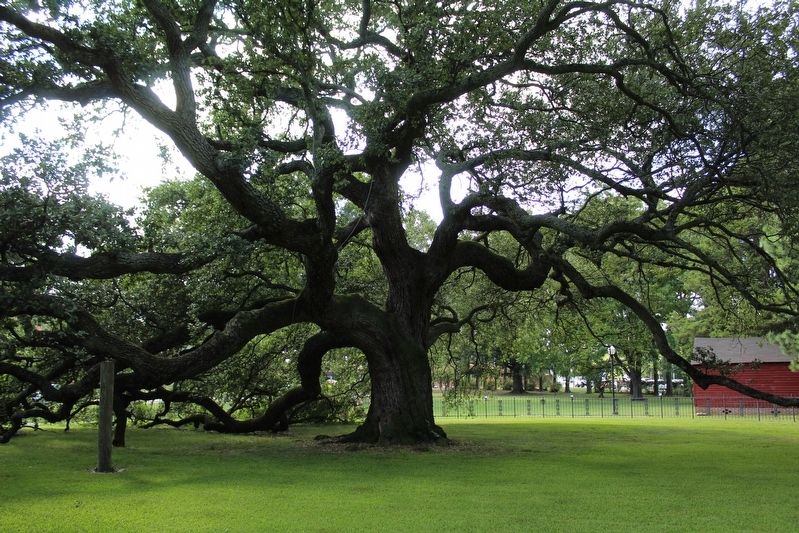
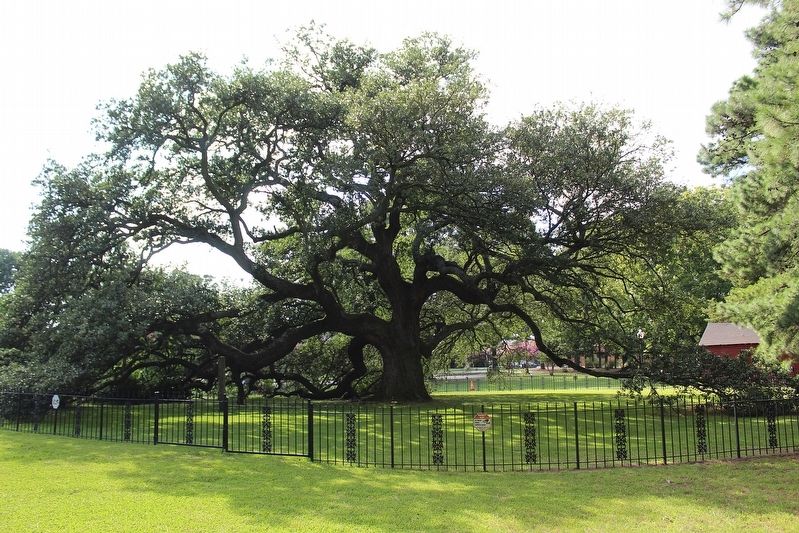
Emancipation Oak
Formerly Enslaved Eager for Education
Photographed by Evan Dwyer, August 9, 2025
1. Emancipation Oak Marker
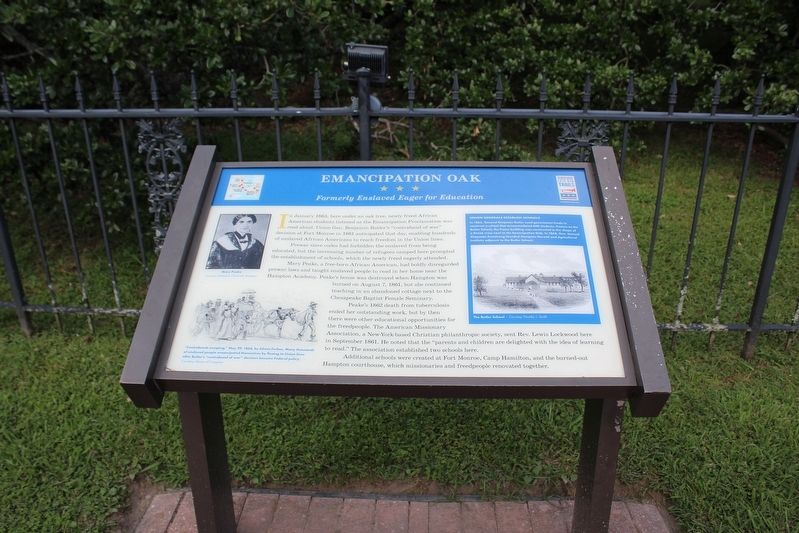
Prewar slave codes had forbidden the enslaved from being educated, but the increasing number of refugees camped here prompted the establishment of schools, which the newly freed eagerly attended.
Mary Peake, a free-born African American, had boldly disregarded prewar laws and taught enslaved people how to read in her home near the Hampton Academy. Peake's house was destroyed when Hampton was burned on August 7, 1861, but she continued teaching in an abandoned cottage next to the Chesapeake Baptist Female Seminary.
Peake's 1862 death from tuberculosis ended her outstanding work, but by then there were other educational opportunities for the freedpeople. The American Missionary Association, a New-York-based Christian philanthropic society, sent Rev. Lewis Lockwood here in September 1861. He noted
this page online
Additional schools were created at Fort Monroe, Camp Hamilton, and the burned-out Hampton courthouse, which missionaries and freedpeople renovated together.
(captions)
Mary Peake Courtesy Hampton University Museum
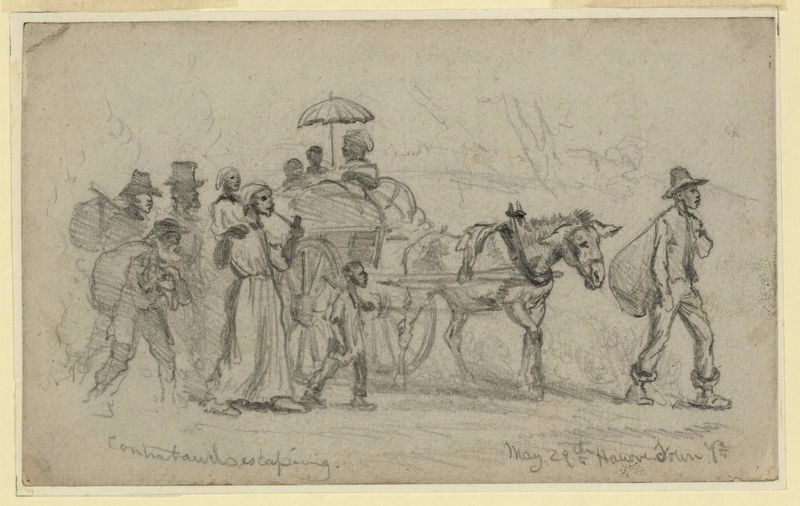
"Contrabands escaping," May 29, 1864, by Edwin Forbes. Many thousands of enslaved people emancipated themselves by fleeing to Union lines after Butler's "contraband of war" decision became Federal policy. Courtesy Library of Congress
Union Generals Establish Schools
In 1863, General Benjamin Butler used government funds to construct a school that accommodated 600 students. Known as the Butler School, the frame building was constructed in the shape of a Greek cross next to the Emancipation Oak. In 1868, Gen. Samuel Chapman Armstrong founded Hampton Normal and Agricultural Institute adjacent to the Butler School.
The Butler School - Courtesy Timothy L. Smith
Erected by Virginia Civil War Trails.
Topics and series. This historical marker is listed in these topic lists: African Americans
Photographed by Evan Dwyer, August 9, 2025
2. Emancipation Oak
Location. 37° 1.386′ N, 76° 19.834′ W. Marker is in Hampton, Virginia. It is on Emancipation Drive 0.1 miles south of Tyler Street, on the left when traveling south. Marker is on the grounds of Hampton University by the Emancipation Oak. Touch for map. Marker is in this post office area: Hampton VA 23667, United States of America. Touch for directions.

Regionally, this marker is on Virginia’s Peninsula and in Coastal Virginia. It is also in the American South, specifically in the Upper South, in the Tidewater, and on the Eastern Seaboard. Globally, it is in the North Atlantic Region, North America, the Western Hemisphere, the Western World, and the Anglosphere. Historically, it finds itself in what was once the territory of the Mississippian Culture, one of the original Thirteen Colonies, one of the Confederate States of America, and the Antebellum South.
Other nearby markers. At least 8 other markers are within walking distance of this marker: Hampton Institute
Photographed by Evan Dwyer, August 9, 2025
3. Emancipation Oak
Other markers no longer nearby. Emancipation Oak (has been replaced with this marker); a different marker also named Emancipation Oak (has been replaced with this marker).
Related markers. Click here for a list of markers that are related to this marker. Old CWT Markers At This Location also titled "Emancipation Oak".
Photographed by Edwin Forbes, May 29, 18
4. Contrabands Escaping
Library of Congress [LC-USZC4-1455]
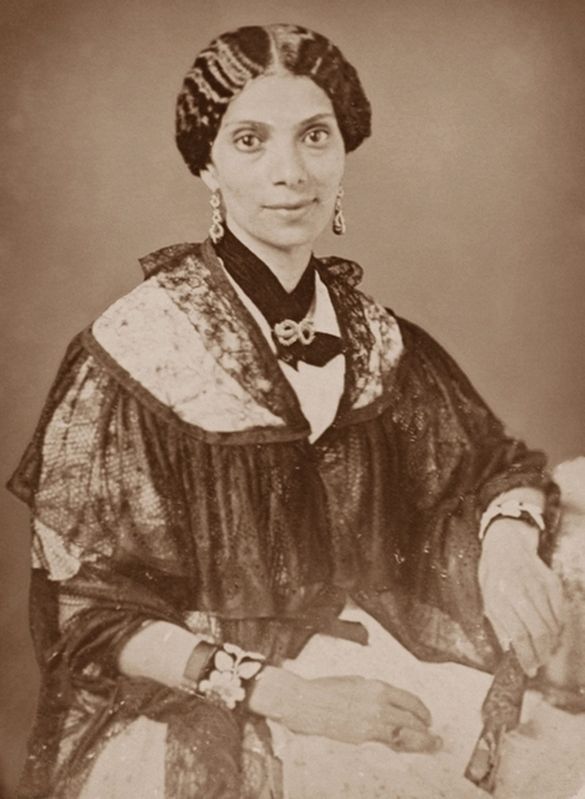
5. Mary Smith Kelsey Peake (1823–1862)
Courtesy Hampton University Museum
Credits. This page was last revised on September 7, 2025. It was originally submitted on September 3, 2025, by Evan Dwyer of Richmond, Virginia. This page has been viewed 100 times since then and 38 times this year. Photos: 1, 2, 3. submitted on September 3, 2025, by Evan Dwyer of Richmond, Virginia. 4, 5. submitted on August 1, 2010, by Bernard Fisher of Richmond, Virginia. • Bernard Fisher was the editor who published this page.
