Guelph in Wellington County, Ontario — Central Canada (North America)
Joseph Benson Reynolds 1867-1948

Photographed by Tim Boyd, September 1, 2025
1. Joseph Benson Reynolds 1867-1948 Marker
OAC, Physics, English Instructor, 1893-1906
Head, English, 1906-1915
President, Manitoba Agricultural College, 1915-1920
President, OAC, 1920-1928
Joseph Reynolds was born on a farm near Bowmanville, Ontario, the youngest of 15 children. He taught school in Durham County, adding janitor's duties to pay for his studies at the University of Toronto, where he finished first in his class in physics and mathematics in 1893. Reynolds arrived at OAC in 1893 as Assistant Resident Master and instructor of English and Physics.
In the late 1890s, he introduced soil analysis in the Physics program and began advocating for a provincial soil testing program, which was not launched until 1923. In 1905, Reynolds involved the Physics Department in farm drainage surveys and eventually hundreds were conducted, vastly improving crop yields. Reynolds also introduced extensive testing of lightning rods for the protection of farm buildings.
An Innovator, he studied the effect of cooling by loading two train cars with fruit and ice in Niagara and sending them on a seven-day trip to Winnipeg. On arrival, the produce was fresher than
this page online
From 1915-1920, Reynolds was President of the Manitoba Agricultural College, returning to Guelph in 1920 as President of OAC, where he introduced matriculation requirements for students entering the degree program. This meant first-year degree students went to labs instead of reporting for farm work.
During Reynolds' presidency, the Ontario Veterinary College was moved to Guelph in 1922 and the 50th anniversary of OAC, including the opening of War Memorial Hall, was celebrated in 1924.
Reynolds retired to his farm at Port Hope in 1928 with the title President Emeritus, Reynolds Building
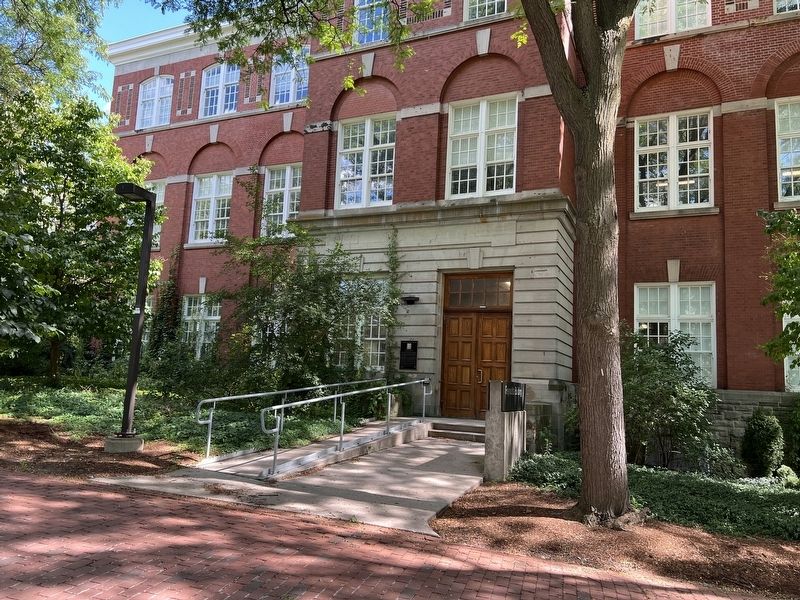
Photographed by Tim Boyd, September 1, 2025
2. Joseph Benson Reynolds 1867-1948 Marker
On Reynolds Building
Reynoids Bullding 1915
On the occasion of the 110th anniversary of the Department of Physics (1895-2005)
Erected by University of Guelph.
Topics. This historical marker is listed in these topic lists: Agriculture • Arts, Letters, Music • Science & Medicine. A significant historical year for this entry is 1893.
Location. 43° 31.852′ N, 80° 13.753′ W. Marker is in Guelph, Ontario, in Wellington County. It can be reached from Gordon Street. The marker is on the campus of the University of Guelph on Johnson Green, accessible by foot on Alumni Walk, approx. 100 metres from Gordon Street. Touch for map. Marker is at or near this postal address: 474 Gordon Street, Guelph ON N1G 1Y4, Canada. Touch for directions.

Regionally, this marker is in the Huron-Perth-Waterloo-Wellington Area and in Southwestern Ontario. It is also in Central Canada. Globally, it is in North America, the Western Hemisphere, the Western World, and the Anglosphere. Historically, it finds itself in what was once a British colony, the Viceroyalty of New France, the Haudenosaunee (Iroquois) Confederacy, and Rupert’s Land.
Other nearby markers. At least 8 other markers are within walking distance of this marker: John Douglas MacLachlan 1906-1987 (within shouting distance of this marker); Massey Hall (about 120 meters away, measured in a direct line); a different marker also named Massey Hall (about 120 meters away); Frank W. Schofield (1889-1970) (about 120 meters away); William Laing Hutt 1867-1948 (about 180 meters away); MacNaughton Building (about 180 meters away); Charles A. Zavitz 1863-1942 (about 180 meters away); Winegard Walk (about 180 meters away). Touch for a list and map of all markers in Guelph.
Credits. This page was last revised on September 7, 2025. It was originally submitted on September 3, 2025, by Tim Boyd of Hamilton, Ontario. This page has been viewed 58 times since then and 17 times this year. Photos: 1, 2. submitted on September 3, 2025, by Tim Boyd of Hamilton, Ontario. • Andrew Ruppenstein was the editor who published this page.
