Hoboken in Hudson County, New Jersey — The American Northeast (Mid-Atlantic)
History of the Hoboken Ferry Terminal

Hoboken, New Jersey was Lenni Lenape Indian Territory until the 17th century. After the revolutionary war, Colonel John Stevens purchased the land, naming it The New City of Hoboken. when the sale of lots to the general public was not immediately successful once Hoboken's street grid was established in 1804, Stevens explored the possibility of establishing ferry service between New York City and Hoboken, and developed the land as an arcadian pleasure resort to which New Yorkers could retreat from the city.
By 1811 Stevens was operating regular service to New York from Hoboken's first ferry house. Robert Fulton, inventor of the first commercial steamboat forced Stevens to abandon his ferry business until 1824, when Fulton's monopoly on Hudson River steam travel was dissolved in the US Supreme Court Case Gibbons vs. Ogden. In 1828 Hoboken had less than five hundred permanent residents but drew as many as 20,000 visitors daily during the summer months; the area continued to evolve as a summer resort for New Yorkers.
The first rail line from Hoboken, serving Morristown to New York City (via the Hoboken Ferry), was leased
this page online
In 1883, the DL&W built a new ferry house on the site that was connected to the railroad station in Hoboken. In 1903, the DL&W leased the ferry service from The Hoboken Ferry Company, and retained the architect Kenneth Marchison to draw plans for a new intermodal terminal complex that would fully integrate rail and ferry service.
On August 7, 1905, the existing ferry house burned in a catastrophic fire. By August 17, 1905, construction had begun on Marchison's new Hoboken Ferry Terminal, and the new intermodal terminal complex opened in February 1907.
The main buildings included the combined
Photographed by Devry Becker Jones (CC0), August 30, 2025
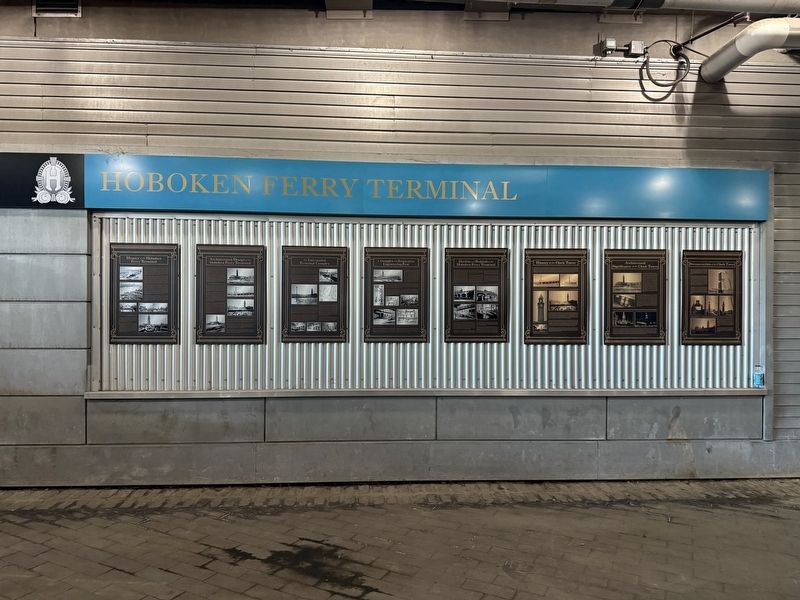
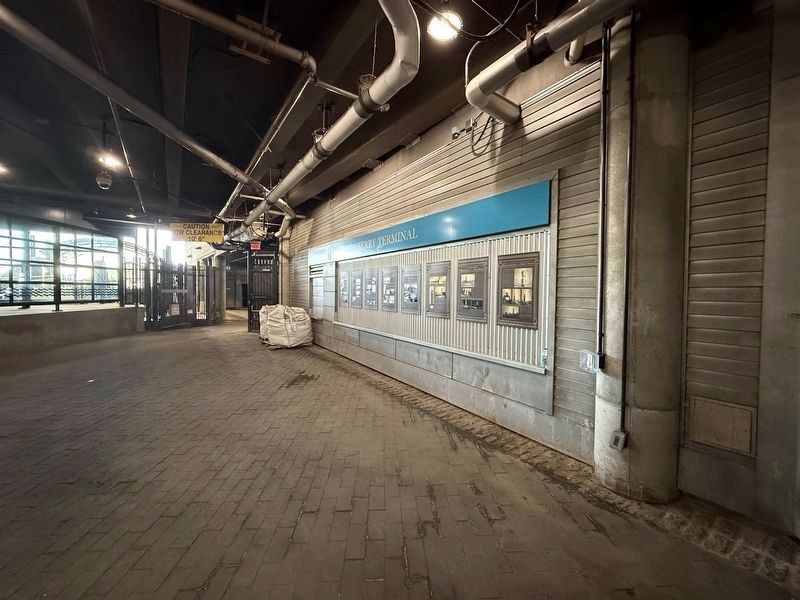
2. Hoboken Ferry Terminal markers
This set of markers can be found between the rail station and the ferry docks. It is partially open-air with entrances to the rail station, and gates that open to ferries as they arrive and depart.
Topics. This historical marker is listed in these topic lists: Immigration • Industry & Commerce • Railroads & Streetcars • Waterways & Vessels. A significant historical month for this entry is February 1907.
Location. 40° 44.107′ N, 74° 1.648′ W. Marker is in Hoboken, New Jersey, in Hudson County. It can be reached from Hudson Place (County Road 736) east of River Street, on the right when traveling east. The marker is on the grounds of the Hoboken Transit Terminal between the rail station and the ferry docks. The area is partially open-air. Touch for map. Marker is at or near this postal address: 1 Hudson Pl, Hoboken NJ 07030, United States of America. Touch for directions.

Regionally, this marker is in North Jersey, in Greater Newark, and in the New York City Metropolitan
Other nearby markers. At least 8 other markers are within walking distance of this marker: Architectural Design of the Hoboken Ferry Terminal (here, next to this marker); The Intermodal Terminal Complex (here, next to this marker); A Complex and Innovative Engineering Feat (here, next to this marker); Decline and Rebirth of the Hoboken Ferry Terminal (here, next to this marker); History of the Clock Tower (here, next to this marker); Architectural Significance of the Clock Tower (here, next to this marker); Reconstruction of the Clock Tower (within shouting distance of this marker); We Remember (about 500 feet away, measured in a direct line). Touch for a list and map of all markers in Hoboken.
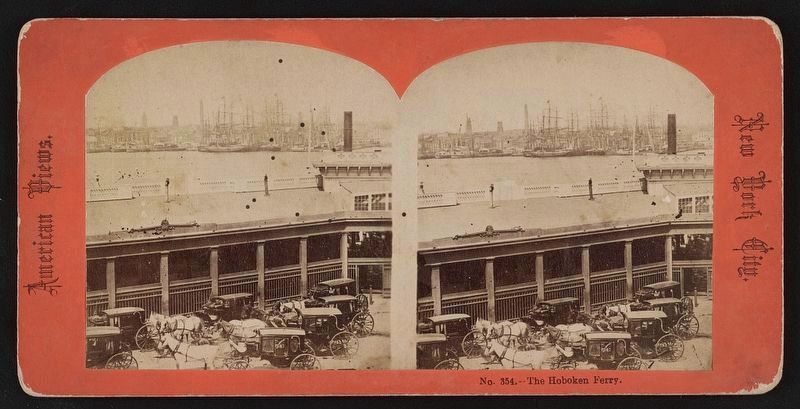
George Stacy, Publisher (courtesy Library of Congress), circa 1865
4. The Hoboken Ferry
Photographed by Devry Becker Jones (CC0), August 30, 2025
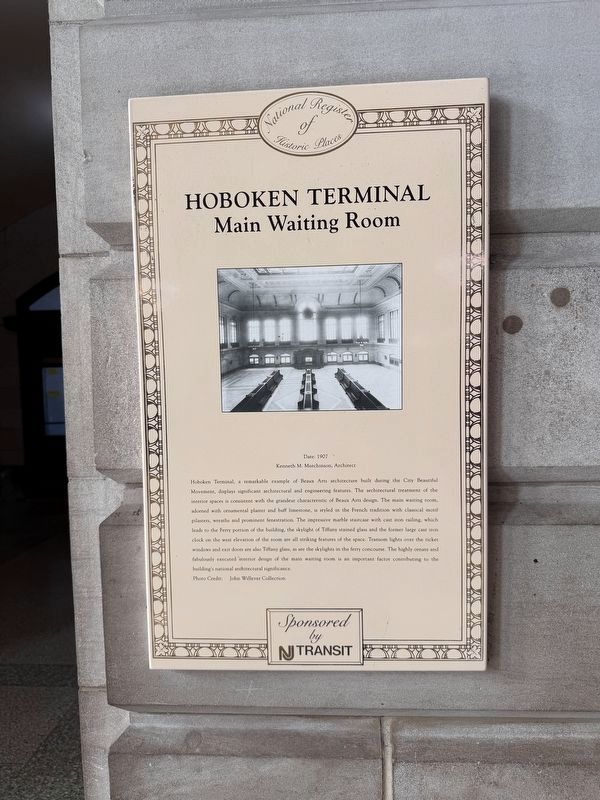
5. National Register of Historic Places plaque inside of the Main Waiting Room
Kenneth M. Murchinson, Architect
Hoboken Terminal, a remarkable example of Beaux Arts architecture built during the City Beautiful Movement displays significant architectural and engineering features. The architectural treatment of the interior spaces is consistent with the grandeur characteristic of Beaux Arts design. The main waiting room, adorned with ornamental plaster and buff limestone, is styled in the French tradition with classical motif pilasters, wreaths and prominent fenestration. The impressive marble staircase with cast iron railing, which leads to the Ferry portion of the building, the skylight of Tiffany stained glass and the former large cast iron clock on the west elevation of the room are all striking features of the space. Transom lights over the ticket windows and exit doors are also Tiffany glass, as are the skylights in the ferry concourse. The highly ornate and fabulously executed interior design of the main waiting room is an important factor contributing to the building's national architectural significance.
Photo Credit: John Willever Collection
Photographed by Devry Becker Jones (CC0), August 30, 2025
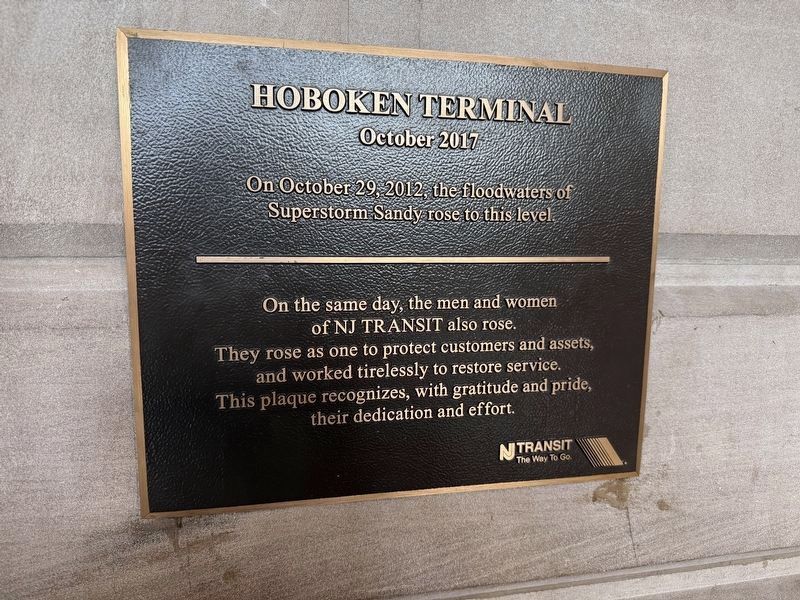
6. Plaque inside the waiting room
October 2017
On October 29, 2012, the floodwaters of Superstorm Sandy rose to this level.
On the same day, the men and women of NJ Transit also rose. They rose as one to protect customers and assets, and worked tirelessly to restore service. This plaque recognizes, with gratitude and pride, their dedication and effort.
Credits. This page was last revised on September 3, 2025. It was originally submitted on September 3, 2025, by Devry Becker Jones of Washington, District of Columbia. This page has been viewed 156 times since then and 79 times this year. Photos: 1, 2, 3. submitted on September 3, 2025, by Devry Becker Jones of Washington, District of Columbia. 4. submitted on September 3, 2025. 5, 6. submitted on September 3, 2025, by Devry Becker Jones of Washington, District of Columbia.
Editor’s want-list for this marker. A link to the National Register of Historic Places nomination form with a citation of the building's historical significance. • Can you help?
