Hoboken in Hudson County, New Jersey — The American Northeast (Mid-Atlantic)
The Intermodal Terminal Complex
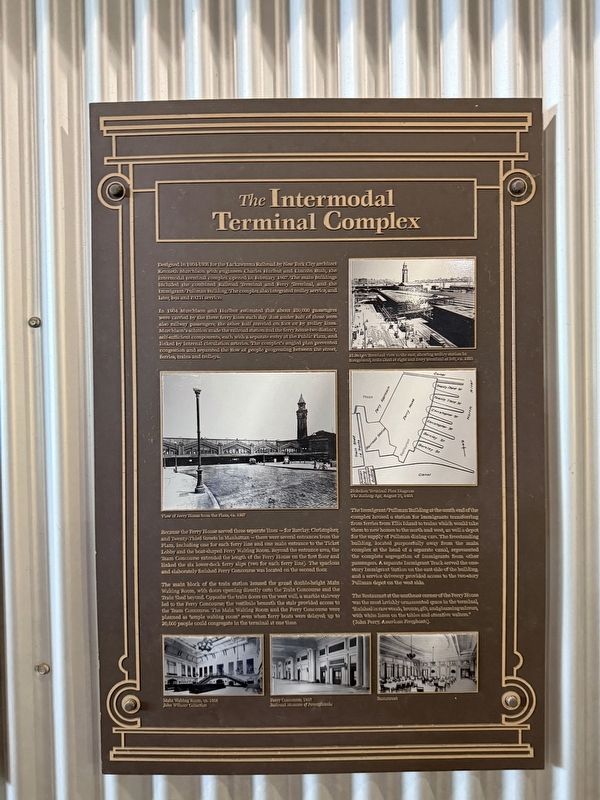
Designed in 1904-1906 for the Lackawanna Railroad by New York City architect Kenneth Murchison with engineers Charles Hurlbut and Lincoln Bush, the intermodal terminal complex opened in February 1907. The main buildings included the combined Railroad Terminal and Ferry Terminal, and the Immigrant/Pullman Building. The complex integrated trolley service, and later, bus and PATH service.
In 1904 Murchison and Hurlbut estimated that about 100,000 passengers were carried by the three ferry lines each day. Just under half of these were also railway passengers; the other half traveled on foot or by trolley lines. Murchison's solution made the railroad station and the ferry house two distinct, self-sufficient components, each with a separate entry at the Public Plaza, and linked by internal circulation arteries. The complex's angled plan prevented congestion and separated the flow of people progressing between the street, ferries, trains and trolleys.
Because the Ferry House served three separate lines — for Barclay, Christopher, and Twenty-Third Streets in Manhattan — there were several entrances from the Plaza, including
this page online
The main block of the train station housed the grand double-height Main Waiting Room, with doors opening directly onto the Train Concourse and the Train Shed beyond. Opposite the train doors on the west wall, a marble stairway led to the Ferry Concourse; the vestibule beneath the stair provided access to the Team Concourse. The Main Waiting Room and the Ferry Concourse were planned as "ample waiting room" even when ferry boats were delayed; up to 20,000 people could congregate in the terminal at one time.
The Immigrant/Pullman Building at the south end of the complex housed a station for immigrants transferring from ferries from Ellis Island to trains which would take them to new homes to the north and west, as well as a depot for the supply of Pullman dining cars. The
Photographed by Devry Becker Jones (CC0), August 30, 2025
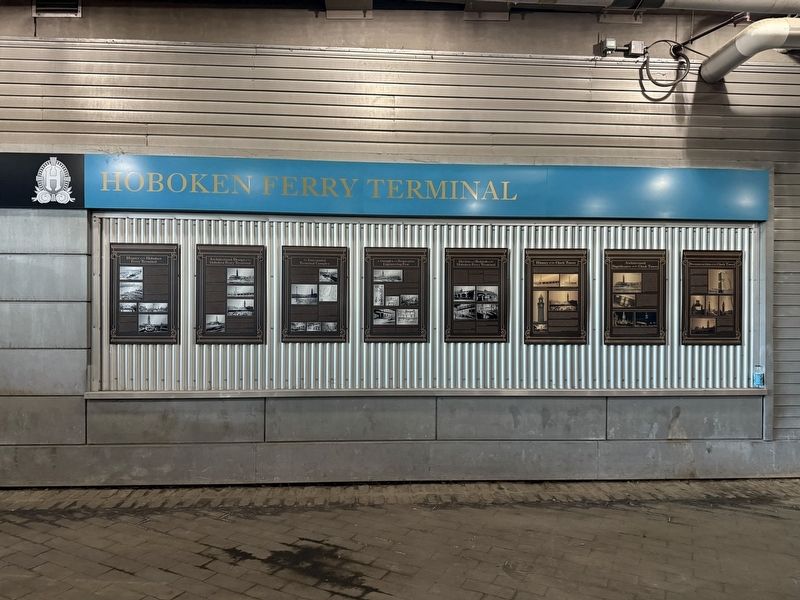
2. Hoboken Ferry Terminal markers
This set of markers can be found between the rail station and the ferry docks. It is partially open-air with entrances to the rail station, and gates that open to ferries as they arrive and depart.
The Restaurant at the southeast corner of the Ferry House was the most lavishly ornamented space in the terminal, finished in rare woods, bronze, gilt, and gleaming mirrors, with white linen on the tables and attentive waiters." (John Perry, American Ferryboats).
Topics. This historical marker is listed in these topic lists: Immigration • Industry & Commerce • Railroads & Streetcars • Waterways & Vessels. A significant historical month for this entry is February 1907.
Location. 40° 44.107′ N, 74° 1.649′ W. Marker is in Hoboken, New Jersey, in Hudson County. It can be reached from Hudson Place (County Road 736) east of River Street, on the right when traveling east. The marker is on the grounds of the Hoboken Transit Terminal between the rail station and the ferry docks. The area is partially open-air. Touch for map. Marker is at or near this postal address: 1 Hudson Pl, Hoboken NJ 07030, United States of America. Touch for directions.

Regionally, this marker is in North Jersey, in Greater Newark, and in the New York City Metropolitan Area. It is also in the American Northeast, in the Mid-Atlantic, and on the Eastern Seaboard. Globally, it is in the North Atlantic Region, North America, the Western Hemisphere, the Western World, and the Anglosphere. Historically, it finds itself in what was once New Netherland and also one of the original Thirteen Colonies.
Other nearby markers. At least 8 other markers are within walking distance of this marker: Architectural Design of the Hoboken Ferry Terminal (here, next to this marker); A Complex and Innovative Engineering Feat (here, next to this marker); Decline and Rebirth of the Hoboken Ferry Terminal (here, next to this marker); History of the Clock Tower (here, next to this marker); Architectural Significance of the Clock Tower (here, next to this marker); History of the Hoboken Ferry Terminal (here, next to this marker); Reconstruction of the Clock Tower (within shouting distance of this marker); We Remember (about 500 feet away, measured in a direct line). Touch for a list and map of all markers in Hoboken.
Credits. This page was last revised on September 3, 2025. It was originally submitted on September 3, 2025, by Devry Becker Jones of Washington, District of Columbia. This page has been viewed 111 times since then and 34 times this year. Photos: 1, 2. submitted on September 3, 2025, by Devry Becker Jones of Washington, District of Columbia.
