Denali National Park and Preserve in Denali Borough, Alaska — Northwest (North America)
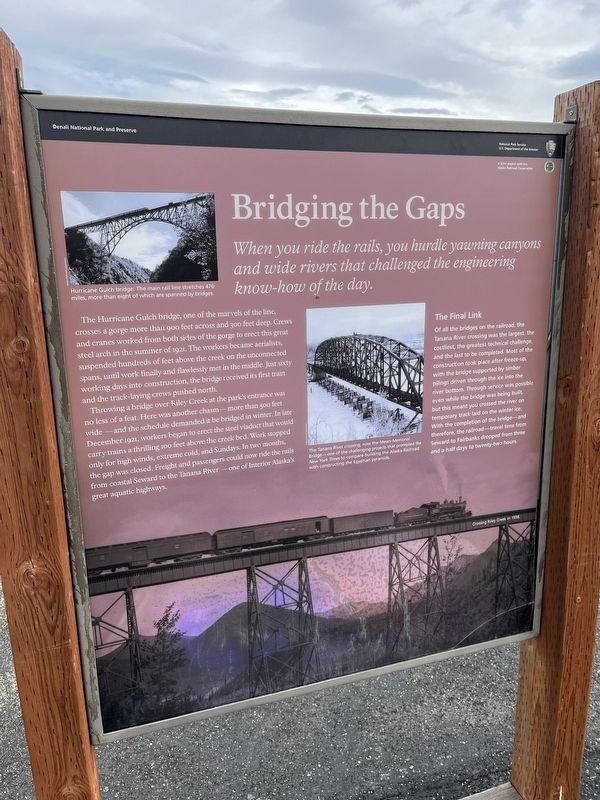
Bridging the Gaps
Denali National Park and Preserve
| — | National Park Service, U.S. Department of the Interior | — |
Photographed by Thomas Smith, August 7, 2025
1. Bridging the Gaps Marker
When you ride the rails, you hurdle yawning canyons and wide rivers that challenged the engineering know-how of the day.
The Hurricane Gulch bridge, one of the marvels of the line, crosses a gorge more than 900 feet across and 300 feet deep. Crews and cranes worked from both sides of the gorge to erect this great steel arch in the summer of 1921. The workers became aerialists, suspended hundreds of feet above the creek on the unconnected spans, until work finally and flawlessly met in the middle. Just sixty working days into construction, the bridge received its first train and the track-laying crews pushed north.
Throwing a bridge over Riley Creek at the park's entrance was no less of a feat. Here was another chasm — more than 500 feet wide — and the schedule demanded it be bridged in winter. In late December 1921, workers began to erect the steel viaduct that would carry trains a thrilling 100 feet above the creek bed. Work stopped only for high winds, extreme cold, and Sundays. In two months the gap was closed. Freight and passengers could now ride the rails from coastal Seward to the Tanana River — one of
this page online
The Final Link
Of all the bridges on the railroad the Tanana River crossing was the largest, the costliest, the greatest technical challenge, and the last to be completed. Most of the construction took place after freeze-up with the bridge supported by timber pilings driven through the ice into the river bottom. Through service was possible even while the bridge was being built, but this meant you crossed the river on temporary track laid on the winter ice with the completion of the bridge — and therefore, the railroad — travel time from Seward to Fairbanks dropped from three and a half days to twenty-two hours.
[Caption:]
The Tanana river crossing, now the Mears Memorial Bridge - one of the challenging projects that prompted the New York Times to compare building the Alaska Railroad with constructing the Egyptian pyramids.
Erected by National Park Service, U.S. Department of the Interior.
Topics. This historical marker is listed in these topic lists: Bridges & Viaducts • Roads & Vehicles • Waterways & Vessels. A significant historical month for this entry is December 1921.
Location. 63° 43.867′ N,
Photographed by Thomas Smith, August 7, 2025
2. Bridging the Gaps Marker

Regionally, this marker is in the Alaska Railroad Corridor, in the Athabascan Region, and in Interior Alaska. It is also on the American Pacific Coast. Globally, it is in North America, on the Pacific Rim, in the Western Hemisphere, in the Western World, and in the Anglosphere. Historically, it finds itself in what was once the Russian Empire.
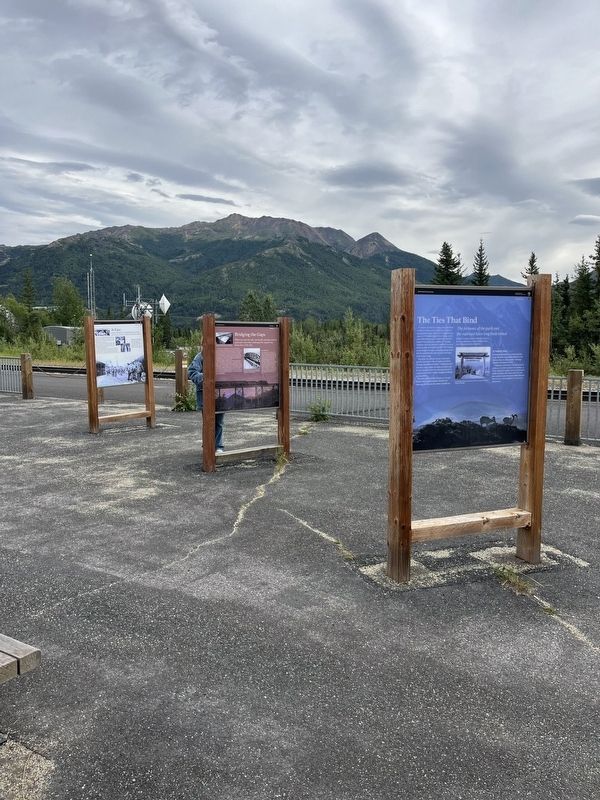
Other nearby markers. At least 8 other markers are within walking distance of this marker: At Ease (here, next to this marker); The Ties That Bind (here, next to this marker); The Station Through Time (a few steps from this marker); Meet the Neighbors (a few steps from this marker); The Time-Honored Trail (a few steps from this marker); Tunnels Lost to Time (within shouting distance of this marker); The Park Hotel (about 600 feet away, measured in a direct line); The Road More Traveled (approx. ¼ mile away). Touch for a list and map of all markers in Denali National Park and Preserve.
Credits. This page was last revised on August 3, 2026. It was originally submitted on September 4, 2025, by Thomas Smith of Waterloo, Ill. This page has been viewed 69 times since then and 41 times this year. Photos: 1, 2. submitted on September 4, 2025, by Thomas Smith of Waterloo, Ill. • Devry Becker Jones was the editor who published this page.
