Guelph in Wellington County, Ontario — Central Canada (North America)
Macdonald Institute
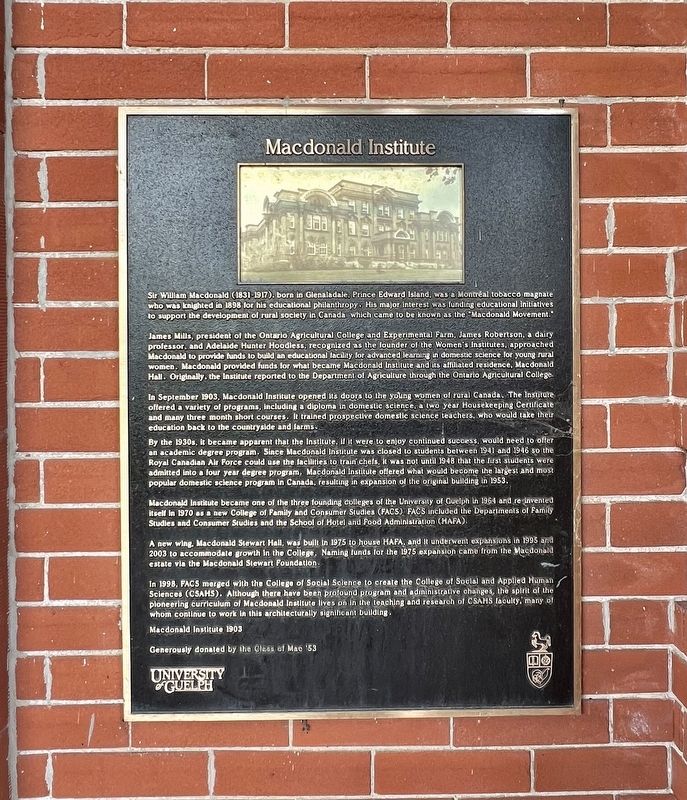
Photographed by Tim Boyd, September 1, 2025
1. Macdonald Institute Marker
Sir William Macdonald (1831-1917), born in Glenaladale, Prince Edward Island, was a Montréal tobacco magnate who was knighted in 1898 for his educational philanthropy. His major interest was funding educational initiatives to support the development of rural society in Canada which came to be known as the “Macdonald Movement".
James Mills, president of the Ontario Agricultural College and Experimental Farm, James Robertson, a dairy professor, and Adelaide Hunter Hoodless, recognized as the founder of the Women's Institutes, approached Macdonald to provide funds to build an educational facility for advanced learning in domestic science for young rural women. Macdonald provided funds for what became Macdonald Institute and its affiliated residence, Macdonald Hall. Originally, the Institute reported to the Department of Agriculture through the Ontario Agricultural College.
In September 1903, Macdonald Institute opened its doors to the young women of rural Canada. The Institate offered a variety of programs, including a diploma in domestic science, a two year Housekeeping Certificate and many three month short courses.
this page online
By the 1930s, it became apparent that the Institute, if it were to enjoy continued success, would need to offer an academic degree program. Since Macdonald Institute was closed to students between 1941 and 1946 so the Royal Canadian Air Force could use the facilities to train chefs, it was not until 1948 that the first students were admitted into a four year degree program. Macdonald Institute offered what would become the largest and most popular domestic science program in Canada, resulting in expansion of the original building in 1953.
Macdonald Institute became one of the three founding colleges of the University of Guelph in 1964 and re-invented itself in 1970 as a new College of Family and Consumer Studies (FACS) FACS included the Departments of Family Studies and Consumer Studies and the School of Hotel and Food Administration (HAFA).
A new wing, Macdonald Stewart Hall, was built in 1975 to house HAFA, and it underwent expansions in 1995 and 2003 to accommodate growth in the College. Naming funds for the

Photographed by Tim Boyd, September 1, 2025
2. Macdonald Institute Marker
On the right of the doorway
In 1998, FACS merged with the College of Social Science to create the College of Social and Applied Human Sciences (SAHS). Although there have been profound program and administrative changes, the spirit of the pioneering curriculum of Macdonald Institute lives on in the teaching and research of CSAMS faculty, many of whom continue to work in this architecturally significant building.
Macdonald Institute 1903
Generously donated by the Class of Mac '53
Topics. This historical marker is listed in these topic lists: Agriculture • Education • Women. A significant historical year for this entry is 1903.
Location. 43° 32.05′ N, 80° 13.924′ W. Marker is in Guelph, Ontario, in Wellington County. It is on Macdonald Street 0.1 kilometers north of College Avenue East, on the right when traveling north. Touch for map. Marker is at or near this postal address: 68 Macdonald Street, Guelph ON N1G 1Y1, Canada. Touch for directions.

Regionally, this marker is in the Huron-Perth-Waterloo-Wellington Area and in Southwestern Ontario. It is also in
Photographed by Tim Boyd, September 1, 2025
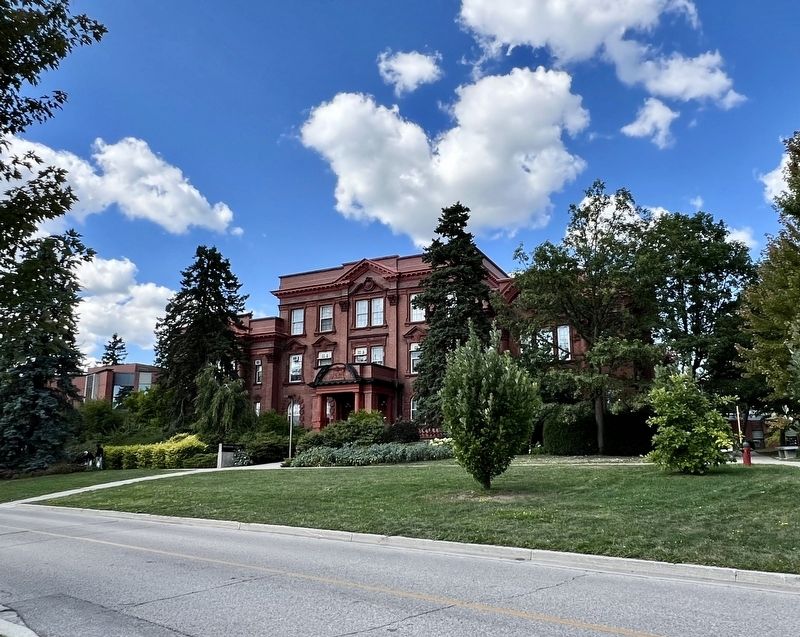
3. Macdonald Institute in 2025
Other nearby markers. At least 8 other markers are within walking distance of this marker: Macdonald Hall (about 90 meters away, measured in a direct line); The Gordon S. Lang School of Business and Economics (about 120 meters away); The President’s House (about 150 meters away); James Mills 1840-1924 (about 180 meters away); George Creelman 1869-1929 (about 210 meters away); Ontario Agricultural College (about 240 meters away); Entrance Old Main Building (about 240 meters away); The Founding of the University of Guelph (approx. 0.2 kilometers away). Touch for a list and map of all markers in Guelph.
Credits. This page was last revised on September 8, 2025. It was originally submitted on September 7, 2025, by Tim Boyd of Hamilton, Ontario. This page has been viewed 91 times since then and 20 times this year. Photos: 1, 2, 3. submitted on September 7, 2025, by Tim Boyd of Hamilton, Ontario. • Andrew Ruppenstein was the editor who published this page.
