Niagara-on-the-Lake in Niagara Region, Ontario — Central Canada (North America)
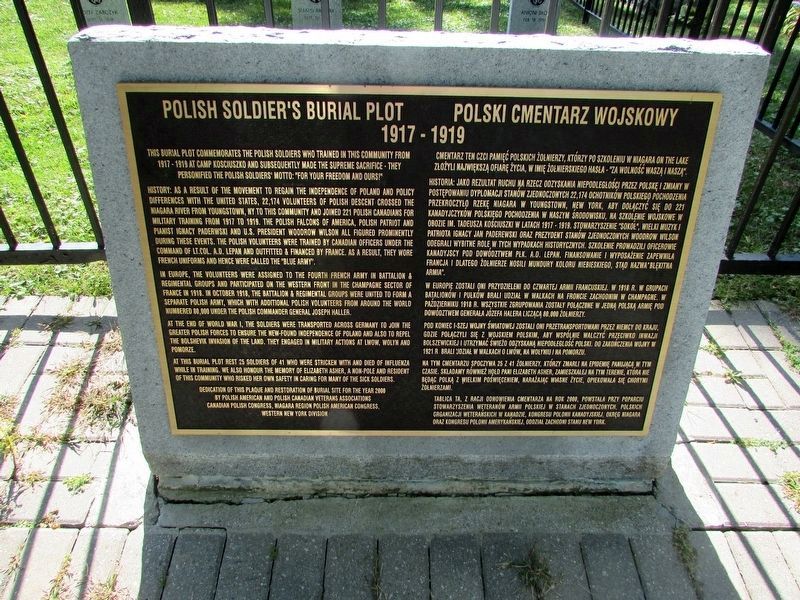
Polish Soldier’s Burial Plot 1917 – 1919
Polski Cmentarz Wojskowy 1917 – 1919
Photographed by Bill Coughlin, September 19, 2019
1. Polish Soldier’s Burial Plot Marker

History: As a result of the movement to regain the independence of Poland and policy differences with the United States, 22,174 volunteers of Polish descent crossed the Niagara River from Youngstown, NY to this community and joined 221 Polish Canadians for military training from 1917 to 1919. The Polish Falcons of America, Polish Patriots and pianist Ignacy Paderwski and U.S. president Woodrow Wilson all figured prominently during these events. The Polish Volunteers were trained by Canadian officers under the command of Lt. Col. A.D. Lepan and outfitted & financed by France. As a result, they wore French uniforms and hence were called the “Blue Army.”
In Europe, the Volunteers were assigned to the Fourth French Army in Battalion & Regimental Groups and participated on the Western Front in the Champagne sector of France in 1918. In October 1918, the Battalion & Regimental Groups
this page online
At the end of World War I, the soldiers were transported across Germany to join the Greater Polish forces to ensure the new-found independence of Poland and also to repel the Bolshevik invasion of the land. They engaged in military actions at Lwow, Wolyn and Pomorze.
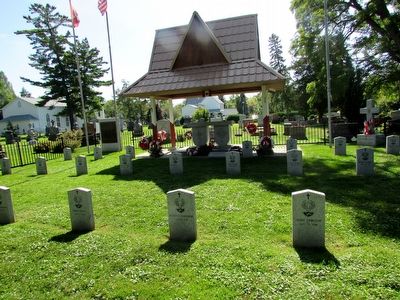
At this burial plot rest 25 soldiers of 41 who were stricken with and died from influenza while in training. We also honour the memory of Elizabeth Asher, a non-Pole and resident of this community who risked her own safety in caring for many of the sick soldiers.
Dedication of this plaque and restoration of burial site for the year 2000 by Polish American and Polish Canadian Veteran Associations
Canadian Polish Congress, Niagara Region Polish American Congress, Western New York Division
_______________
Cmentarz ten czci pamięć Polskich żołnierzy, którzy po szkoleniu w Niagara On The Lake złożyli największą ofiarę życia, w imię
Photographed by Bill Coughlin, September 19, 2019
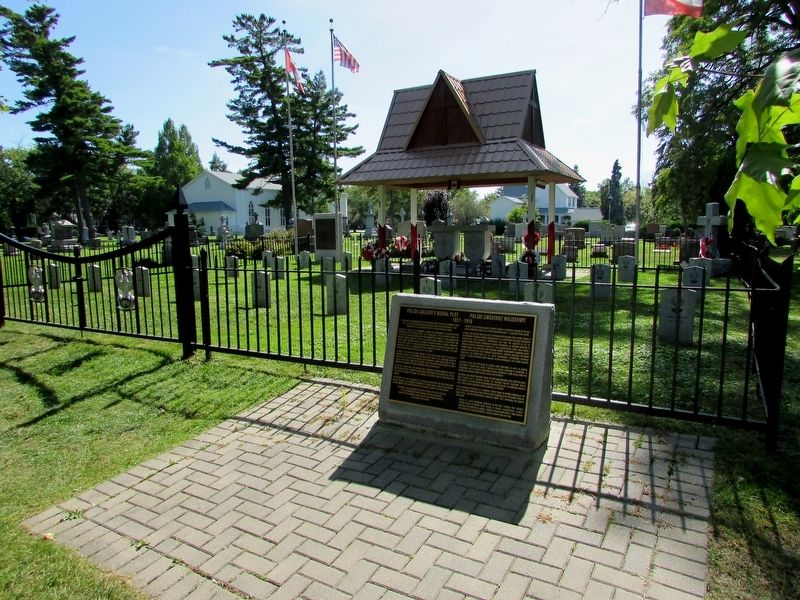
2. Polish Soldier’s Burial Plot Marker
Historia: Jako rezultat ruchu na rzecz odzyskania niepodległości przez Polskę i zmiany w postępowaniu dyplomacji Stanów Zjednoczonych, 22,174 ochotników Polskiego pochodzenia przekroczyło rzekę Niagara w Youngstown, New York, aby dołączyć się do 221 Kanadyjczyków Polskięgo pochodzenia w naszym środowisku, na szkolenie wojskowe w obozie im. Tadeusz kościuszki w latach 1917-1919. Stowarzyszenie "Sokól", wielki muzyk i patriota Ignacy Paderewski oraz prezydent Stanów Zjednoczonych Woodrow Wilson odegrali wybitne rolę w tych wypadkach historycznych. Szkolenie prowadzili oficerowie Kanadyjscy pod dowództwem płk. A.D. Lepan. Finansowani i wyposażenie zapewniła Francja i dlatego żołnierze nosili mundury koloru niebieskiego, stąd nazwa "Błękitna Armia".
W Europie zostali óni przydzieleni do Czwartej Armii Francuskiej. W 1918 r. w grupach batalionów i pułków brali udział w walkach na Froncie zachodnim w Champagne. W październiku
Photographed by Bill Coughlin, September 19, 2019
3. Polish Soldier’s Burial Plot
Pod koniec i-szej wojny światowej zostali oni przetransportowani przez Niemcy do kraju, gdzie połączyli się z wojskiem Polskim, aby wspólnie walczyć przeciwko inwazji bolszewickiej i utrzymać świeżo odzyskaną niepodłeglość Polski. Do zakończenia wojny w 1921 r brali udzial w walkach o Lwów, na Wołyniu i na Pomorzu.
Na tym cmentarzu spoczywa 25 z 41 żołnierzy, którzy zmarli na epidemię panującą w tym czasie. Składamy również hołd pani Elizabeth Asher, zamieszkałej na tym terenie, ktora nie będąc polką z wielkim poświęceniem, narażając wiasne życie, opiekowała się chorymi żołnierzami.
Tablica ta, z racji odnowienia cmentarz na rok 2000, powstała przy Poparciu Stowarzyszenie Weteranów armii Polskiej W Stanach Zjednoczonych, Polskich organizacji weterańskich w Kańadie, Kongresu Polonii Kanadyjskiej, Okręg Niagara oraz Kongresu Polonii Amerykańskiej, Oddział Zachodni stanu New York.
Erected 2000.
Topics and series. This historical marker is listed in these topic lists: Cemeteries & Burial Sites • War, World I. In addition, it is included in the Former U.S. Presidents: #28 Woodrow Wilson series list. A significant historical year for this entry is 1917.
Location. 43° 15.292′ N, 79° 4.072′ W. Marker is in Niagara-on-the-Lake, Ontario, in Niagara Region. It is on Byron Street, on the right when traveling east. Touch for map. Marker is at or near this postal address: 41 Byron Street, Niagara-on-the-Lake ON L0S 1J0, Canada. Touch for directions.

Regionally, this marker is on Ontario’s Golden Horseshoe and in Niagara Canada. It is also in Central Canada. Globally, it is in North America, on the Great Lakes, in the Western Hemisphere, in the Western World, and in the Anglosphere. Historically, it finds itself in what was once a British colony, the Viceroyalty of New France, the Haudenosaunee (Iroquois) Confederacy, and Rupert’s Land.
Other nearby markers. At least 8 other markers are within walking distance of this marker: St. Mark’s Church (within shouting distance of this marker); Centennial of Confederation (about 150 meters away, measured in a direct line); St. Vincent de Paul Church, 1835 (about 150 meters away); First Legislative Assembly of Upper Canada (about 180 meters away); Upper Canada Gazette, or American Oracle (about 180 meters away); John Graves Simcoe (about 180 meters away); The First Provincial Parliament 1792 (about 180 meters away); Bicentennial of First Parliament (about 180 meters away). Touch for a list and map of all markers in Niagara-on-the-Lake.
Credits. This page was last revised on October 5, 2025. It was originally submitted on September 23, 2019, by Bill Coughlin of Woodland Park, New Jersey. This page has been viewed 575 times since then and 49 times this year. Last updated on September 7, 2025, by Kevin Westell of St. Catharines, Ontario. Photos: 1, 2, 3. submitted on September 23, 2019, by Bill Coughlin of Woodland Park, New Jersey. • Andrew Ruppenstein was the editor who published this page.
