Bainbridge in Decatur County, Georgia — The American South (South Atlantic)
Village of Fowltown
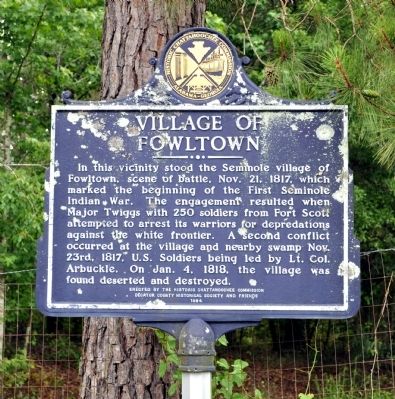
Photographed by David Seibert, May 16, 2012
1. Village of Fowltown Marker
Erected 1994 by Historical Chattahoochee Commission, Decatur County Historical Society and Friends.
Topics. This historical marker is listed in these topic lists: Indigenous Peoples and Communities • Settlements & Settlers • Wars, US Indian.
Location. 30° 47.396′ N, 84° 36.739′ W. Marker is in Bainbridge, Georgia, in Decatur County. It is at the intersection of Faceville Highway (Georgia Route 97) and Green Shade Road, on the left when traveling south on Faceville Highway. Touch for map. Marker is in this post office area: Bainbridge GA 39819, United States of America. Touch for directions.

Regionally,
this page online
Other nearby markers. At least 8 other markers are within 9 miles of this marker, measured as the crow flies: Charles James Munnerlyn / “Refuge” (within shouting distance of this marker); Ira Sanborn (approx. 3.1 miles away); Fort Scott (approx. 7.4 miles away); Camp Recovery (approx. 7½ miles away); Camp Recovery Monument (approx. 7.6 miles away); Attapulgite / Fullers Earth (approx. 8 miles away); Attapulgus (approx. 8.1 miles away); Attapulgus High School (approx. 8.1 miles away). Touch for a list and map of all markers in Bainbridge.
More about this marker. The marker was refurbished and moved to this location about 2023, which is a much safer location to pull over. It is next to the marker for Charles James Munnerlyn,
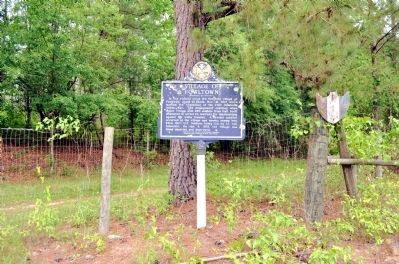
Photographed by David Seibert, May 16, 2012
2. Village of Fowltown Marker
Regarding Village of Fowltown. Despite the marker, the attack on Fowltown was not because of "its warriors depredations against the white frontier". The issue was sovereignty of the land south of the Flint River. This land had been ceded to the United States by Creek (Muscogee) Indians in the Treaty of Fort Jackson. The Mikosuki Indians inhabiting Fowltown, though ethnically related to the Creeks, held that they were not party to the treaty, it did not apply to them, and the Creeks had no authority to "give away" this land. They also maintained that the Flint River was the northern border of Spanish Florida. The U.S. army made it clear to the Mikosuki that their position was militarily unsustainable, and they abandoned the land and relocated Fowltown to what is today Jefferson County, Florida.
Also see . . . The Battle of Fowltown. (Submitted on June 6, 2020.)
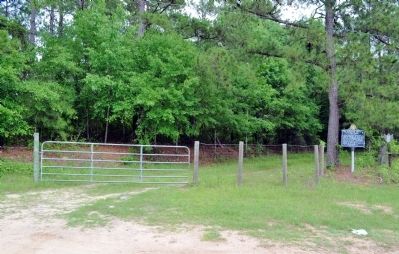
Photographed by David Seibert, May 16, 2012
3. Village of Fowltown Marker
To the left of the marker is the private, gated McLaughlin Road.
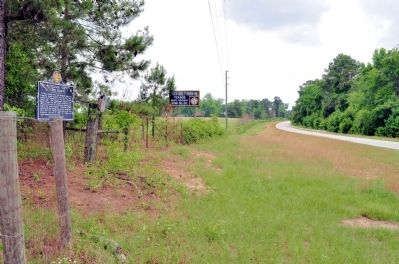
Photographed by David Seibert, May 16, 2012
4. Village of Fowltown Marker
Looking south on Faceville Highway, Georgia Highway 97.
Credits. This page was last revised on September 11, 2025. It was originally submitted on May 25, 2012, by David Seibert of Sandy Springs, Georgia. This page has been viewed 2,682 times since then and 200 times this year. Last updated on September 8, 2025, by Christopher Kimball of Tallahassee, Florida. Photos: 1, 2, 3, 4. submitted on May 25, 2012, by David Seibert of Sandy Springs, Georgia. • Bernard Fisher was the editor who published this page.
