Perryville in Boyle County, Kentucky — The American South (East South Central)
First Settlement of Perryville
Perryville • The Battle For Kentucky
| — | October 8, 1862 | — |
Photographed by Bernard Fisher, August 18, 2011
1. First Settlement of Perryville Marker
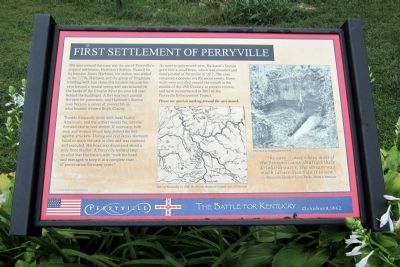
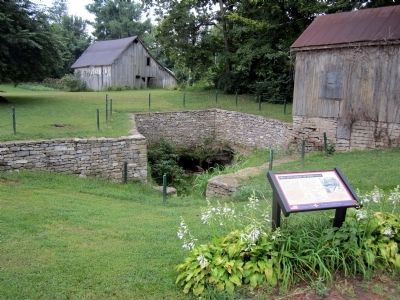
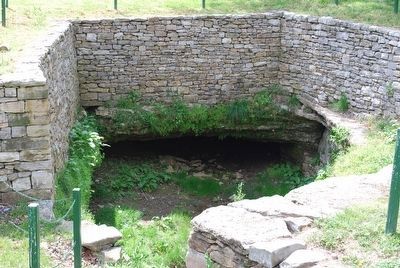
Trouble frequently arose with local Native Americans, and the settlers would flee into the fort and cave to seek shelter. If necessary, both men and women would help defend the fort against attackers. During one raid James Harbison failed to reach the cave in time and was captured and executed. His head was discovered about a mile from the fort. A Perryville resident later recalled that Harbison’s wife “took the head and managed to keep it in a complete state of preservation for many years.”
As more people moved west, Harbison’s Station grew into a small town, which was renamed and incorporated
this page online
Please use caution walking around the cave mouth.
“The cave…was where most of the Perryvillians obtained their drinking water. The stream was much larger then than it is now.”
—Perryville resident Lora Parks, from a memoir
Erected by The Perryville Enhancement Project.
Topics. This historical marker is listed in these topic lists: Forts and Castles • Settlements & Settlers • War, US Civil • Wars, US Indian. A significant historical year for this entry is 1817.
Location. 37° 38.889′ N, 84° 57.13′ W. Marker is unreadable. Marker is in Perryville, Kentucky, in Boyle County. It is at the intersection of West Fourth Street and South Buell Street (U.S. 68), on the left when traveling west on West Fourth Street. Touch for map. Marker is in this post office area: Perryville KY 40468, United States of America. Touch for directions.

Regionally, this marker is in Kentucky’s
Photographed by Bernard Fisher, August 18, 2011
2. The Perryville Cave
Other nearby markers. At least 8 other markers are within walking distance of this location: Sad And Weary (a few steps from this marker); Karrick-Parks House / Harberson's Station (a few steps from this marker); Letter Box (within shouting distance of this marker); Green's Drug Store (within shouting distance of this marker); In The Crucible Of War (about 600 feet away); The Hard Hand Of War (about 600 feet away); The Battle of Perryville (about 600 feet away); Bragg's Invasion of Kentucky (about 600 feet away). Touch for a list and map of all markers in Perryville.
Other markers no longer nearby. Perryville in the Crucible of War (was about 400 feet away, measured in a direct line but has been permanently removed); “If You Meet the Enemy, Overpower Him” (was about 400 feet away but has been confirmed missing);
Photographed by Brandon Fletcher, March 31, 2012
3. The Cave
More about this marker. In the center is a map of “Central Kentucky in 1784. Harbison’s Station is located west of Danville.”
On the upper right is a photograph of “The cave as it appeared in 1929.”
Additional commentary.
1. David Potts and the James Harbison Encounter with Native Americans
My ancestor, David Potts, was in the field with Harbison when they were encountered by the “indians.”
David was chased across the river and to the cave by one of them carrying a rifle. David shot and killed him. David stayed all night in the cave. The next morning he retrieved the rifle, but had to cut off the man’s trigger finger to do so.
This story was related many times to John Henry by his mother Margaret Potts Henry, one of David’s daughters. Note To Editor only visible by Contributor and editor
— Submitted March 7, 2022, by George Dallas Potts of Gypsum, Kansas.
Photographed by Mark Parker, August 18, 2025
4. First Settlement of Perryville Marker unreadable
Credits. This page was last revised on September 11, 2025. It was originally submitted on August 23, 2011, by Bernard Fisher of Richmond, Virginia. This page has been viewed 2,596 times since then and 209 times this year. Last updated on September 8, 2025, by Mark Parker of Hickory, North Carolina. Photos: 1, 2. submitted on August 23, 2011, by Bernard Fisher of Richmond, Virginia. 3. submitted on September 15, 2015, by Brandon Fletcher of Chattanooga, Tennessee. 4. submitted on September 8, 2025, by Mark Parker of Hickory, North Carolina.
