Roma in Città metropolitana di Roma Capitale, Latium, Rome, Italy — Central Italy (Tyrrhenian Coast)
Piazza Massimo Alle Colonne
secc. XVI, XVII
⎯⎯⎯
16th, 17th century
| — | Architettura: B. Peruzzi (1481-1536) | — |
Photographed by Sean P. Flynn, August 2, 2025
1. Piazza Massimo Alle Colonne Marker
this page online
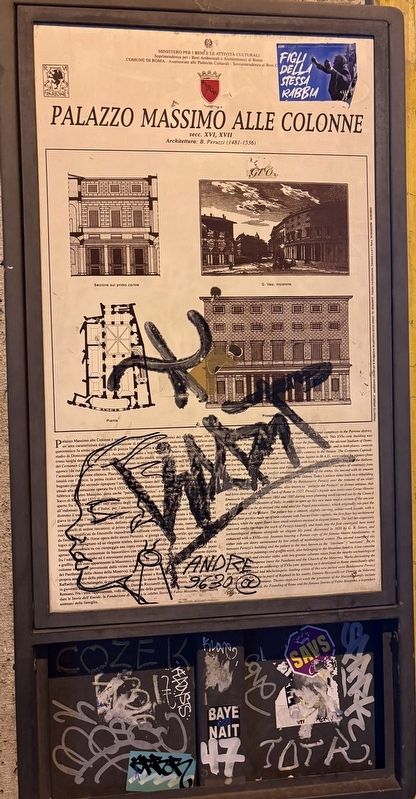
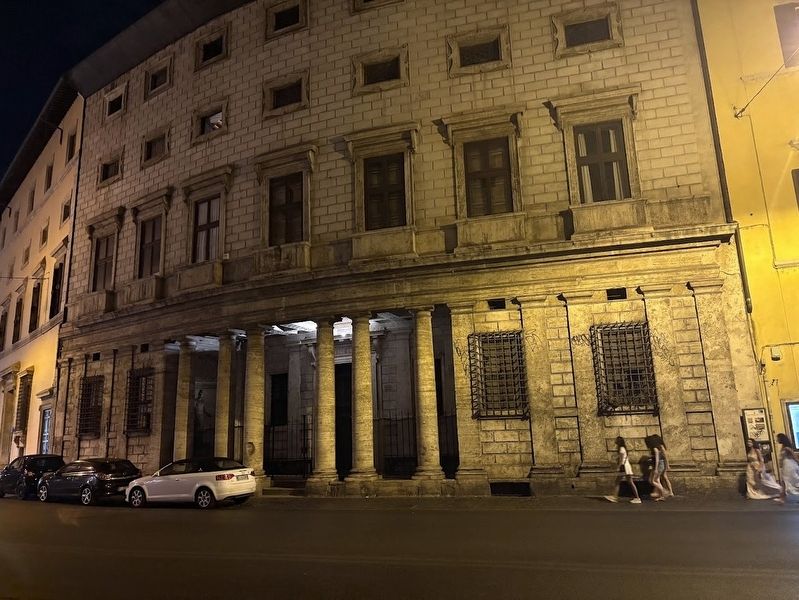
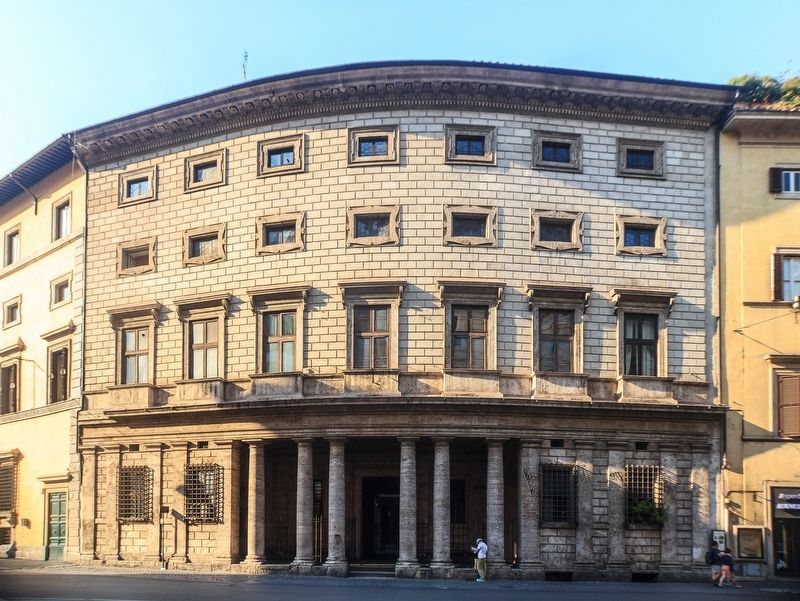
Palazzo Massimo alle Colonne is one of the major architectural complexes in the Parione district, in an area that features a larger number of important monuments. This XVIth cent. building was erected near Piazza Navona, which in turn rose over the ancient Stadium of Domitian (1st cent. A.D.). Next to the stadium stood the Odeon, a covered theatre, and in both places, contests were held: athletics in the stadium, music and poetry contests in the theatre. The Certamen Capitolinum games, instituted by Domitian in honour of Roman Jupiter in 86 A.D., were called the agones (from which a nearby square took its name) and has to do with both body and spirit, in line with the Hellenic concept of harmony. Piazza Navona and Palazzo Massimo are two clear examples of continuity from [unreadable] antique, the first with its perfect emulation of the shape of an arena, the second with its smooth [unreadable] façade [unreadable] the curving lines of the Odeon. Today's palace dates back to a rebuilding project carried out between 1532 and 1536 by Baldassare Peruzzi over the remains of an older building belonging to Pietro Massimo, also known as "palazzo del Portico" or domus antiqua, that had been destroyed during the Sack of Rome in 1527. Peruzzi's façade now looks onto Corso Vittorio Emanuele IInd, opened between 1883 and 1887 during town-planning work carried bout by the Council of Rome after the Unification of Italy; in order to open up this new main road a section of the ancient Via Papalis had to be destroyed (the road for Papal processions), which originally ran past the main entrance of the palace. The palace has a smooth, slightly curving, ashlar-work façade, with a second-floor portico made up of twin columns with Tuscan Order capitals; the first floor has architraved windows, while the upper floors have small windows encased in elegant frames. The hall has exquisitely stuccoed vaults (perhaps the work of Peruzzi himself), and leads into the first courtyard; here stand archaeological remains alongside an elegant lily pond, decorated in 1620 by G. B. Solari, and enhanced with a XVIIth cent. fountain bearing a Roman copy of the famous Venere Anadiomene; to either side are doors surmounted by low reliefs of mythological scenes. The second courtyard sits between Peruzzi's building and the palace to the rear, known as the "Istoriato" ("narrated", for its facade covered in paintings and graffiti-work, also belonging to the Massimo family); it too contains many low reliefs and circular slabs, with two granite columns taken from the nearby archaeological site of the Iseo Campense (near the Pantheon and the Church of the Minerva). Works decorating the inner walls constitute an anthology of XVIth cent. painting as it developed in Rome immediately after the prime of Raphael and Michelangelo; leading artists of this new period were Baldassarre Peruzzi himself, Perin del Vaga (a pupil of Raphael in his youth), Daniele Ricciarelli (or Daniele da Volterra) and pupils of Giulio Romano. Themes depicted to exalt the greatness of the Massima family include Stories from Anaeid, the Founding of Rome and the famous Stories of Fabio Massimo, a legendary family ancestor.
Topics.
Photographed by Sean P. Flynn, August 2, 2025
2. Piazza Massimo Alle Colonne Marker
Location. 41° 53.8′ N, 12° 28.426′ E. Marker has been reported damaged. Marker is in Roma, Lazio (Latium, Rome), in Città metropolitana di Roma Capitale. It is on Corso Vittorio Emanuele II. Touch for map. Marker is at or near this postal address: Corso Vittorio Emanuele II 142, Roma, Lazio 00186, Italy. Touch for directions.

Regionally, it is in Europe, the European Union, the Schengen Area, a coastal Mediterranean country, and the Western World. Historically, it finds itself in what was once the Roman Empire.
Other nearby markers. At least 8 other markers are within walking distance of this location: Libreria Croce (within shouting distance of this marker); Galleria Spada / Spada Gallery (about 90 meters away, measured in a direct line); Chiesa di Sant'Andrea della Valle / Church of Saint Andrew of the Valley (about 90 meters away); 13th Century St. Gregory Monastery Cross-stone (about 120 meters away); Hotel Teatro di Pompeo (about 120 meters away); Parione (about 120 meters away); Adelaide Ristori and Aldo Palazzeschi (about 150 meters away); Adelaide Ristori Capranica del Grillo and Aldo Palazzeschi (about 150 meters away). Touch for a list and map of all markers in Roma.
More about this marker. WHen viewed in August 2025, the marker was covered in graffiti
Photograph by Pedro P. Palazzo (CC BY-SA 4.0); courtesy of Wikimedia Commons, 2015
3. Piazza Massimo Alle Colonne
Also see . . . Massimo alle Colonne Palace (Chapel of San Filippo Neri). From the Rome tourism official site. (Submitted on September 9, 2025, by Sean P. Flynn of Oak Park, Illinois.)
Credits. This page was last revised on September 10, 2025. It was originally submitted on September 9, 2025, by Sean P. Flynn of Oak Park, Illinois. This page has been viewed 72 times since then and 15 times this year. Photos: 1, 2, 3. submitted on September 9, 2025, by Sean P. Flynn of Oak Park, Illinois.
