Roma in Città metropolitana di Roma Capitale, Latium, Rome, Italy — Central Italy (Tyrrhenian Coast)
Ponte Vittorio Emanuele II
⎯⎯⎯
Victor Emmanuel II Bridge
Photographed by Sean P. Flynn, August 3, 2025
1. Ponte Vittorio Emanuele II Marker
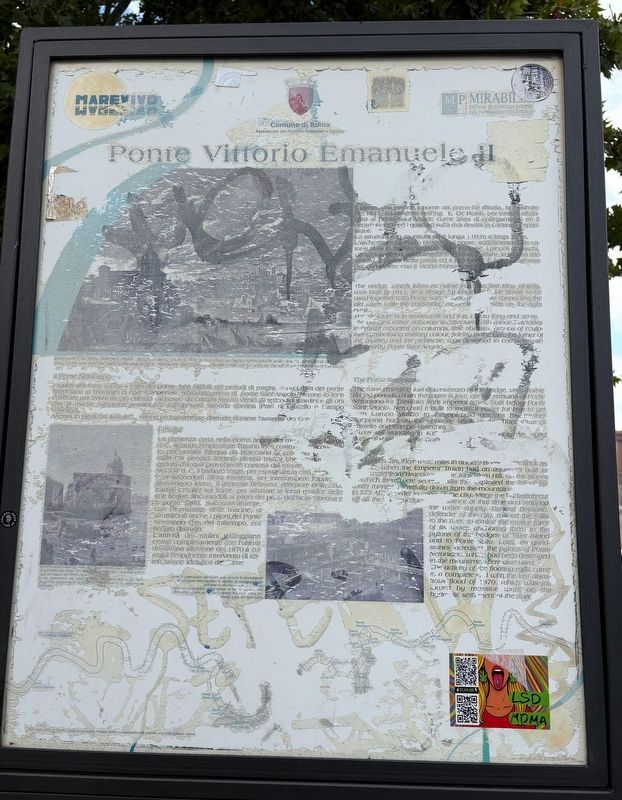
La struttura è in muratura ed è lunga 10m e larga 20m. L'architettura [unreadable] del ponte, sotolineata [unreadable] le Vittorio alate [~six unreadable words] i plecoli [fom here, about two lines that are hard to decipher] con il vicino Ponte Sant'Angelo.
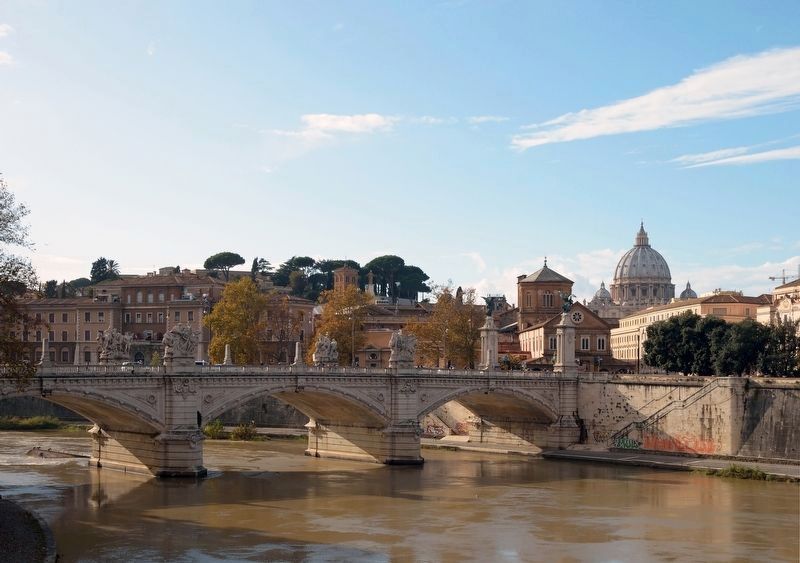
The bridge, which takes its name from the first King of Italy, was built in 1911, to a design by engineer [?] E. De Rossi to be used together with Ponte Sant'Angelo [unreadable] connecting the old town with the constantly expanding districts on the right bank.
The structure is in stonework and it is 10m long and 20 m. The bridge's rather elaborate architecture with winged victories in bronze mounted on columns, little obelisks, groups of sculptures symoblising military valour, fidelity to the law, the father of the country and the plebiscite, was designed to compete [?] with the nearby Ponte Sant'Angelo.
Il Ponte Neroniano
Fruderi
this page online
Ancora in piedi nel 405 d.C. venne probabilmente distrutto durante l'assedio del [unreadable.]
I mulini
La presenza certa nella Roma antica del [unreadable] al 109 d.C., quando l'imperatore Traiano fece [two or three unreadable words] per portare l'acqua da Bracciano al [two or three unreadable words] sulle cui pendici sorsero diversi mulini che [two or three unreadable words] caduta d'acqua proveniente copiosa dal monte.
Nel 537 d.C. il barbaro Vitige, per espugnare la città, [unreadable] i 14 acquedotti aflora esistenti, per interrompere l'approvvigionamento idrico. Il generale Belisario, difensore della città, trasferì i mulini sul fiume, per struttare la forza mortice delle sue acque ancorandoli ai piloni dei sponti dell'Isola Tiberina
Photographed by Sean P. Flynn, August 3, 2025
2. Ponte Vittorio Emanuele II Marker
La'ttivita dei mulini galleggianti cesso complentamente con l'ultima disastrosa alluvione del 1870 a cul cegui l'imponente invervento di sistemazione idrautica del flume.
The Ponte Neroniano
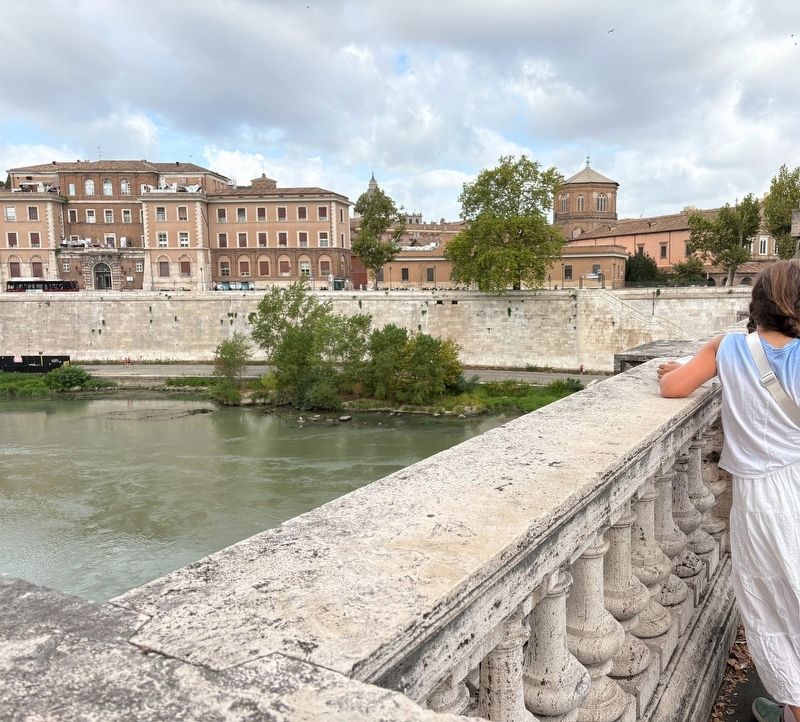
The ruins emerging just downstream of the bridge, very visible during periods when the water is low, are remains of Ponte Neroniano (or Trionfale) from imperial times, built before Ponte Sant'Angelo. Nero had it built to make it easier for him to get from Campo Marzio to the splendid gardens his mother Agrippa had on the opposite bank of the Tiber (Prati di Castello and Campo Vaticano). [Four or five unreadable words] was still standing in 405 AD and was probably destroyed during the siege [?} by the Goth [the next two or three lines are unreadable].
The mills
It is known that there were mills in ancient Rome as far back as 109 AD, when the Emperor Trajan had an aqueduct built to [unreadable word] water from Bracciano [unreadable word] the Janiculum Hill, on the slopes of which there were several hills that exploited the fall of the water running plentifully down from the mountains.
In 573 AD, in order to conquer the city, Vitige the barbarian cut off all the aqueducts in existence at that time and stopped the water supply. General Belisario, defender of the city, moved the mills to the river, to exploit the motive force of its water, anchoring them to the pylons of the bridges of Tiber Island and to Ponte Sisto. Later, as grindstones increased, the pylons of Ponte Neroniano, which had been destroyed in the meantime, were also used.
The activity of the floating mills came to a complete end with the last disastrous flood of 1870, which was followed by massive work on the hydraulic settlement of the river.
Topics.
Photographed by Sean P. Flynn, August 3, 2025
3. Ponte Vittorio Emanuele II
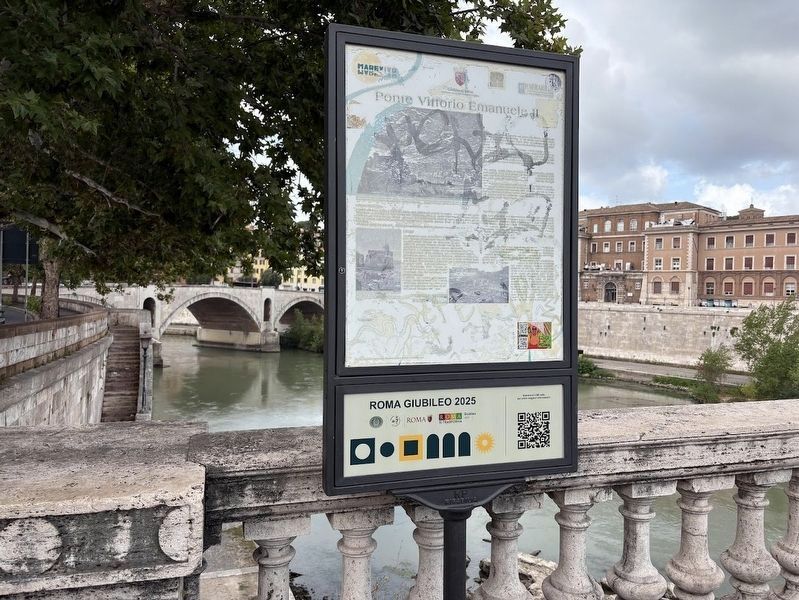
Location. 41° 54.058′ N, 12° 27.873′ E. Marker has been reported unreadable. Marker is in Roma, Lazio (Latium, Rome), in Città metropolitana di Roma Capitale. It is on Ponte Vittorio Emanuele II west of Lungotevere degli Altoviti, on the right when traveling east. Touch for map. Marker is in this post office area: Roma, Lazio 00186, Italy. Touch for directions.

Regionally, it is in Europe, the European Union, the Schengen Area, a coastal Mediterranean country, and the Western World. Historically, it finds itself in what was once the Roman Empire.
Other nearby markers. At least 8 other markers are within walking distance of this location: Convento ed Oratorio dei Filippini alla Vallicella / Convent and Oratory of Saint Philip Neri (approx. 0.4 kilometers away); Parione (approx. half a kilometer away); Ponte Umberto I / Umberto I Bridge (approx. 0.6 kilometers away); Spirito Santo dei Napoletani / Holy Spirit of the Neapolitans
Livioandronico2013 (CC BY-SA 4.0), courtesy of Wikimedia Commons, 2014
4. Ponte Vittorio Emanuele II with St. Peter's in the background
More about this marker. The marker has a significant amount of wear, some seemingly just from its age, and some from graffiti and its aftereffects. Some portions of the text were hard to read or unreadable; as such, the inscription outlined above may have some inaccuracies. The bottom of the marker has a much-eroded map of the Tiber and its crossings, starting north of Rome through the city until near the sea at Ostia.
Also see . . . Ponte Vittorio Emanuele II. From Rome Tourism's official website.
Excerpt: "Ponte Vittorio is spread over three masonry arches, is 110 meters long, and 20 wide. It has a sumptuous sculptural decoration with four marble groups and four Victories on its pillars and headboards. The groups had to represent "The virtues of King Vittorio Emanuele II." In June 1909, a public contest was to decide on their execution."(Submitted on September 10, 2025, by Sean P. Flynn of Oak Park, Illinois.)
Credits. This page was last revised on September 10, 2025. It was originally submitted on September 9, 2025, by Sean P. Flynn of Oak Park, Illinois. This page has been viewed 162 times since then and 80 times this year. Photos: 1, 2, 3, 4. submitted on September 9, 2025, by Sean P. Flynn of Oak Park, Illinois.
