Old Montreal in Montréal, Québec — Central Canada (French-Canadian)
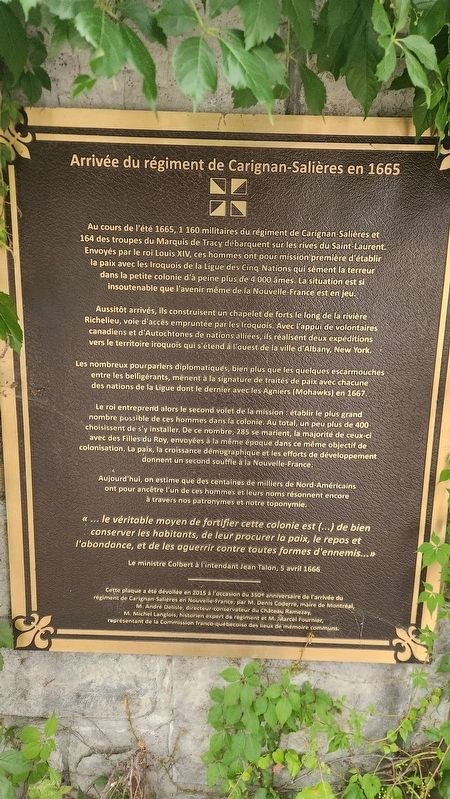
Arrivée du régiment de Carignan-Salières en 1665
⎯⎯⎯
Arrival of the Carignan-Salières Regiment in 1665
August 4, 2025
1. Arrivee du regiment de Carignan-Salieres en 1665 Marker

Aussitôt arrivés, ils construisent un chapelet de forts le long de la rivière Richelieu, voie d'accès empruntée par les Iroquois. Avec l'appui de volontaires canadiens et d'Autochtones de nations alliées, ils réalisent deux expéditions vers le territoire iroquois qui s'étend à l'ouest de la ville d'Albany, New York.
Les nombreux pourparlers diplomatiques, bien plus que les quelques escarmouches entre les belligérants, mènent à la signature de traités de paix avec chacune des nations de la Ligue dont le dernier avec les Agniers (Mohawks) en 1667.
Le roi entreprend alors le second volet de la mission: établir le plus grand nombre possible de ces hommes dans la colonie. Au total, un peu plus de 400 choisissent de s'y installer. De ce nombre, 285 se marient, la majorité de ceux-ci avec des Filles du Roy, envoyées à la même époque dans ce même objectif de colonisation. La paix, la croissance démographique et les efforts de développement donnent un second souffle à la Nouvelle-France.
Aujourd'hui, on estime que des centaines de milliers de Nord-Américains ont pour ancêtre l'un de ces hommes et leurs noms résonnent encore à travers nos patronymes et notre toponymie.
"... le véritable moyen de fortifier cette colonie est (...) de bien conserver les habitants, de leur procurer la paix, le repos et l'abondance, et de les aguerrir contre toutes formes d'ennemis..."
Le
this page online
Cette plaque a ete devoilee en 2015 a l'occasion du 350e anniversaire de l'arrivee du regiment de Carignan-Salieres en Nouvelle-France, par M. Denis Coderre, maire de Montreal, M. Andre Delisle, director-conservateur du Chateau Ramezay, M. Michael Langlois, historien expert du regiment et M. Marcel Fournier, representant de la Commission franco-quebecoise des lieux de memoire communs.
(English Translation:)
During the summer of 1665, 1,160 soldiers from the Carignan-Salières regiment and 164 from the Marquis de Tracy's troops landed on the banks of the St. Lawrence. Sent by King Louis XIV, these men's primary mission was to establish peace with the Iroquois of the League of Five Nations, who were sowing terror in the small colony of just over 4,000 souls. The situation was so unbearable that the very future of New France was at stake.
Upon arrival, they built a string of forts along the Richelieu River, the access route used by the Iroquois. With the support of Canadian volunteers and Indigenous people from allied nations, they carried out two expeditions into the Iroquois territory, which extended west of the city of Albany, New York.
The numerous diplomatic negotiations, far more than the few skirmishes between the belligerents, led to the signing of peace treaties with each of the League's nations, the last of which was with the Mohawks in 1667.
The king then undertook the second part of his mission: to settle as many of these men as possible in the colony. In total, just over 400 chose to settle there. Of this number, 285 married, the majority of them with the King's Daughters, sent at the same time for the same colonization objective. Peace, population growth, and development efforts breathed new life into New France.
Today, it is estimated that hundreds of thousands of North Americans can trace their ancestors back to one of these men, and their names still resonate through our surnames and place names.
"...the true way to strengthen this colony is (...) to preserve its inhabitants, to provide them with peace, rest, and abundance, and to toughen them against all forms of enemies..."
Minister Colbert to Intendant Jean Talon, April 5, 1666
This plaque was unveiled in 2015 on the occasion of the 350th anniversary of the arrival of the Carignan-Salieres Regiment in New France, by Mr. Denis Coderre, Mayor of Montreal; Mr. Andre Delisle, Director-Curator of the Château Ramezay; Mr. Michael Langlois, an expert historian of the regiment; and Mr. Marcel Fournier, representative of the Franco-Quebec Commission for Common Memorial Sites.
Erected 2015 by Mayor of Montreal, Director-Curator of the Chateau-Ramezay, Franco-Quebec Commission for Common Memorial Sites.
Topics. This historical marker is listed in these topic lists: Immigration • Indigenous Peoples and Communities • Settlements & Settlers. A significant historical year for this entry is 1665.
Location. 45° 30.506′ N, 73° 33.183′ W. Marker is in Montréal, Québec. It is in Old Montreal. It can be reached from Rue le Royer Est. Marker is on a fence a short walk southeast of Chateau Ramezay (the fence is part of the Chateau grounds). It is on the external side of the fence facing out towards Place Jacques Cartier. Touch for map. Marker is in this post office area: Montréal QC H2Y 1E3, Canada. Touch for directions.

Regionally, this marker is in Central Canada. Globally, it is in North America, the Western Hemisphere, and the Western World. Historically, it finds itself in what was once a British colony, the Viceroyalty of New France, the Haudenosaunee (Iroquois) Confederacy, and Rupert’s Land.
Other nearby markers. At least 8 other markers are within walking distance of this marker: La Grande Recrue de 1653 / The Great Recruitment of 1653 (here, next to this marker); Un jardin à la mode de Nouvelle-France / A Garden in the Style of New France (a few steps from this marker); Entrez dans l'histoire! / Step into History! (within shouting distance of this marker); Château de Ramezay (within shouting distance of this marker); Les délices de la belle saison / The delicacies of the beautiful season (within shouting distance of this marker); Le Château Ramezay / Château Ramezay (within shouting distance of this marker); Horatio Nelson (within shouting distance of this marker); The Nelson Column, Montreal (within shouting distance of this marker). Touch for a list and map of all markers in Montréal.
Credits. This page was last revised on December 21, 2025. It was originally submitted on September 9, 2025. This page has been viewed 114 times since then and 71 times this year. Photo 1. submitted on September 9, 2025. • Andrew Ruppenstein was the editor who published this page.
Editor’s want-list for this marker. photo of the marker within its surroundings • Can you help?
