Elizabeth City in Pasquotank County, North Carolina — The American South (South Atlantic)
Culpeper’s Rebellion
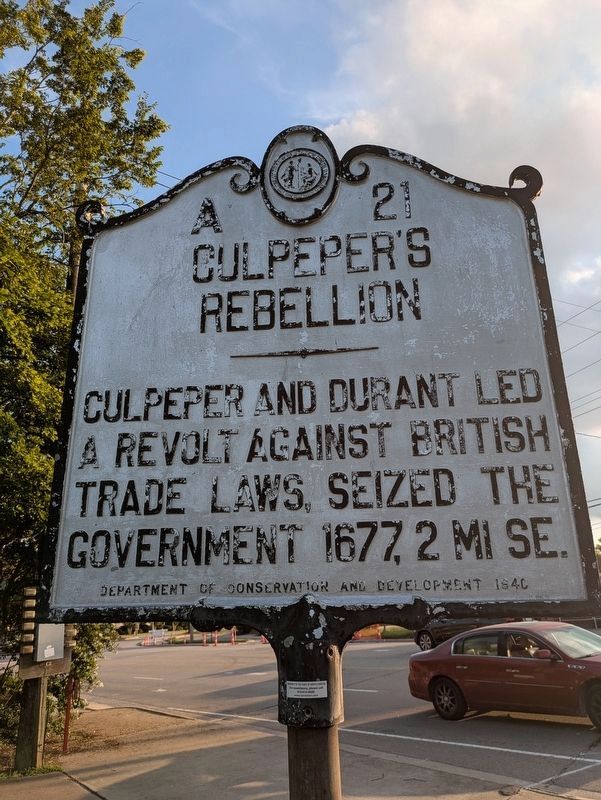
Photographed by Bruce InCharlotte, July 28, 2025
1. Culpeper’s Rebellion Marker
Erected 1940 by Department of Conservation and Development. (Marker Number A-21.)
Topics and series. This historical marker is listed in these topic lists: Colonial Era • Notable Events. In addition, it is included in the North Carolina Division of Archives and History series list. A significant historical year for this entry is 1672.
Location. 36° 17.886′ N, 76° 13.135′ W. Marker is in Elizabeth City, North Carolina, in Pasquotank County. It is on South Water Street near East Church Street, on the right when traveling north. Touch for map. Marker is in this post office area: Elizabeth City NC 27909, United States of America. Touch for directions.

Regionally, this marker is in North Carolina’s Coastal Plain. It is also in the American South, specifically in the Upper South, in the Tidewater, and on the Eastern Seaboard. Globally, it is in the North Atlantic Region, North America, the Western Hemisphere, the Western World, and the Anglosphere. Historically, it finds itself in what was once the territory
this page online
Other nearby markers. At least 8 other markers are within walking distance of this marker: Rev. Edward M. Forbes (a few steps from this marker); Soybean Processing (a few steps from this marker); Wright Brothers in the Albemarle (within shouting distance of this marker); Elizabeth City (within shouting distance of this marker); Wild's Raid (about 300 feet away, measured in a direct line); a different marker also named Wright Brothers in the Albemarle (about 300 feet away); a different marker also named Wright Brothers in the Albemarle (about 400 feet away); Battle of Elizabeth City (about 400 feet away). Touch for a list and map of all markers in Elizabeth City.
Regarding Culpeper’s Rebellion. Culpeper’s Rebellion took place in 1677–1678 in Albemarle County (what is now Pasquotank County). The rebellion was in response a variety of complaints about the government, but arose primarily as a reaction to the Navigation Acts imposed on the colonies by England. At the time, North Carolina was ruled
Photographed by Laura Troy, October 1, 2007
2. Culpepper's Rebellion Marker
The people were unhappy with the government. The Proprietors, who paid little heed to the increasing discontent, kept appointing deputies, and the people saw this as a way for the Proprietors to continue to limit the people’s privileges. With the passage in England of the Navigation Acts, resentment for the Proprietors grew. The Navigation Acts regulated the shipping of goods, and many of the acts passed imposed duties or taxes on items shipped between colonies.
In 1672, Governor Peter Carteret traveled to England to try and convince the Proprietors that they should not enforce the new laws. His attempt failed. Tensions ran high between two factions that existed in Albemarle. The three opposition leaders were John Culpeper, John Jenkins, and George Durant. John Miller, one of the supporters of the Proprietors, was appointed secretary and collector of the duties. He later
Photographed by Laura Troy, October 1, 2007
3. Mariners' Wharf
Finally, the opposition had had enough. Durant, Culpeper, and some armed supporters captured and imprisoned Miller. They arrested other officials and eventually seized the reins of government. For two years, the colonists enjoyed peace and the government ran more smoothly. The Proprietors summoned Culpeper to England, where he was arrested and charged with treason. He was put on trial, but he was found not guilty, marking the end of the rebellion.
References:
• Hugh F. Rankin, Upheaval in Albemarle: The Story of Culpeper’s Rebellion, 1675-1689 (1962)
• Mattie Erma E. Parker, “Legal Aspects of Culpeper’s Rebellion,” North Carolina Historical Review (April 1968): 111–127
• William S. Powell, ed., Encyclopedia of North Carolina (2006)—sketch by Lindley S. Butler
• Elizabeth City & Pasquotank County website page on Culpeper’s Rebellion: http://www.elizcity.com/history/culpepers-rebellion.shtml
• William S. Smith, Jr., “Culpeper’s Rebellion: New Data and Old Problems” (M.A. thesis, North Carolina State University, 1990), available at: http://gen.culpepper.com/historical/rebellion/default.htm
Copied from the North Carolina Department of Cultural Resources
Credits. This page was last revised on September 11, 2025. It was originally submitted on October 1, 2007, by Laura Troy of Burke, Virginia. This page has been viewed 7,859 times since then and 66 times this year. Last updated on September 11, 2025, by Bruce InCharlotte of Charlotte, North Carolina. Photos: 1. submitted on September 11, 2025, by Bruce InCharlotte of Charlotte, North Carolina. 2, 3. submitted on October 1, 2007, by Laura Troy of Burke, Virginia. • Bernard Fisher was the editor who published this page.
