
Roswell in Fulton County, Georgia — The American South (South Atlantic)
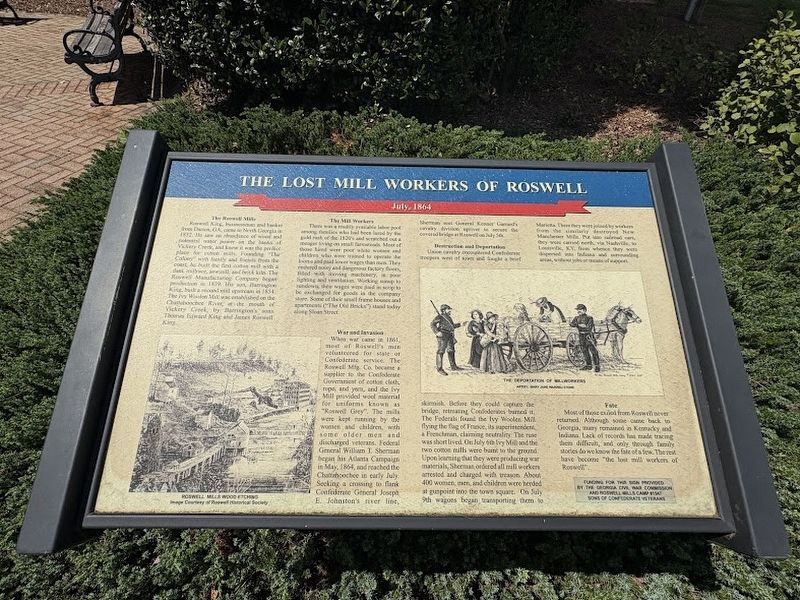
The Lost Mill Workers Of Roswell
July, 1864
Photographed by Darren Jefferson Clay, August 29, 2025
1. The Lost Mill Workers of Roswell Marker
The Roswell Mills
Roswell King, businessman and banker from Darien, GA, came to North Georgia in 1832. He saw an abundance of wood and potential water power on the banks of Vickery Creek, and knew it was the perfect place for cotton mills. Founding "The Colony" with family and friends from the coast, he built the first cotton mill with a dam, millrace, sawmill, and brick kiln. The Roswell Manufacturing Company began production in 1839. His son, Barrington King, built a second mill upstream in 1854. The Ivy Woolen Mill was established on the Chattahoochee River, at the mouth of Vickery Creek, by Barrington's sons Thomas Edward King and James Roswell King.
The Mill Workers
There was a readily available labor pool among families who had been lured by the gold rush of the 1820's and scratched out a meager living on small farmsteads. Most of those hired were poor white women and children who were trained to operate the looms and paid lower wages than men. They endured noisy and dangerous factory floors, filled with moving machinery, in poor lighting and ventilation. Working sunup to sundown, their wages were paid in scrip
this page online
War and Invasion
When war came in 1861, most of Roswell's men volunteered for state or Confederate service. The Roswell Mfg. Co. became a supplier to the Confederate Government of cotton cloth, rope, and yarn, and the Ivy Mill provided wool material for uniforms known as "Roswell Grey". The mills were kept running by the women and children, with some older men and discharged veterans. Federal General William T. Sherman began his Atlanta Campaign in May, 1864, and reached the Chattahoochee in early July. Seeking a crossing to flank Confederate General Joseph E. Johnston's river line, Sherman sent General Kenner Garrard's cavalry division upriver to secure the covered bridge at Roswell on July 5th.
Destruction and Deportation
Union cavalry encountered Confederate troopers west of town and fought a brief skirmish. Before they could capture the bridge, retreating Confederates burned it. The Federals found the Ivy Woolen Mill flying the flag of France, its superintendent, a Frenchman,

Photographed by Darren Jefferson Clay, August 29, 2025
2. The Lost Mill Workers of Roswell Marker
Fate
Most of those exiled from Roswell never returned. Although some came back to Georgia, many remained in Kentucky and Indiana. Lack of records has made tracing them difficult, and only through family stories do we know the fate of a few. The rest have become "the lost mill workers of Roswell".
Erected by Georgia Civil War Commission and Roswell Mills Camp #1547 SCV.
Topics. This historical marker is listed in these topic lists: Industry & Commerce • War, US Civil • Women. A significant historical month for this entry is July 1864.
Location. 34° 0.917′ N, 84° 21.547′ W. Marker is in Roswell, Georgia, in Fulton County. It is at the intersection of Sloan Street and Vickery Street, on the right when traveling east on Sloan Street. Touch for map. Marker is at or near this postal address: 75 Sloan St, Roswell GA 30075, United States of America. Touch for directions.

Regionally, this marker is in Georgia’s Piedmont and in Metro Atlanta. It is also in the American South and specifically in the Deep South. Globally, it is in North America, the Western Hemisphere, the Western World, and the Anglosphere. Historically, it finds itself in what was once the territory of the Mississippian Culture, one of the original Thirteen Colonies, one of the Confederate States of America, and the Antebellum South.
Other nearby markers. At least 8 other markers are within walking distance of this marker: Original Mill (about 500 feet away, measured in a direct line); An Introduction to the Roswell Manufacturing Company (about 600 feet away); Roswell Factory (about 600 feet away); Roswell Manufacturing Company During the Civil War (about 600 feet away); The Old Bricks (about 700 feet away); The History of Vickery Creek and the Covered Bridge (about 700 feet away); Site of the 1839 Mill and the 1882 Mill (about 700 feet away); Site of the First Factory of the Roswell Manufacturing Company (approx. 0.2 miles away). Touch for a list and map of all markers in Roswell.
Also see . . . Deportation of Roswell Mill Women. New Georgia Encyclopedia (Submitted on September 13, 2025.)
Credits. This page was last revised on September 13, 2025. It was originally submitted on September 12, 2025, by Darren Jefferson Clay of Duluth, Georgia. This page has been viewed 115 times since then and 54 times this year. Photos: 1, 2. submitted on September 12, 2025, by Darren Jefferson Clay of Duluth, Georgia. • Bernard Fisher was the editor who published this page.
