Fanshawe in London in Middlesex County, Ontario — Central Canada (North America)
Arrival of European Settlers
Photographed by Tim Boyd, September 14, 2025
1. Arrival of European Settlers Marker
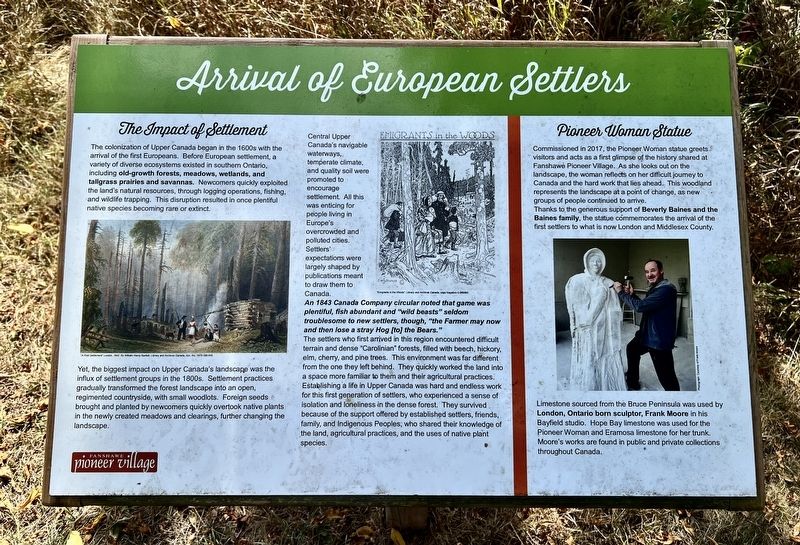
The Impact of Settlement
The colonization of Upper Canada began in the 1600s with the arrival of the first Europeans. Before European settlement, a variety of diverse ecosystems existed in southern Ontario, including old-growth forests, meadows, wetlands, and tallgrass prairies and savannas. Newcomers quickly exploited the land's natural resources, through logging operations, fishing, and wildlife trapping. This disruption resulted in once plentiful native species becoming rare or extinct.
Yet, the biggest impact on Upper Canada's landscape was the influx of settlement groups in the 1800s. Settlement practices gradually transformed the forest landscape into an open, regimented countryside, with small woodlots. Foreign seeds brought and planted by newcomers quickly overtook native plants in the newly created meadows and clearings, further changing the Landscape.
Central Upper Canada's navigable waterways, temperate climate, and quality soil were promoted to encourage settlement. All this was enticing for people living in Europe's overcrowded and polluted cities. Settlers' expectations were largely shaped by publications
this page online
An 1843 Canada Company circular noted that game was plentiful, fish abundant and "wild beasts" seldom troublesome to new settlers, though, "the Farmer may now and then lose a stray Hog [to] the Bears."
The settlers who first arrived in this region encountered difficult terrain and dense "Carolinian" forests, filled with beech, hickory, elm, cherry, and pine trees. This environment was far different from the one they left behind. They quickly worked the land into a space more familiar to them and their agricultural practices. Establishing a life in Upper Canada was hard and endless work for this first generation of settlers, who experienced a sense of isolation and loneliness in the dense forest. They survived because of the support offered by established settlers, friends, family, and Indigenous Peoples, who shared their knowledge of the land, agricultural practices, and the uses of native plant species.
Pioneer Woman Statue
Commissioned in 2017, the Pioneer Woman statue greets visitors and acts as a first glimpse of the history shared at Fanshawe Pioneer Village. As she looks out on the landscape,

2. Arrival of European Settlers marker illustration and caption detail (centre)
Thanks to the generous support of Beverly Baines and the Baines family, the statue commemorates the arrival of the first settlers to what is now London and Middlesex County.
Limestone sourced from the Bruce Peninsula was used by London, Ontario born sculptor, Frank Moore in his Bayfield studio. Hope Bay limestone was used for the Pioneer Woman and Eramosa limestone for her trunk. Moore's works are found in public and private collections throughout Canada.
Erected by Fanshawe Pioneer Village.
Topics. This historical marker is listed in these topic lists: Agriculture • Indigenous Peoples and Communities • Settlements & Settlers. A significant historical year for this entry is 1843.
Location. 43° 3.302′ N, 81° 10.86′ W. Marker is in London, Ontario, in Middlesex County. It is in Fanshawe. It can be reached from Fanshawe Park Road East. The marker is on the grounds of the Fanshawe Pioneer Village, accessibility subject to its

3. Arrival of European Settlers marker illustration and caption detail (centre)

Regionally, this marker is in the Southwest Ontario Area and in Southwestern Ontario. It is also in Central Canada. Globally, it is in North America, the Western Hemisphere, the Western World, and the Anglosphere. Historically, it finds itself in what was once a British colony, the Viceroyalty of New France, the Haudenosaunee (Iroquois) Confederacy, and Rupert’s Land.
Other nearby markers. At least 8 other markers are within walking distance of this marker: Indigenous Peoples (here, next to this marker); Emigration: (within shouting distance of this marker); Impact of European Settlement (within shouting distance of this marker); Denfield General Store (within shouting distance of this marker); Harmer Sawmill (within shouting distance

Photographed by Tim Boyd, September 14, 2025
4. Arrival of European Settlers Marker
The Pioneer Women statue is to the left of the marker
Credits. This page was last revised on September 15, 2025. It was originally submitted on September 15, 2025, by Tim Boyd of Hamilton, Ontario. This page has been viewed 59 times since then and 13 times this year. Photos: 1, 2, 3, 4. submitted on September 15, 2025, by Tim Boyd of Hamilton, Ontario. • Andrew Ruppenstein was the editor who published this page.
