Winnabow in Brunswick County, North Carolina — The American South (South Atlantic)
Yankee Catchers & Infernal Machines
Photographed by Mike McKeown, September 12, 2025
1. Yankee Catchers & Infernal Machines Marker
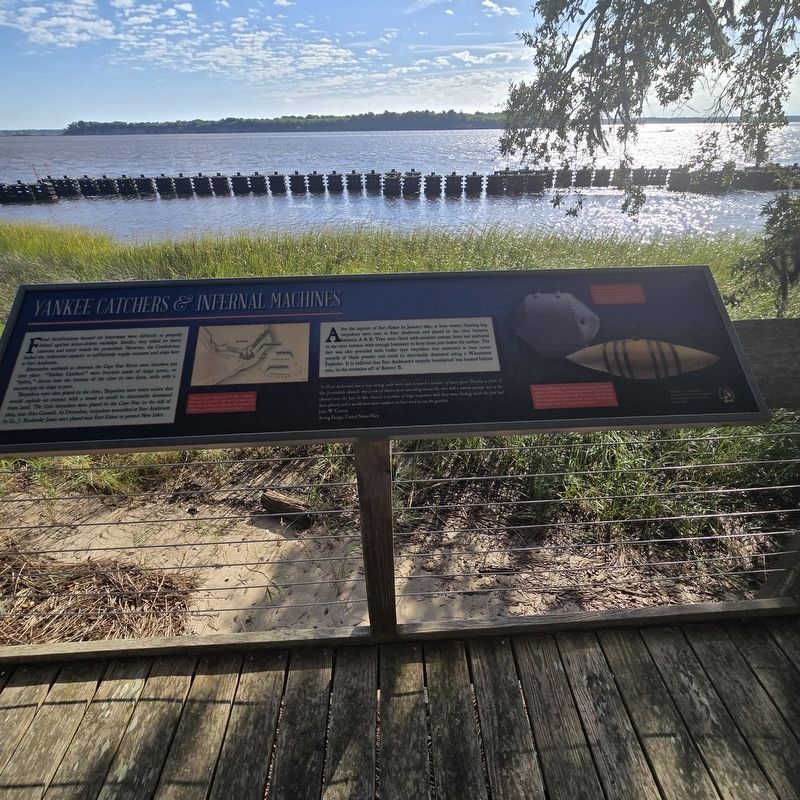
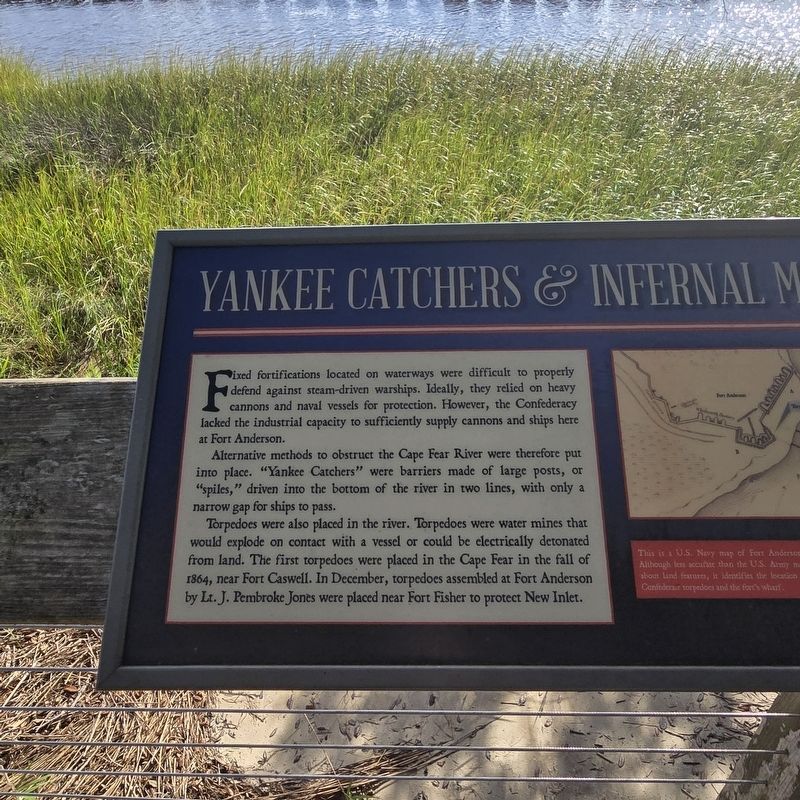
Alternative methods to obstruct the Cape Fear River were therefore put into place. "Yankee Catchers" were barriers made of large posts, or "spiles," driven into the bottom of the river in two lines, with only a narrow gap for ships to pass.
Torpedoes were also placed in the river. Torpedoes were water mines that would explode on contact with a vessel or could be electrically detonated from land. The first torpedoes were placed in the Cape Fear in the fall of 1864, near Fort Caswell. In December, torpedoes assembled at Fort Anderson by Lt. J. Pembroke Jones were placed near Fort Fisher to protect New Inlet.
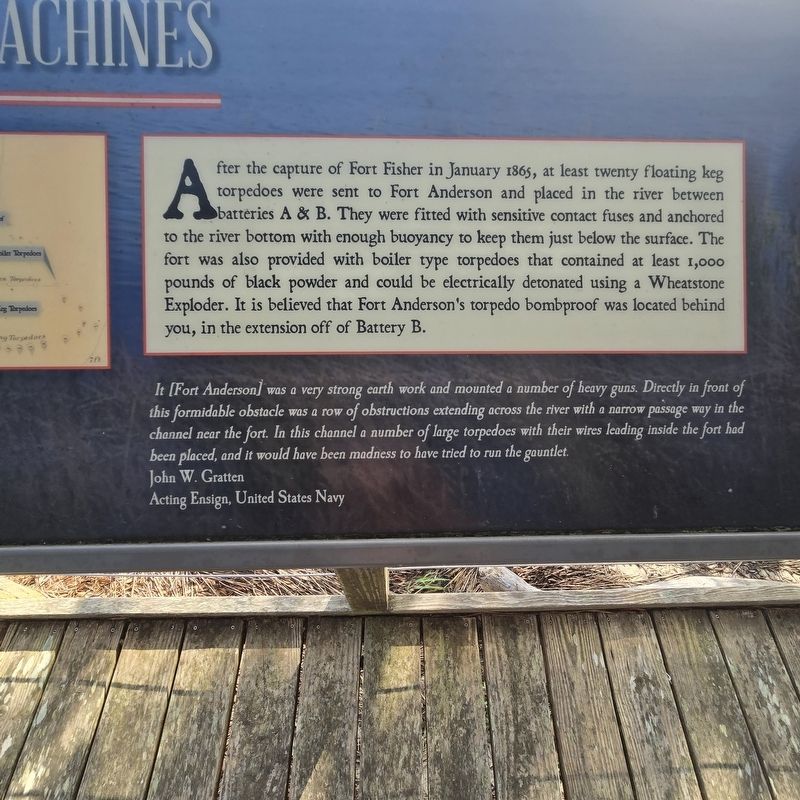
After the capture of Fort Fisher in January 1863, at least twenty floating keg torpedoes were sent to Fort Anderson and placed in the river between . batteries A ex B. They were fitted with sensitive contact fuses and
this page online
It [Fort Anderson] was a very strong earth work and mounted a number of heavy guns. Directly in front of this formidable obstacle was a row of obstructions extending across the river with a narrow pas* sage way in the channel near the fort. In this channel a number of large torpedoes with their wires leading inside the fort had been placed, and it would have been madness to have tried to run the gauntlet. John W. Gratten Acting Ensign, United States Navy(captions)
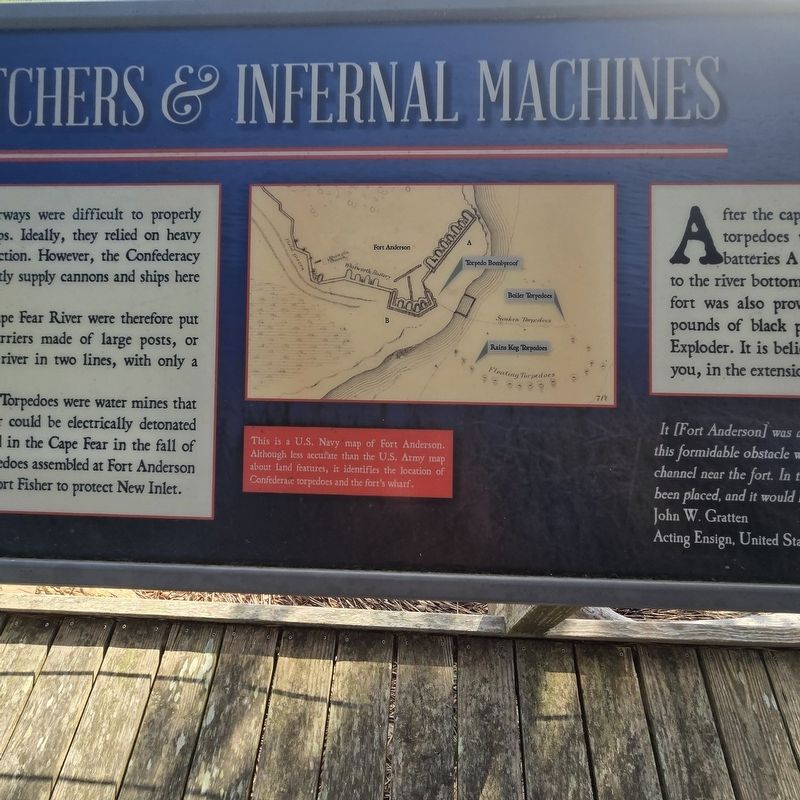
This is a U.S. Navy map of Fort Anderson. Although less accurate than the U.S. Army map about land features, it identifies the location of Confederate torpedoes and the fort's wharf.
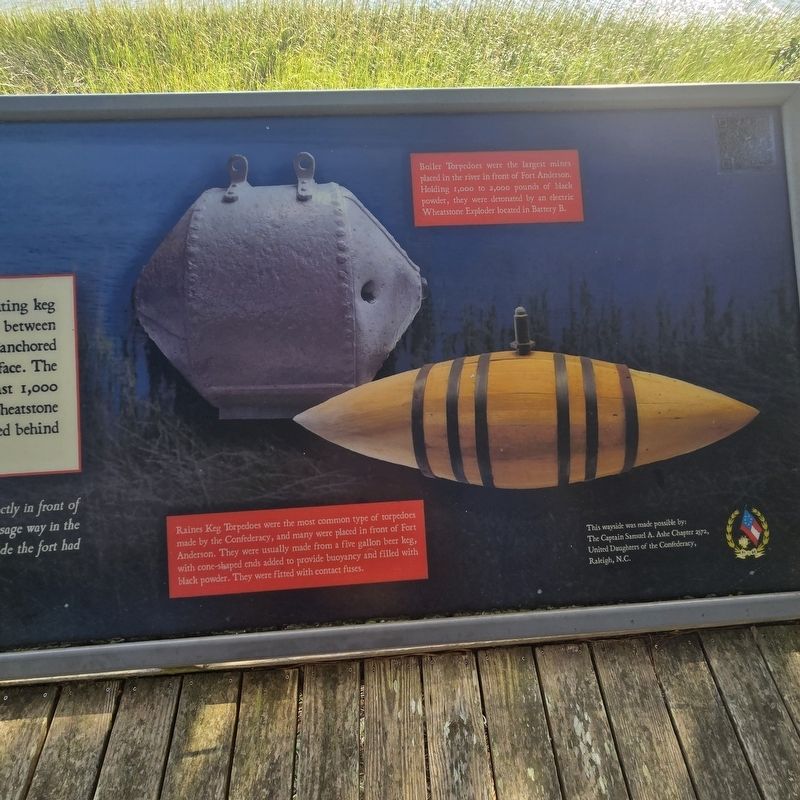
Boiler Torpedoes were the largest mines placed in the river in front of Fort Anderson. Holding 1,000 to 2,000 pounds of black powder, they were detonated by an electric Wheatstone Exploder located in Battery B.
Raines Keg Torpedoes were the most common type of torpedoes made by the Confederacy, and many were placed in front of Fort Anderson. They were usually made from a five gallon beer keg, with cone-shaped ends added to provide buoyancy and filled with black powder. They were fitted with contact fuses.
This wayside was made possible by: The Captain Samuel A. Ashe Chapter 2572, United Daughters of the Confederacy, Raleigh, N.C.
Erected by Captain
Photographed by Mike McKeown, September 12, 2025
2. Yankee Catchers & Infernal Machines Marker
End of marker close up
Topics. This historical marker is listed in these topic lists: Forts and Castles • War, US Civil • Waterways & Vessels. A significant historical month for this entry is January 1865.
Location. 34° 2.323′ N, 77° 56.63′ W. Marker is in Winnabow, North Carolina, in Brunswick County. It can be reached from St Phillips Road SE 0.6 miles east of Plantation Road SE, on the left when traveling east. Located along the Fort Anderson Trail behind the visitor Center at the Brunswick Town and Fort Anderson historic site. Touch for map. Marker is at or near this postal address: 8884 St Phillips Rd SE, Winnabow NC 28479, United States of America. Touch for directions.

Regionally, this marker is in the Coastal Plain and on the Cape Fear Coast. It is also in the American South, specifically in the Upper South, in the Tidewater, and on the Eastern Seaboard. Globally, it is in the North Atlantic Region, North America, the Western Hemisphere, the Western World, and the Anglosphere. Historically, it finds itself in what was once the territory of the Mississippian Culture, one of the original Thirteen Colonies,
Photographed by Mike McKeown, September 12, 2025
3. Yankee Catchers & Infernal Machines Marker
Close up
Other nearby markers. At least 8 other markers are within walking distance of this marker: Fort Anderson (within shouting distance of this marker); 32-Pounder Rifled Cannon (within shouting distance of this marker); The Big Guns Of Fort Anderson (within shouting distance of this marker); Capt. William Dry and the Spanish Attack (about 400 feet away, measured in a direct line); A Home at Brunswick: Hepburn-Reonolds Site (about 700 feet away); Margaret McCorkall: A Brunswick Woman (approx. 0.2 miles away); Brunswick Town State Historic Site (approx. 0.2 miles away); a different marker also named Fort Anderson (approx. 0.2 miles away). Touch for a list and map of all markers in Winnabow.
Also see . . .
1. Brunswick Town/Fort Anderson (North Carolina Historic Sites). (Submitted on September 15, 2025, by Mike McKeown of Baltimore, Maryland.)
2. The Impact of Mine Warfare Upon U.S. Naval Operations during the CW (Defense Tech. Info. Center). (Opens in .pdf)<blockquote>Confederate forces employed both electrically-detonated bottom
mines and floating
Photographed by Mike McKeown, September 12, 2025
4. Yankee Catchers & Infernal Machines Marker
Close up
Wilmington, North Carolina. Union naval forces were not hazarded by
these weapons until Fort Fisher, which guarded the approaches to the
Cape Fear, had been seized by a joint Army-Navy operation in January
1865. The electrical mine threat was neutralized when the shore
stations controlling the weapons fell into Union hands with the fall of
the land fortifications. Union forces moved up the Cape Fear in
February in support of General Terry's forces advancing on Wilmington.
On February 20th, a large number of keg mines were released by the
Confederates up the river to drift down upon the Federal naval force. (Submitted on September 15, 2025, by Mike McKeown of Baltimore, Maryland.)
Photographed by Mike McKeown, September 12, 2025
5. Yankee Catchers & Infernal Machines Marker
Close up
Credits. This page was last revised on September 16, 2025. It was originally submitted on September 15, 2025, by Mike McKeown of Baltimore, Maryland. This page has been viewed 103 times since then and 32 times this year. Photos: 1, 2, 3, 4, 5. submitted on September 15, 2025, by Mike McKeown of Baltimore, Maryland. • Bernard Fisher was the editor who published this page.
