Fanshawe in London in Middlesex County, Ontario — Central Canada (North America)
Indigenous Peoples
Photographed by Tim Boyd, September 14, 2025
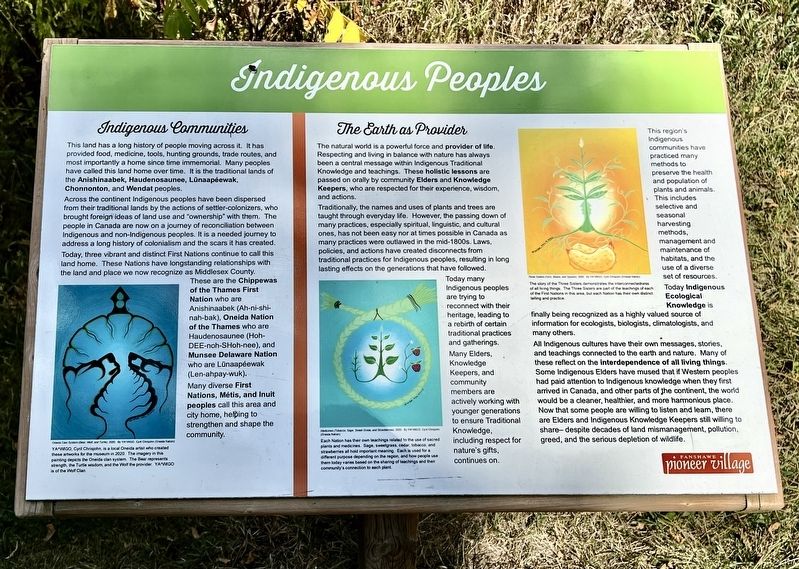
1. Indigenous Peoples Marker
Indigenous Communities
This land has a long history of people moving across it. It has provided food, medicine, tools, hunting grounds, trade routes, and most importantly a home since time immemorial. Many peoples have called this land home over time. It is the traditional lands of the Anishinaabek, Haudenosaunee, Lūnaapéewak, Chonnonton, and Wendat peoples.
Across the continent Indigenous peoples have been dispersed from their traditional lands by the actions of settler-colonizers, who brought foreign ideas of land use and "ownership" with them. The people in Canada are now on a journey of reconciliation between Indigenous and non-Indigenous peoples. It is a needed journey to address a long history of colonialism and the scars it has created. Today, three vibrant and distinct First Nations continue to call this land home. These Nations have longstanding relationships with the land and place we now recognize as Middlesex County. These are the Chippewas of the Thames First Nation who are Anishinaabek (Ah-ni-shi-nah-bak), Oneida Nation of the Thames who are Haudenosaunee (Hoh-DEE-noh-SHoh-nee), and Munsee
this page online
Many diverse First Nations, Métis, and Inuit peoples call this area and city home, helping to strengthen and shape the community.
The Earth as Provider
The natural world is a powerful force and provider of life. Respecting and living in balance with nature has always been a central message within Indigenous Traditional Knowledge and teachings. These holistic lessons are passed on orally by community Elders and Knowledge Keepers, who are respected for their experience, wisdom, and actions.
Traditionally, the names and uses of plants and trees are taught through everyday life. However, the passing down of many practices, especially spiritual, linguistic, and cultural ones, has not been easy nor at times possible in Canada as many practices were outlawed in the mid-1800s. Laws, policies, and actions have created disconnects from traditional practices for Indigenous peoples, resulting in long lasting effects on the generations that have followed.
Today many Indigenous peoples are trying to reconnect with their heritage, leading to a rebirth of certain traditional practices

2. Indigenous Peoples marker artwork and caption detail (left)
This region's Indigenous communities have practiced many methods to preserve the health and population of plants and animals. This includes selective and seasonal harvesting methods, management and maintenance of habitats, and the use of a diverse set of resources.
Today Indigenous Ecological Knowledge is finally being recognized as a highly valued source of information for ecologists, biologists, climatologists, and many others.
All Indigenous cultures have their own messages, stories, and teachings connected to the earth and nature. Many of these reflect on the interdependence of all living things. Some Indigenous Elders have mused that if Western peoples had paid attention to Indigenous knowledge when they first arrived in Canada, and other parts of the continent, the world would be a cleaner, healthier, and more harmonious place. Now that some people are willing to listen and learn, there are Elders and Indigenous Knowledge Keepers still willing to share despite decades of land mismanagement, pollution, greed, and the serious depletion of wildlife.
Erected by Fanshawe Pioneer Village.
Topics. This historical marker is listed in these topic lists: Environment • Indigenous Peoples and Communities.
Location. 43° 3.303′ N, 81° 10.86′ W. Marker is in London, Ontario, in Middlesex County. It is in Fanshawe. It can be reached from Fanshawe Park Road East. The marker is on the grounds of the Fanshawe Pioneer Village, accessibility subject to its operating hours and requiring paid admission. The Village is accessed by driving east from Clark Road and Veterans’
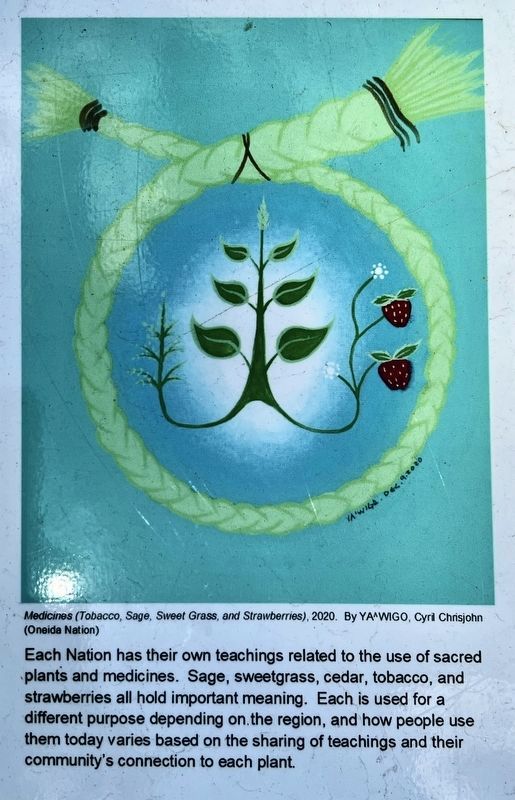
3. Indigenous Peoples marker artwork and caption detail (centre)

Regionally, this marker is in the Southwest Ontario Area and in Southwestern Ontario. It is also in Central Canada. Globally, it is in North America, the Western Hemisphere, the Western World, and the Anglosphere. Historically, it finds itself in what was once a British colony, the Viceroyalty of New France, the Haudenosaunee (Iroquois) Confederacy, and Rupert’s Land.
Other nearby markers. At least 8 other markers are within walking distance of this marker: Arrival of European Settlers (here, next to this marker); Emigration: (within shouting distance of this marker); Impact of European Settlement (within shouting distance of this marker); Denfield General Store (within shouting distance of this marker); Elgie Log House (within shouting distance of this marker); London Brewery (within shouting distance of this marker); Harmer Sawmill (within shouting distance of this marker); Print Shop (within shouting distance of this marker). Touch for a list and map of all markers in London.

4. Indigenous Peoples marker artwork and caption detail (right)

Photographed by Tim Boyd, September 14, 2025
5. Indigenous Peoples Marker
Credits. This page was last revised on September 18, 2025. It was originally submitted on September 15, 2025, by Tim Boyd of Hamilton, Ontario. This page has been viewed 78 times since then and 28 times this year. Photos: 1, 2, 3, 4, 5. submitted on September 15, 2025, by Tim Boyd of Hamilton, Ontario. • Andrew Ruppenstein was the editor who published this page.
