Fanshawe in London in Middlesex County, Ontario — Central Canada (North America)
Emigration:
Why did people come to Middlesex County and who were they?

Photographed by Tim Boyd, September 14, 2025
1. Emigration: Marker
One immigrant group to London Township was known as the Richard Talbot Settlers from North Tipperary, Ireland. In 1818, forty families from the region were recruited by Richard Talbot, an impoverished gentleman seeking a new start in the colonies, under an emigration plan funded in part by the British government. The Talbot emigrants were predominantly Protestant, leaving homes in southern Irish counties. Half of this group included farmers coming from
this page online
As the transatlantic passenger trade evolved from the timber shipping industry, emigrant ships of the early 1800s were outfitted largely for the needs of cargo rather than passengers. Emigrants were required to supply their own food and bedding for the voyage, which could take a couple of months. In addition to enduring cramped living quarters and limited provisions, passengers suffered dreadfully from bouts of seasickness and other illness caused by contaminated water and unsanitary conditions. Cholera and typhus spread easily and were often deadly.
Unfortunately, the voyage of the Richard Talbot Settlers was affected by such illnesses. The party set sail from Cork, Ireland on June 13th, 1818 on the brig Brunswick and docked at Quebec forty-three days later. Twenty-three of Talbot's original party of 183 perished during the voyage, all of them children.
Follow their difficult journey on the adjacent panel, and visit the Corbett Tavern to learn more about the Richard Talbot Settlers!
Fanshawe
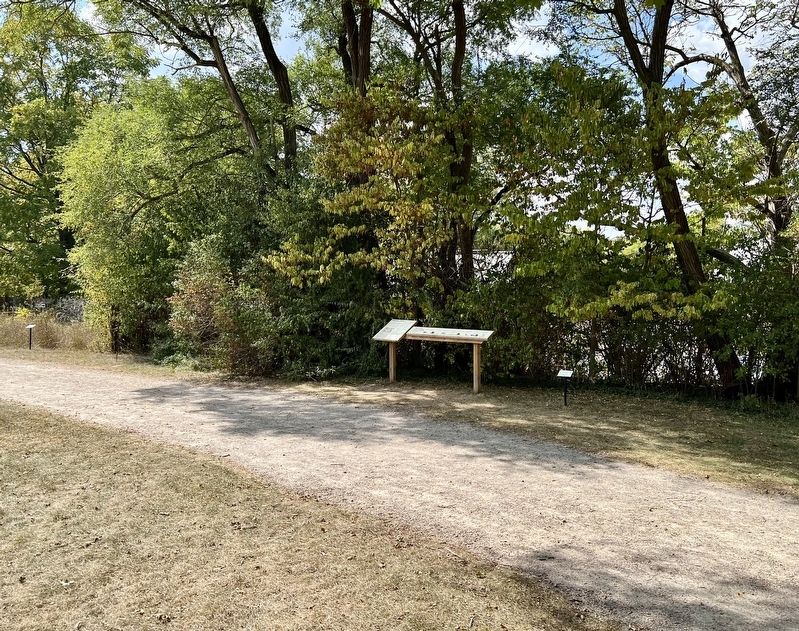
Photographed by Tim Boyd, September 14, 2025
2. Emigration: Marker
Topics. This historical marker is listed in these topic lists: Immigration • Settlements & Settlers • Waterways & Vessels. A significant historical date for this entry is June 13, 1818.
Location. 43° 3.318′ N, 81° 10.849′ W. Marker is in London, Ontario, in Middlesex County. It is in Fanshawe. It can be reached from Fanshawe Park Road East. The marker is on the grounds of the Fanshawe Pioneer Village, accessibility subject to its operating hours and requiring paid admission. The Village is accessed by driving east from Clark Road and Veterans’ Parkway. Admission is paid at the entrance to the Fanshawe Conservation Area, and then follow signposts for approx. 2km to the Village. Touch for map. Marker is at or near this postal address: 2609 Fanshawe Park Road E, London ON N0M 2P0, Canada. Touch for directions.

Regionally, this marker is in the Southwest Ontario Area and in Southwestern Ontario. It is also in Central Canada. Globally, it is in North America, the Western Hemisphere, the Western World, and the Anglosphere. Historically, it finds itself in what was once a British colony, the Viceroyalty of New France, the Haudenosaunee (Iroquois) Confederacy, and Rupert’s Land.
Other nearby markers. At least 8 other markers are within walking distance of this marker: Impact of European Settlement (a few steps from this marker); Elgie Log House (within shouting distance of this marker); Indigenous Peoples (within shouting distance of this marker); Arrival of European Settlers (within shouting distance of this marker); The Resources of the Woodland (within shouting distance of this marker); African Methodist Episcopal Church (within shouting distance of this marker); a different marker also named African Methodist Episcopal Church (within shouting distance of this marker); Denfield General Store (within shouting distance of this marker). Touch for a list and map of all markers in London.
Credits. This page was last revised on September 18, 2025. It was originally submitted on September 16, 2025, by Tim Boyd of Hamilton, Ontario. This page has been viewed 225 times since then and 120 times this year. Photos: 1, 2. submitted on September 16, 2025, by Tim Boyd of Hamilton, Ontario. • Andrew Ruppenstein was the editor who published this page.
