Winnabow in Brunswick County, North Carolina — The American South (South Atlantic)
A Home at Brunswick: Hepburn-Reonolds Site
Photographed by Mike McKeown, September 12, 2025
1. A Home at Brunswick: Hepburn-Reonolds Site Marker
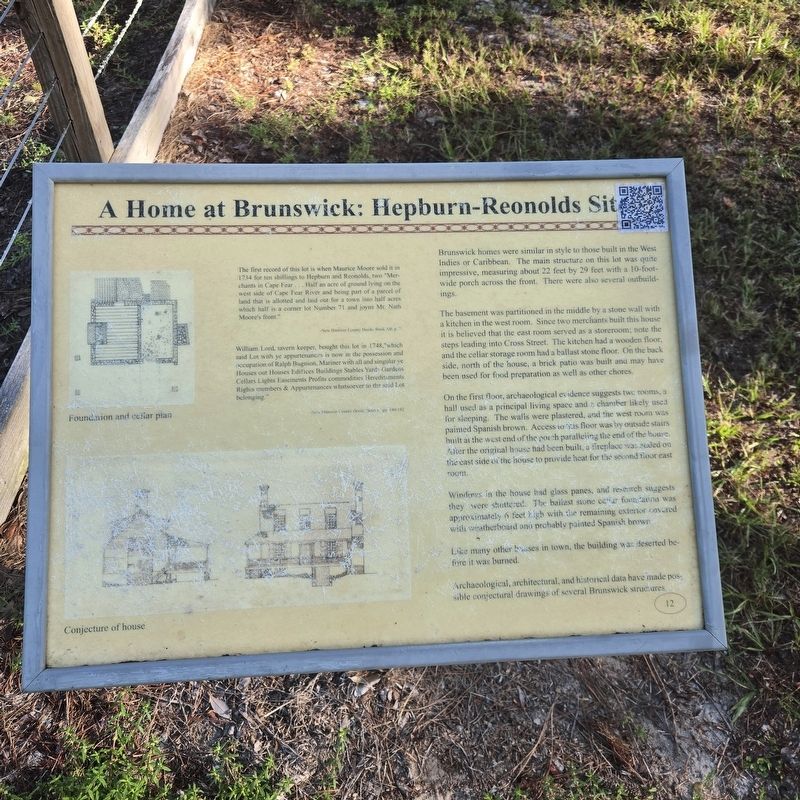
Brunswick homes were similar in style to those built in the West Indies or Caribbean. The main structure on this lot was quite impressive, measuring about 22 feet by 29 feet with a 10-foot-wide porch across the front. There were also several outbuildings.
The basement was partitioned in the middle by a stone wall with a kitchen in the west room. Since two merchants built this house it is believed that the east room served as a storeroom: note the steps leading into Cross Street. The kitchen had a wooden floor and the cellar storage room had a ballast stone floor. On the back side, north of the house, a brick patio was built and may have been used for food preparation as well as other chores.
On the first floor, archaeological evidence suggests two rooms, a hall used as a principal living space and a chamber likely used for sleeping. The walls were plastered, and the west room was painted Spanish brown. Access to this floor was outside stairs built at the west end of the porch paralleling the end of the house. After the original had been built, a fireplace was added on the east side of the house to provide heat for
this page online
Windows in the house had glass panes, and research suggests they were shattered. The ballast stone cellar foundation was approximately 6 feet high with the remaining exterior covered with weatherboard and probably painted Spanish brown.
Like many other houses in town, the building was deserted before it was burned.
Archaeological, architectural, and historical data have made possible conjectural drawings of several Brunswick structures.
The first record of this lot is when Maurice Moore sold it in 1734 for ten shillings to Hepburn and Reonolds, two "Merchants in Cape Fear ... Half an acre of ground lying on the west side of Cape Fear River and being part of a parcel of land that is allotted and laid out for a town into half acres which half is a corner lot Number 71 and joyns Mr. Nath Moore's front." New Hanover County Deeds, Book AB, p. 7
William Lord, tavern keeper, bought this lot in 1748,"which said Lot with ye appurtenances is now in the possession and occupation of Ralph Bugnion, Mariner with all and singular ye Houses out Houses Edifices Buildings Stables Yard, Gardens Cellars Lights Easements Profits commodities Hereditaments Rights members & Appurtenances whatsoever to the said Lot belonging." New Hanover County Deeds, Book C, pp. 180-182
Foundation and cellar plan
Conjecture of house
Topics.
Photographed by Mike McKeown, September 12, 2025
2. A Home at Brunswick: Hepburn-Reonolds Site Marker
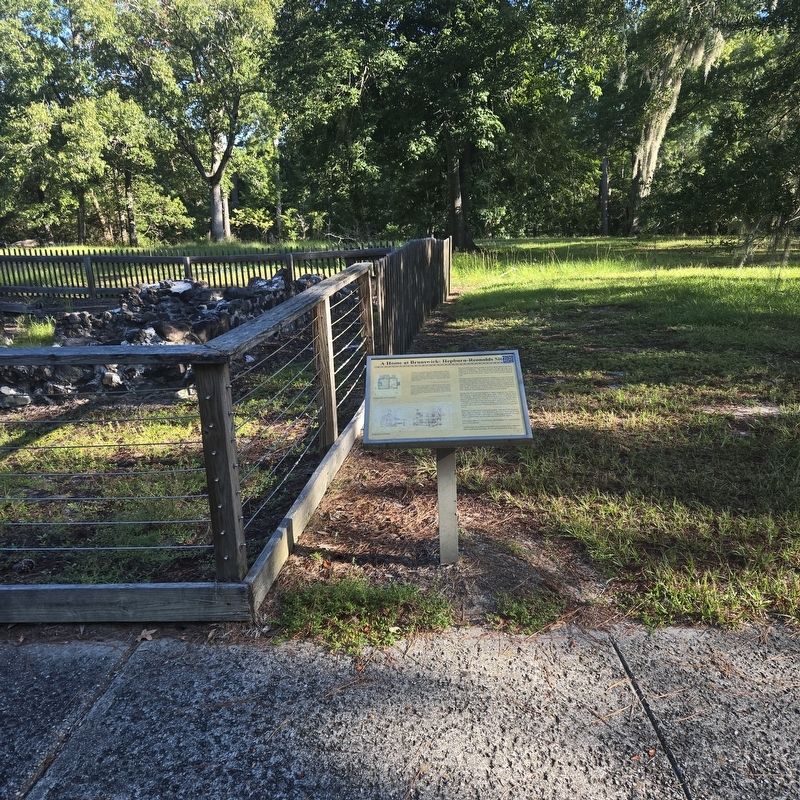
Location. 34° 2.284′ N, 77° 56.759′ W. Marker is in Winnabow, North Carolina, in Brunswick County. It can be reached from St Phillips Road SE 0.6 miles east of Plantation Road, on the right when traveling south. Along the trail leading from the Visitor Center at the Brunswick Town/Fort Anderson Historic Site. Touch for map. Marker is at or near this postal address: 8884 St Phillips Rd SE, Winnabow NC 28479, United States of America. Touch for directions.

Regionally, this marker is in the Coastal Plain and on the Cape Fear Coast. It is also in the American South, specifically in the Upper South, in the Tidewater, and on the Eastern Seaboard. Globally, it is in the North Atlantic Region, North America, the Western Hemisphere, the Western World, and the Anglosphere. Historically, it finds itself in what was once the territory of the Mississippian Culture, one of the original Thirteen Colonies, one of the Confederate States of
Photographed by Mike McKeown, September 12, 2025
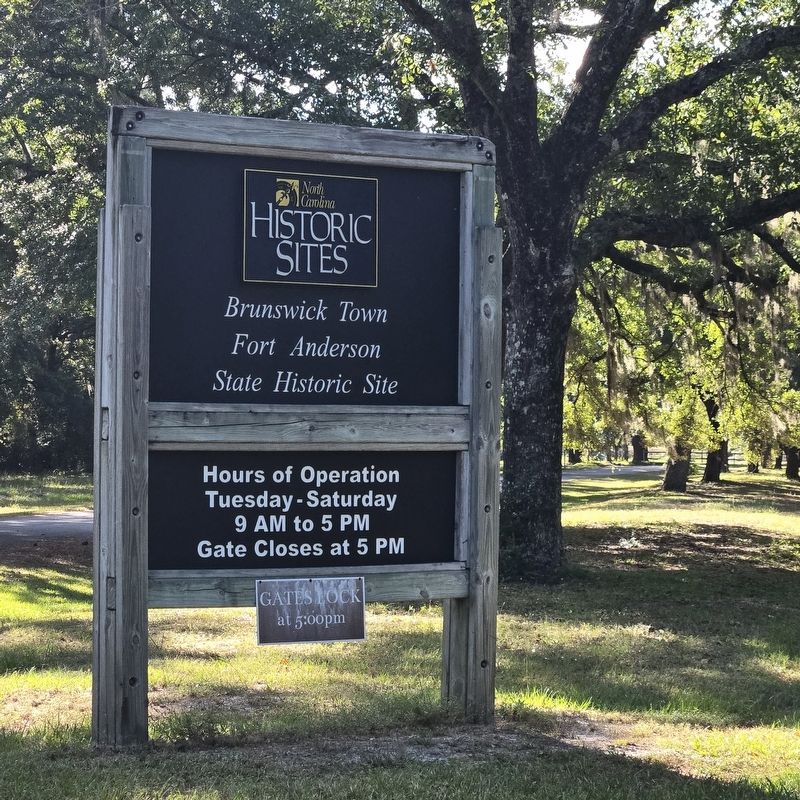
3. Sign near enterance to Brunswick Town/Fort Anderson Historic Site
Other nearby markers. At least 8 other markers are within walking distance of this marker: Margaret McCorkall: A Brunswick Woman (within shouting distance of this marker); Capt. William Dry and the Spanish Attack (about 400 feet away, measured in a direct line); Fort Anderson (about 500 feet away); Colonel Maurice Moore (about 500 feet away); St. Phillips Church Interior (about 500 feet away); John LaPierre (about 600 feet away); Brunswick Town State Historic Site (about 600 feet away); Yankee Catchers & Infernal Machines (about 700 feet away). Touch for a list and map of all markers in Winnabow.
Also see . . .
1. Brunswick Town/Fort Anderson (North Carolina Historic Sites). (Submitted on September 17, 2025, by Mike McKeown of Baltimore, Maryland.)
2. Brunswick Town/Fort Anderson National Reg. of Historic Places Inventory Nomination Form (pdf file).
Hepburn Reonolds. Excavated 1959. An analysis of excavated materials indicates that the house must have been occupied between the years of 1730 and 1776. This ruin is one of the most impressive found at Brunswick. A stone partition divides the basement into two rooms, a kitchen which opens onto a brick patio extending the entire length of the structure, and a second room with a cobblestone floor, possibly a storage cellar. Mortared column footings and an outside chimney indicate that the house had a second floor and a porch extending from it. Archeological evidence suggests that this house, like many others in the town, was deserted before the British raid on Brunswick in 1776 at the end of the Revolution, this lot was among the Loyalist property confiscated by the new state of North Carolina.(Submitted on September 17, 2025, by Mike McKeown of Baltimore, Maryland.)
Credits. This page was last revised on September 17, 2025. It was originally submitted on September 17, 2025, by Mike McKeown of Baltimore, Maryland. This page has been viewed 85 times since then and 31 times this year. Photos: 1, 2, 3. submitted on September 17, 2025, by Mike McKeown of Baltimore, Maryland. • Bernard Fisher was the editor who published this page.
