
St. Catharines in Niagara Region, Ontario — Central Canada (North America)
Global Irish Famine Way
Photographed by Kevin Westell, September 22, 2025
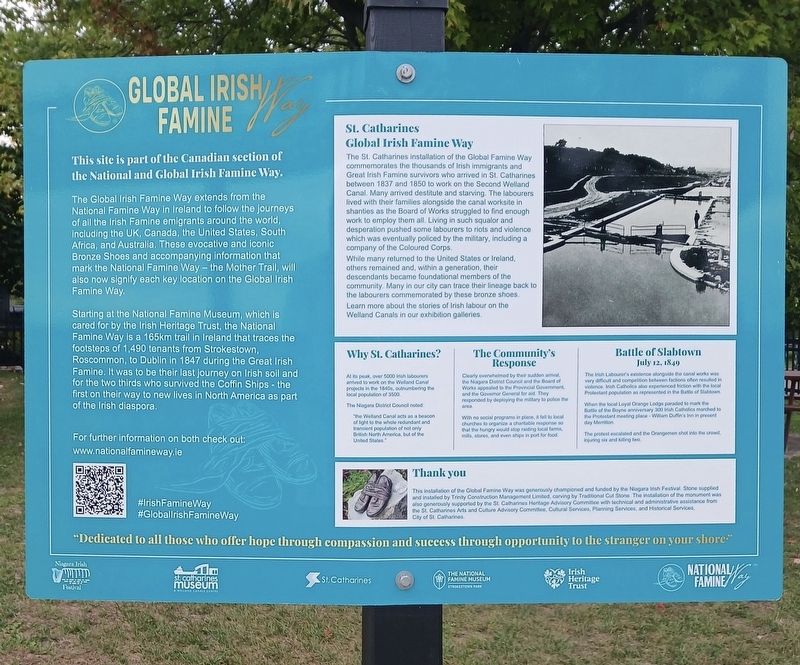
1. Global Irish Famine Way - Marker
The Global Irish Famine Way extends from the National Famine Way in Ireland to follow the journeys of all the Irish Famine emigrants around the world, including the UK, Canada, the United States, South Africa, and Australia. These evocative and iconic bronze shoes and accompanying information that mark the National Famine Way - the Mother Trail, will also now signify each key location on the Global Irish Famine Way.
Starting at the National Famine Museum, which is cared for by the Irish Heritage Trust, the National Famine Way is a 165km trail in Ireland that traces the footsteps of 1,490 tenants from Strokestown, Roscommon, to Dublin in 1847 during the Great Irish Famine. It was to be their last journey on Irish soil and for the two thirds who survived the Coffin Ships - the first on their way to new lives in North America as part of the Irish diaspora.
For further information on both check out:
www.nationalfamineway.ie
#IrishFamineWay
#GlobalIrishFamineWay
"Dedicated to all those who offer
this page online
St. Catharines Global Irish Famine Way
The St Catharines installation of the Global Famine Way commemorates the thousands of Irish immigrants and Great Irish Famine survivors who arrived in St. Catharines between 1837 and 1850 to work on the Second Welland Canal. Many arrived destitute and starving. The labourers lived with their families alongside the canal worksite in shanties as the Board of Works struggled to find enough work to employ them all. Living in such squalor and desperation pushed some labourers to riots and violence which was eventually policed by the military, including a company of the Coloured Corps. While many returned to the United States or Ireland, others remained and, within a generation, their descendants became foundational members of the community. Many in our city can trace their lineage back to the labourers commemorated by these bronze shoes.
Lean more about the stories of Irish labour on the Welland Canals in our exhibition galleries.
Why St. Catharines?
At its peak, over 5000

Photographed by Kevin Westell, September 22, 2025
2. Global Irish Famine Way - Marker in context
Photo faces south-west, from near the north-east end of the elevated viewing platform. The museum's "back" doors (the east doors, facing the canal) are visible. The south-west corner of the L-shaped elevated viewing platform (far left) joins to the museum's second floor.
The Niagara District Council noted:
"The Welland Canal acts as a beacon of light to the whole redundant and transient population of not only British North America, but of the United States."
The Community's Response
Clearly overwhelmed by their sudden arrival, the Niagara District Council and the Board of Works appealed to the Provincial Government, and the Governor General for aid. They responded by deploying the military to police the Area.
With no social programs in place, it fell to local churches to organize a charitable response so that the hungry would stop raiding local farms, mills, stores, and even ships in port for food.
Battle of Slabtown July 12, 1849
The Irish Labourer's existence alongside the canal works was very difficult and competition between factions often resulted in violence. Irish Catholics also experienced friction with the local Protestant population as represented in the Battle of Slabtown.
When the local Loyal Orange Lodge paraded

Photographed by Kevin Westell, September 22, 2025
3. Global Irish Famine Way - Monument
This is perhaps 90 cm (3 feet) high.
The protest escalated and the Orangemen shot into the crowd, injuring six and killing two.
Thank you
This installation of the Global Famine Way was generously championed and funded by the Niagara Irish Festival. Stone supplied and installed by Trinity Construction Management Limited, carving by Traditional Cut Stone. The installation of the monument was also generously supported by the St. Catharines Heritage Advisory Committee with technical and administrative assistance from the St. Catharines Arts and Culture Advisory Committee, Cultural Services, Planning Services, and Historical Services, City of St. Catharines.
Erected 2025.
Topics and series. This historical marker is listed in these topic lists: Disasters • Immigration • Waterways & Vessels. In addition, it is included in the The Welland Canals series list. A significant historical year for this entry is 1837.
Location. 43° 9.351′ N, 79° 11.651′ W. Marker is in St. Catharines, Ontario, in Niagara Region. It can be reached from Welland Canals Parkway, on the right when traveling north. The marker and monument are within the grounds of the St. Catharines Museum and Welland Canals Centre, along a diagonal concrete walkway between the museum and the canal. Touch for map. Marker is at or near this postal address: 1932 Welland Canals Parkway, St Catharines ON L2R 7K6, Canada. Touch for directions.

Regionally, this marker is on Ontario’s Golden Horseshoe and in Niagara Canada. It is also in Central Canada. Globally, it is in North America, the Western Hemisphere, the Western World, and the Anglosphere. Historically, it finds itself in what was once a British colony, the Viceroyalty of New France, the Haudenosaunee (Iroquois) Confederacy, and Rupert’s Land.
Other nearby markers. At least 8 other markers are within walking distance of this marker: Welland Ship Canal (here, next to this marker); William Hamilton Merritt 1793 - 1862 (here, next to this marker); How It Works: Locking Through (a few steps from this marker); The St. Lawrence Seaway (a few steps from this marker); How it Works: Operations and Safety (within shouting distance of this marker); The Fourth Welland Canal (within shouting distance of this marker); International Shipmasters' Association (within shouting distance of this marker); Bollard (within shouting distance of this marker). Touch for a list and map of all markers in St. Catharines.
Regarding Global Irish Famine Way. This event was also known as "the Irish potato famine" and "the great potato famine".
Also see . . . National Famine Way, a website by an Irish organization associated with this monument. (Submitted on September 22, 2025, by Kevin Westell of St. Catharines, Ontario.)
Credits. This page was last revised on September 23, 2025. It was originally submitted on September 22, 2025, by Kevin Westell of St. Catharines, Ontario. This page has been viewed 63 times since then and 24 times this year. Photos: 1, 2, 3. submitted on September 22, 2025, by Kevin Westell of St. Catharines, Ontario. • Andrew Ruppenstein was the editor who published this page.
