Eufaula in Barbour County, Alabama — The American South (East South Central)
Creek Pottery
| — | Creek Heritage Trail | — |
Photographed by Darren Jefferson Clay, September 20, 2025
1. Creek Pottery Marker
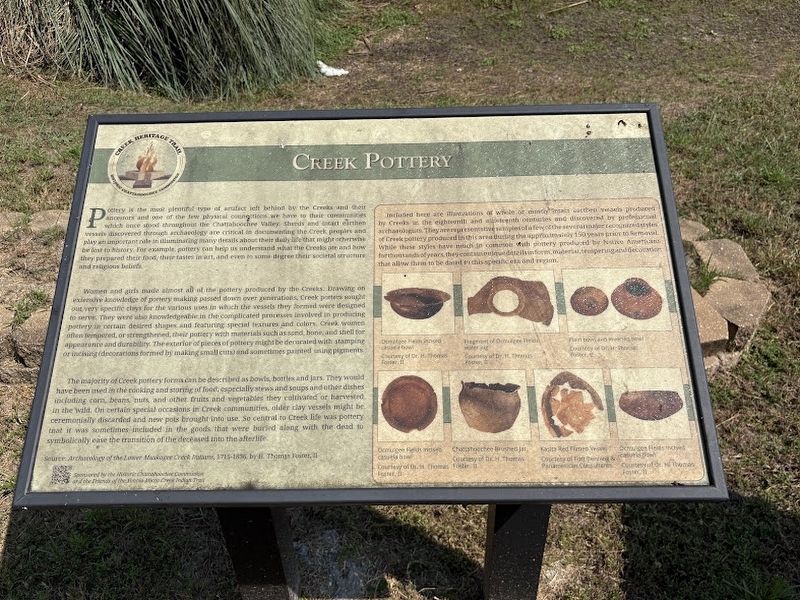
Women and girls made almost all of the pottery produced by the Creeks. Drawing on extensive knowledge of pottery making passed down over generations, Creek potters sought out very specific clays for the various uses in which the vessels they formed were designed to serve. They were also knowledgeable in the complicated processes involved in producing pottery in certain desired shapes and featuring special textures and colors. Creek women often tempered, or strengthened, their pottery with materials
this page online
The majority of Creek pottery forms can be described as bowls, bottles and jars. They would have been used in the cooking and storing of food, especially stews and soups and other dishes including corn, beans, nuts, and other fruits and vegetables they cultivated or harvested in the wild. On certain special occasions in Creek communities, older clay vessels might be ceremonially discarded and new pots brought into use. So central to Creek life was pottery that it was sometimes included in the goods that were buried along with the dead to symbolically ease the transition of the deceased into the afterlife.
Source: Archaeology of the Lower Muskogee Creek Indians, 1715-1836, by H. Thomas Foster, II
Included here are illustrations of whole or mostly intact earthen vessels produced by Creeks in the eighteenth and nineteenth centuries and discovered by professional archaeologists. They are representative samples
Photographed by Darren Jefferson Clay, September 20, 2025
2. Creek Pottery Marker (second marker from right)
Image captions:
(Top, left): Ocmulgee Fields incised casuela bowl. Courtesy of Dr. H. Thomas Foster, II
(Top, center): Fragment of Ocmulgee Fields water jug. Courtesy of Dr. H. Thomas Foster, II
(Top, right): Plain bowl and inverted bowl. Courtesy of Dr. H. Thomas Foster, II
(Bottom, left): Ocmulgee Fields incised casuela bowl. Courtesy of Dr. H. Thomas Foster, II.
(Bottom, center left): Chattahoochee Brushed Jar. Courtesy of Dr. H. Thomas Foster, II
(Bottom, center right): Kasita Red Filmed Vessel. Courtesy of Fort Benning & Panamerican Consultants
(Bottom, right): Ocmulgee Fields incised casuele bowl. Courtesy of Dr. H. Thomas Foster, II
Erected by Historic Chattahoochee Commission and the Friends of the Yoholo Micco Heritage Trail.
Topics. This historical marker is listed in these topic lists: Indigenous Peoples and Communities • Women.
Location. 31° 53.675′ N, 85° 8.367′ W. Marker is in Eufaula, Alabama, in Barbour County. It can be reached from the intersection of E. Broad St. and N Forsyth Ave, on the right when traveling west. Interpretive marker is located on the Yoholo Micco Trail, about 500 feet north of Broad Street. Touch for map. Marker is in this post office area: Eufaula AL 36027, United States of America. Touch for directions.

Regionally, this marker is in the American South, specifically in the Deep South, in the Black Belt, and in the Wiregrass. Globally, it is in North America, a Gulf of Mexico state, the Western Hemisphere, the Western World, and the Anglosphere. Historically, it finds itself in what was once the territory of the Mississippian Culture, one of the Confederate States of America, and the Antebellum South.
Other nearby markers. At least 8 other markers are within walking distance of this marker: The Importance of Waterways to the Creeks (here, next to this marker); Cotton and Creek Country (here, next to this marker); Chief Eufaula (Yoholo Micco) (here, next to this marker); The Second Creek War in the Eufaula Area (about 500 feet away, measured in a direct line); The City of Eufaula (about 500 feet away); The Town of Irwinton (about 500 feet away); The Creek Town of Eufaula (about 500 feet away); William Thomas "Tom" Mann / Eufaula, Alabama (about 500 feet away). Touch for a list and map of all markers in Eufaula.
Credits. This page was last revised on September 27, 2025. It was originally submitted on September 23, 2025, by Darren Jefferson Clay of Duluth, Georgia. This page has been viewed 140 times since then and 74 times this year. Photos: 1, 2. submitted on September 23, 2025, by Darren Jefferson Clay of Duluth, Georgia. • James Hulse was the editor who published this page.
