Crow Wing State Park in Crow Wing County, Minnesota — The American Midwest (Upper Plains)
A Community Forms
Main Street, Crow Wing — Self-Guiding Trail
Photographed by McGhiever, June 28, 2025
1. A Community Forms Marker
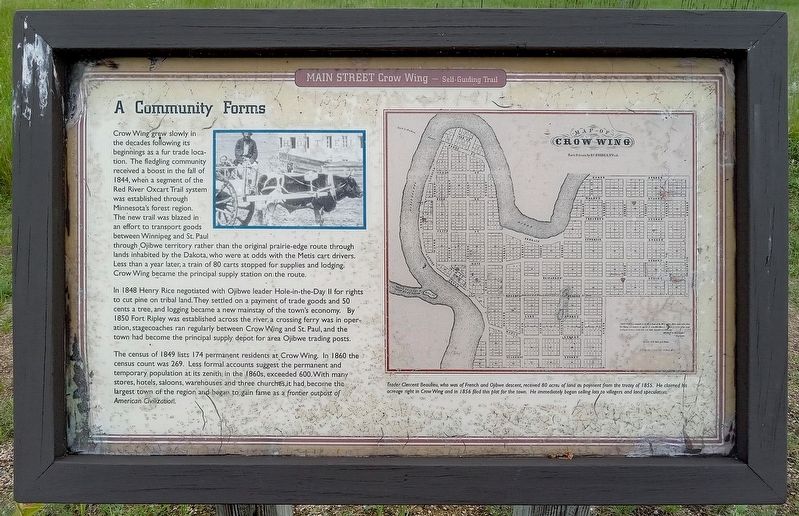
Crow Wing grew slowly in the decades following its beginnings as a fur trade location. The fledgling community received a boost in the fall of 1844, when a segment of the Red River Oxcart Trail system was established through Minnesota's forest region. The new trail was blazed in an effort to transport goods between Winnipeg and St. Paul through Ojibwe territory rather than the original prairie-edge route through lands inhabited by the Dakota, who were at odds with the Metis cart drivers. Less than a year later, a train of 80 carts stopped for supplies and lodging. Crow Wing became the principal supply station on the route.
In 1848 Henry Rice negotiated with Ojibwe leader Hole-in-the-Day II for rights to cut pine on tribal land. They settled on a payment of trade goods and 50 cents a tree, and logging became a new mainstay of the town's economy. By 1850 Fort Ripley was established across the river, a crossing ferry was in operation, stagecoaches ran regularly between Crow Wing and St. Paul, and the town had become the principal supply depot for area Ojibwe trading posts.
The census of 1849 lists 174 permanent residents
this page online
Trader Clement Beaulieu, who was of French and Ojibwe descent, received 80 acres of land as payment from the treaty of 1866. He claimed his acreage right in Crow Wing and in 1856 filed this plat for the town. He immediately began selling lots to villagers and land speculators.
Erected by Minnesota Department of Natural Resources.
Topics. This historical marker is listed in these topic lists: Indigenous Peoples and Communities • Industry & Commerce • Roads & Vehicles • Settlements & Settlers. A significant historical year for this entry is 1844.
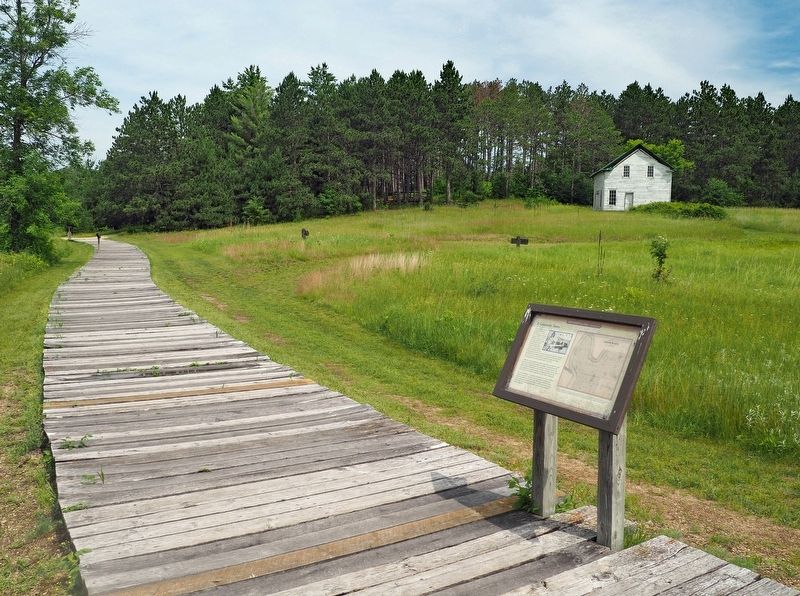
Location. 46° 16.589′ N, 94° 20.267′ W. Marker is near Crow Wing, Minnesota, in Crow Wing County. It is in Crow Wing State Park. It can be reached from Crow Wing State Park Road. The marker is on the boardwalk through the Old Crow Wing
Photographed by McGhiever, June 28, 2025
2. A Community Forms Marker on the boardwalk south of the Clement Beaulieu House

Regionally, this marker is in the Northland. It is also in the American Midwest, in the Corn Belt, and in the Great River Road Region. Globally, it is in North America, the Great North Woods, the Western Hemisphere, the Western World, and the Anglosphere. Historically, it finds itself in what was once Rupert’s Land, the territory of the Mississippian Culture, and the Northwest Territory.
Other nearby markers. At least 8 other markers are within walking distance of this marker: Boardwalk (a few steps from this marker); Town Well (within shouting distance of this marker); Sioux Camp Prior to 1768 Ambush (within shouting distance of this marker); a different marker also named Town Well (within shouting distance of this marker); Warehouse (within shouting distance of this marker); The Meeting Place (within shouting distance of this marker); Commercial District (within shouting distance of this marker); The Clement Beaulieu House (about 300 feet away, measured in a direct line). Touch for a list and map of all markers in Crow Wing.
Credits. This page was last revised on April 16, 2026. It was originally submitted on September 26, 2025, by McGhiever of Minneapolis, Minnesota. This page has been viewed 47 times since then and 15 times this year. Photos: 1, 2. submitted on September 26, 2025, by McGhiever of Minneapolis, Minnesota.
