Rock Hill in York County, South Carolina — The American South (South Atlantic)
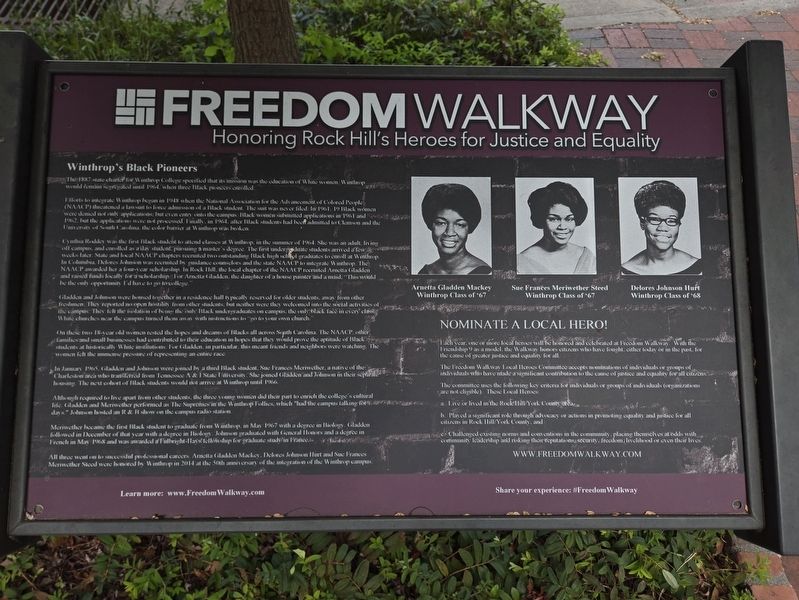
Winthrop's Black Pioneers
Freedom Walkway
| — | Honoring Rock Hill's Heroes for Justice and Equality | — |
Photographed by Mark Parker, September 25, 2025
1. Winthrop's Black Pioneers Marker
The 1887 State charter for Winthrop College specified that its mission was the education of White women. Winthrop would remain segregated until 1964 when three Black pioneers enrolled.
Efforts to integrate Winthrop began in 1948 when the National Association for the Advancement of Colored People (NAACP) threatened a lawsuit to force admission of a Black student. The suit was never filed. In 1961, 19 Black women were denied not only applications, but even entry onto the campus. Black women submitted applications in 1961 and 1962, but the applications were not processed. Finally, in 1964, after Black students had been admitted to Clemson and the University of South Carolina, the color barrier at Winthrop was broken.
Cynthia Roddey what's the first Black student to attend classes at Winthrop in the summer of 1964. She was an adult, living off campus, and enrolled as a day student pursuing a master's degree. The first undergraduate students arrived A few weeks later. State and local NAACP chapters recruited two outstanding Black high school graduates to enroll at Winthrop. In Columbia, Dolores Johnson was recruited
this page online
Gladden and Johnson were housed together in a residence hall typically reserved for older students, away from other freshmen. They reported no open hostility from other students, but neither were they welcomed into the social activities of the campus. They felt the isolation of being the only Black undergraduates on campus, the only black face in every class. White churches near the campus turned them away with instructions to "go to your own church."
On these two 18-year-old women arrested the hopes and dreams of all Blacks all across South Carolina. The NAACP, other families and small businesses had contributed to their education and hopes that they would prove the aptitude of Black students at historically White institutions. For Gladden, in particular, this meant friends and
Photographed by Mark Parker, September 25, 2025
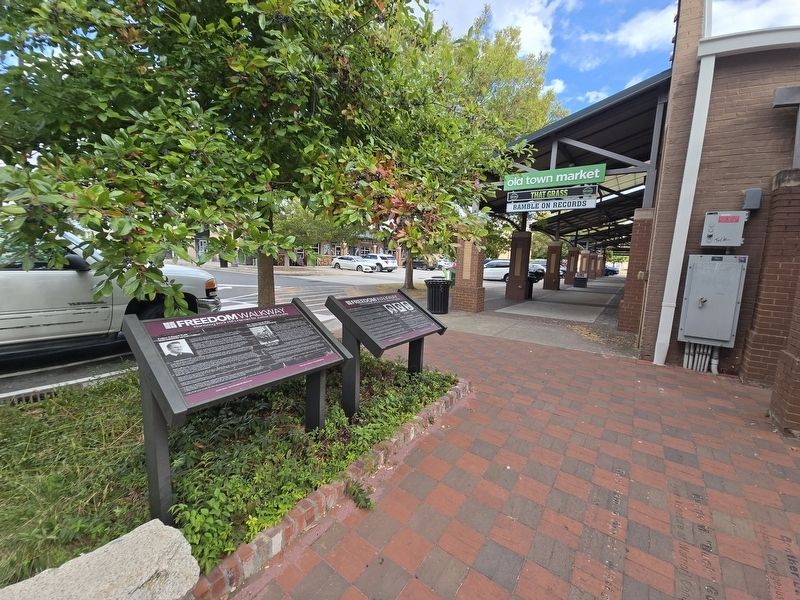
2. Winthrop's Black Pioneers Marker on the right of the two markers
In January 1965, Gladden and Johnson were joined by a third black student. Sue Francis Meriwether, a native of the Charleston area who transferred from Tennessee A & I State University. She joined Gladden and Johnson in their separate housing. The next cohort of Black students would not arrive at Winthrop until 1966.
Of the required to live apart from other students, the three young women did their part to enrich the college's cultural life. Gladden and Meriwether performed as The Supremes and the Winthrop Follies, "which had the campus talking for days." Johnson hosted an R&B show on the campus radio station.
Meriwether became the first Black student to graduate from Winthrop in May 1967 with a degree in Biology. Gladden followed in December of that year with a degree in Biology. Johnson graduated with General Honors and a degree in French in 1968 and was awarded a Fulbright-Hayes fellowship for graduate study in France.
All three went on to successful professional careers. Arnetta Gladden Mackey, Dolores Johnson Hurt and Sue Frances
Photographed by Mark Parker, September 25, 2025
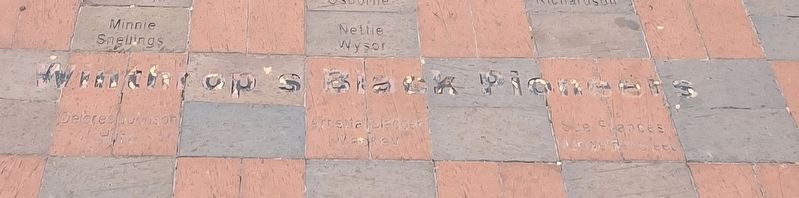
3. Winthrop's Black Pioneers, honored on the Freedom Walkway
Nominate a Local Hero!
Eaah year, one or more local heroes will be honored and celebrated at Freedom Walkway. With the Friendship 9 as a model, the Walkway honors citizens who have fought, either today or in the past, for the cause of greater justice and equality for all.
The Freeedom Walkway Local Heroes Committee accepts nominations of individuals or groups of individuals who have made a significant contribution to the cause of justice and equality for all citizens.
The committee uses the following key criteria for individuals or groups of individuals (organizations are not eligible). These Local Heroes:
a. Live or lived in the Rock Hill/York County area.
b. Played signilicant role through advocacy or actions in promoting equality and justice for all citizens in Rock Hill /York County, and
c. Challenged existing norms and conventions in the community, placing themselves at odds with community leadership and risking their reputations, security, freedom, livelihood or even their lives.
[Captions:]
Arnetta Gladden Mackey Withrop Class of '67
Sue Frances Meriwether Steed Winthrop Class of '67
Delores Johnson Hurt Winthrop Class of '68
www.freedomwalkway.com
Topics. This historical marker is listed in these topic lists: African Americans • Civil Rights • Education • Women. A significant historical year for this entry is 1964.
Location. 34° 55.542′ N, 81° 1.571′ W. Marker is in Rock Hill, South Carolina, in York County. It can be reached from East Main Street west of Hampton Street, on the right when traveling west. This marker is located on the rear side of the East Main Street building, next to a large parking lot shared by local businesses. Touch for map. Marker is at or near this postal address: 141 E Main St, Rock Hill SC 29730, United States of America. Touch for directions.

Regionally, this marker is in the Midlands and in the Olde English District. It is also in the American South and specifically in the Deep South. Globally, it is in North America, the Western Hemisphere, the Western World, and the Anglosphere. Historically, it finds itself in what was once the original Cherokee Nation, the territory of the Mississippian Culture, one of the original Thirteen Colonies, one of the Confederate States of America, and the Antebellum South.
Other nearby markers. At least 8 other markers are within walking distance of this marker: Friendship 9 (here, next to this marker); Freedom Walkway (here, next to this marker); Father Edward Wahl / Rev. James Spratt White (here, next to this marker); Rock Hill's Civil Rights Giant (within shouting distance of this marker); Jail, No Bail! (within shouting distance of this marker); Rock Hill's Sit-in Movement (within shouting distance of this marker); McCrory's Civil Rights Sit-ins / "Friendship Nine" (within shouting distance of this marker); Village of Rock Hill / City of Rock Hill (within shouting distance of this marker). Touch for a list and map of all markers in Rock Hill.
More about this marker. The marker is one of four that is part of the Freedom Walkway, which includes honorees listed on the adjacent paved brickwork, and a large mural displayed in a pocket park between Main Street and the parking lot.
Credits. This page was last revised on September 29, 2025. It was originally submitted on September 26, 2025, by Mark Parker of Hickory, North Carolina. This page has been viewed 63 times since then and 37 times this year. Photos: 1, 2, 3. submitted on September 26, 2025, by Mark Parker of Hickory, North Carolina. • Devry Becker Jones was the editor who published this page.
