
Rock Hill in York County, South Carolina — The American South (South Atlantic)
Friendship 9
Freedom Walkway
| — | Honoring Rock Hill's Heroes for Justice and Equality | — |

Photographed by Mark Parker, September 25, 2025
1. Friendship 9 Marker
On the morning of January 31, 1961, eighteen African American civil rights protesters, most of whom were students at Friendship College, gathered on Main Street in downtown Rock Hill. City police and SLED agents had been notified in advance in case of trouble and were on duty by 8:30 a.m. The protesters, made up of thirteen wand five woman, marched up and down the street carrying protest signs. While the women initially marched along the street, the men went inside McCrory's store. Ten sat down at the lunch counter and refused to leave:
John Alexander Gaines • Thomas Walter Gaither • Clarence Henry Graham • Willie T. "Dub" Massey • Robert Lewis McCollough • Wille Edward McLeod • Charles Edward Taylor • James Frank Wells • David Williamson, Jr. • Mack Cartier Workman
Nine of these men were Friendship College students. Thomas Gaither was not a student; however, he was a resident of Rock Hill and a field secretary for the Congress of Racial Equality (CORE). Around 11:30 a.m., the protestors were arrested and taken to the city jail. The women left the scene shortly after the men were arrested. On February 1, the ten
this page online
After their convictions, the men were quickly given name the "Friendship 9" by the press, and the case became famous nationwide. Other protesters soon adopted the "jail, no bail" strategy initiated by the Friendship 9. Convicted demonstrators across the country began serving their jail sentences rather than paying bail — a monetary penalty which they considered to be subsidizing a system that supported
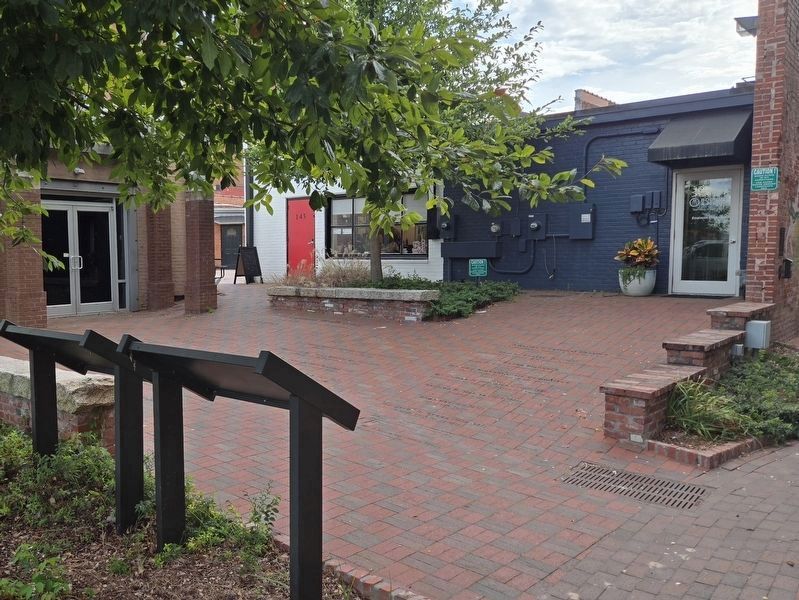
Photographed by Mark Parker, September 25, 2025
2. Rear view of Friendship 9 Marker on the left
Freedom Walkway honorees, including the Friendship 9, are etched into the brickwork in the background. The Freedom Walkway mural is off the photo to the right
On January 28, 2015, the 1961 trespassing convictions for these men were vacated from court records. This important moment in history was distinct from a pardon, which is forgiveness for a crime. The convictions were vacated to signify that they never should have been charged in the first place.
[footer:]
A) Members of the Friendship in jail. B) Members of the Friendship 9, taken after their release from jail. In front, from left, are James Wells, Wille McCleod and Thomas Gaither. In back, from left, are Clarence Graham, Dub Massey and Mary and David Williamson, Jr. C) Historic marker on Main Street. D) There are no known images of the Friendship 9's sit-in, but this image shows one of the earlier 1960 protests at McCrory's lunch counter. E) Visitors to the prison camp where the Friendship 9 were serving their sentence during February 1961. F) Protesters sit at the Woolworth lunch counter on February 12, 1960. This was the first sit-in in Rock Hill. Photos courtesy of the Culture & Heritage Museums.
Topics.

Photographed by Mark Parker, September 25, 2025
3. Friendship 9 Marker on the right in front of the parking lot
Location. 34° 55.544′ N, 81° 1.57′ W. Marker is in Rock Hill, South Carolina, in York County. It can be reached from East Main Street west of Hampton Street, on the right when traveling west. This marker is situated on the rear side of the East Main Street building, next to a large parking lot shared by local businesses. Touch for map. Marker is at or near this postal address: 141 E Main St, Rock Hill SC 29730, United States of America. Touch for directions.

Regionally, this marker is in the Midlands and in the Olde English District. It is also in the American South and specifically in the Deep South. Globally, it is in North America, the Western Hemisphere, the Western World, and the Anglosphere. Historically, it finds itself in what was once the original Cherokee Nation, the territory of the Mississippian Culture, one of the original Thirteen Colonies, one of the Confederate States of America, and the Antebellum South.
Other nearby markers. At least 8 other
Photographed by Mark Parker, September 25, 2025
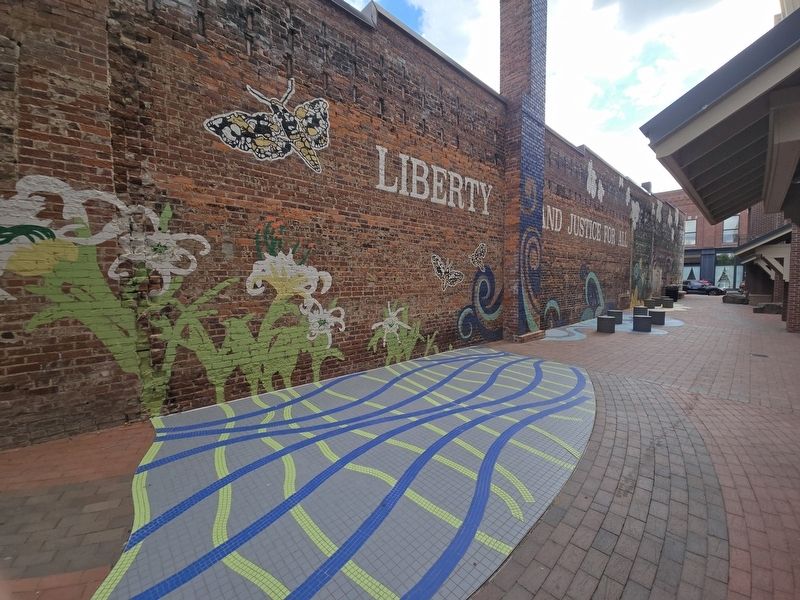
4. Freedom Walkway mural leading from Friendship 9 Marker to East Main Street
More about this marker. It is one of four markers incorporated into the Freedom Walkway along the brick sidewalk in this parking area. Nearby, the Friendship 9 group is also honored with an engraving on the brickwork of the Walkway. A large Freedom Walkway mural is prominently displayed in the pocket park that connects East Main Street to the parking lot.
Related marker. Click here for another marker that is related to this marker.
Credits. This page was last revised on September 28, 2025. It was originally submitted on September 25, 2025, by Mark Parker of Hickory, North Carolina. This page has been viewed 56 times since then and 23 times this year. Last updated on September 26, 2025, by Mark Parker of Hickory, North Carolina. Photos: 1, 2, 3, 4. submitted on September 25, 2025, by Mark Parker of Hickory, North Carolina. • Devry Becker Jones was the editor who published this page.
