Fanshawe in London in Middlesex County, Ontario — Central Canada (North America)
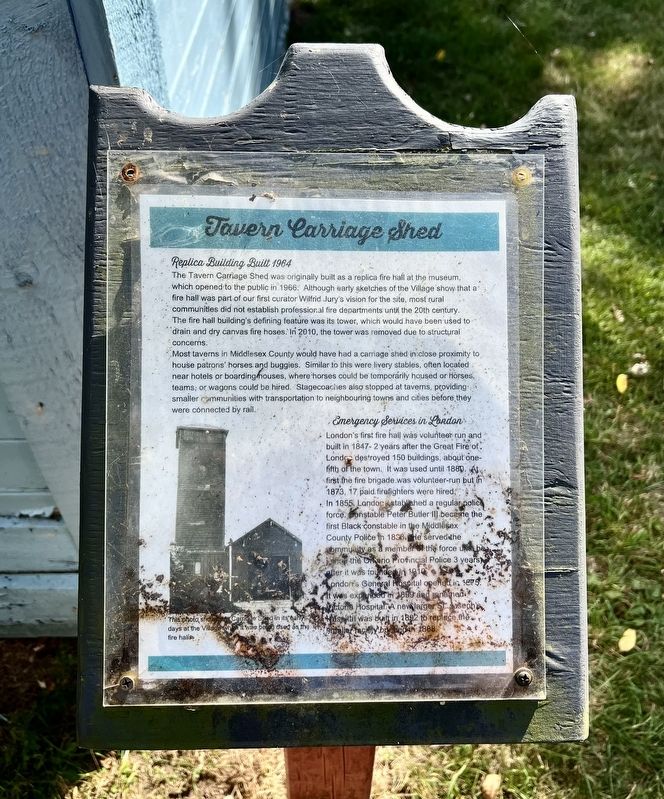
Tavern Carriage Shed
Photographed by Tim Boyd, September 14, 2025
1. Tavern Carriage Shed Marker
Replica Building Built 1964
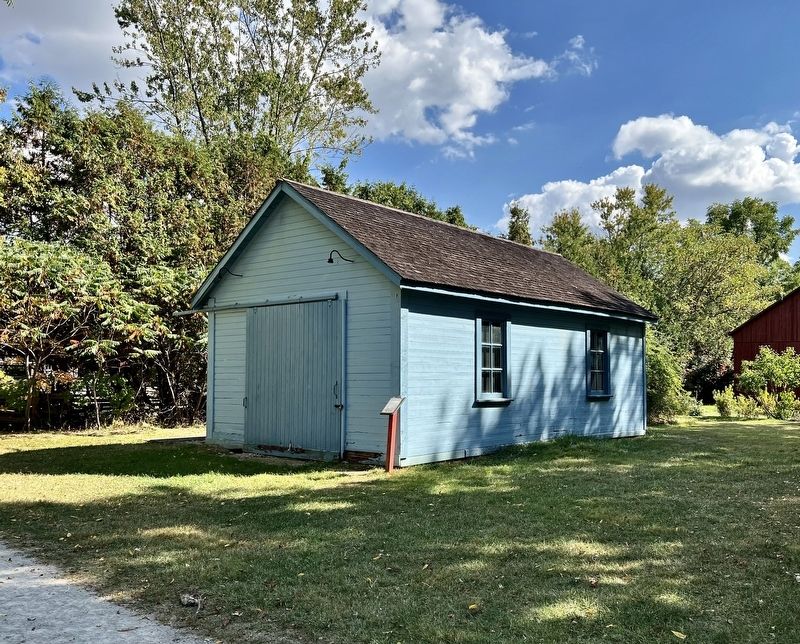
The Tavern Carriage Shed was originally built as a replica fire hall at the museum, which opened to the public in 1966. Although early sketches of the Village show that a fire hall was part of our first curator Wilfrid Jury's vision for the site, most rural communities did not establish professional fire departments until the 20th century. The fire hall building's defining feature was its tower, which would have been used to drain and dry canvas fire hoses. In 2010, the tower was removed due to structural concerns.
Most taverns in Middlesex County would have had a carriage shed in close proximity to house patrons' horses and buggies. Similar to this were livery stables, often located near hotels or boarding houses, where horses could be temporarily housed or horses, teams, or wagons could be hired. Stagecoaches also stopped at taverns, providing smaller communities with transportation to neighbouring towns and cities before they were connected by rail.
Emergency Services in London
London's first fire hall was volunteer run and built in 1847- 2 years after the Great Fire of London destroyed
this page online
In 1855, London established a regular police force. Constable Peter Butler III became the first Black constable in the Middlesex County Police in 1888. He served the community as a member of the force until he joined the Ontario Provincial Police 3 years after it was founded in 1910. London’s General Hospital opened in 1875. It was expanded in 1899 and renamed the Victoria Hospital. A new larger St. Jospeh’s Hospital was built in 1892 to replace the smaller facility opened in 1888.
Topics. This historical marker is listed in these topic lists: African Americans • Law Enforcement • Science & Medicine. A significant historical year for this entry is 1964.
Location. 43° 3.319′ N, 81° 10.757′ W. Marker is in London, Ontario, in Middlesex County. It is in Fanshawe. It can be reached from Fanshawe Park Road East. The marker is on the grounds of the Fanshawe Pioneer Village, accessibility subject to its operating hours and requiring paid admission. The Village is accessed
Photographed by Tim Boyd, September 14, 2025
2. Tavern Carriage Shed Marker

Regionally, this marker is in the Southwest Ontario Area and in Southwestern Ontario. It is also in Central Canada. Globally, it is in North America, the Western Hemisphere, the Western World, and the Anglosphere. Historically, it finds itself in what was once a British colony, the Viceroyalty of New France, the Haudenosaunee (Iroquois) Confederacy, and Rupert’s Land.
Other nearby markers. At least 8 other markers are within walking distance of this marker: Mount Moriah Masonic Lodge (a few steps from this marker); Lochaber Church (a few steps from this marker); Corbett Tavern (a few steps from this marker); Lochaber Carriage Shed (within shouting distance of this marker); Caverhill Stable (within shouting distance of this marker); Dr. Jones’ House: (within shouting distance of this marker); Purple Hill Loyal Orange Lodge (within shouting distance of this marker); Dr. Jones House (within shouting distance of this marker). Touch for a list and map of all markers in London.
Credits. This page was last revised on September 27, 2025. It was originally submitted on September 27, 2025, by Tim Boyd of Hamilton, Ontario. This page has been viewed 38 times since then and 15 times this year. Photos: 1, 2. submitted on September 27, 2025, by Tim Boyd of Hamilton, Ontario. • Andrew Ruppenstein was the editor who published this page.
