Down Town in Springfield in Sangamon County, Illinois — The American Midwest (Great Lakes)
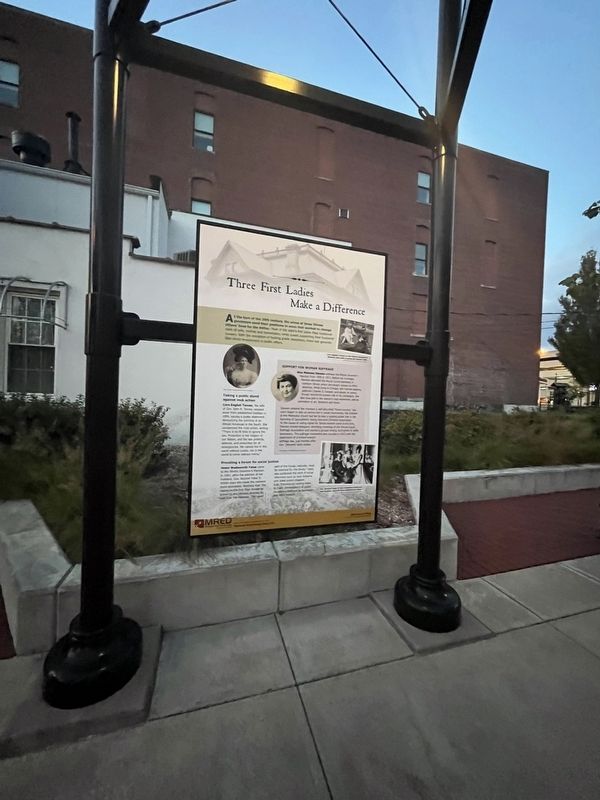
Three First Ladies Make a Difference

Photographed by Thomas Smith, September 22, 2025
1. Three First Ladies Make a Difference Marker
At the turn of the 20th century, the wives of three Illinois governors used their positions in way that worked to change others' lives for the better. Most of the state's first ladies filled traditional roles of wife, mother and homemaker, while quietly supporting their husbands careers. With the exception of hosting public receptions, there was generally little direct involvement in public affairs.
Taking a public stand against mob action
Cora English Tanner, the wife of Gov. John R. Tanner, stepped away from established tradition in 1899, issuing a public statement denouncing the lynching of an African American in the South. She condemned the mob action, writing: "There is no fit time to ignore the law. Protection is the religion of our Nation, and the law protects, defends, and prescribes for all emergencies. We cannot live in this world without justice, nor in the world to come without mercy.
Support for Woman Suffrage
Bina Maloney Deneen oversaw the Illinois Governor's Mansion from 1905 to 1913. Before her marriage, Deneen attended the Mount Carroll Seminary in northern Illinois where she taught classes
this page online
Deneen entered the mansion a self-described "home woman," but soon began to play an active role in social movements. Her interest in the Methodist church led her to take a leading public role in the founding of Springfield's Young Woman's Christian Association. As the cause of voting rights for Illinois women came to the fore, Deneen hosted delegates attending meetings of the Illinois Equal Suffrage Association and women's groups visiting Springfield to lobby lawmakers. The suffrage movement won success in 1913 with the enactment of a limited woman suffrage law, just months after Gov. Deneen's term ended.
Providing a forum for social justice
Helen Wadsworth Yates came to the Illinois Governor's Mansion in 1901, after the election of her husband, Gov. Richard Yates II. Within days she made the mansion more accessible, directing that "the rooms on the first
Photographed by Thomas Smith, September 22, 2025
2. Three First Ladies Make a Difference Marker
upper picture part of the house, naturally, must be reserved for the family." Yates also publicized the work of social reformers such as Jane Addams and Joliet prison chaplain S.W. Thornton by inviting them to make presentations at public receptions attended by lawmakers and other leaders.
Topics. This historical marker is listed in these topic lists: Charity & Public Work • Civil Rights • Women. A significant historical year for this entry is 1899.
Location. 39° 47.835′ N, 89° 38.942′ W. Marker is in Springfield, Illinois, in Sangamon County. It is in Down Town. It is at the intersection of S. Fifth Street and E. Jackson Street, on the left when traveling south on S. Fifth Street. Touch for map. Marker is at or near this postal address: 522 S 5th Street, Springfield IL 62701, United States of America. Touch for directions.

Regionally, this marker is in Central Illinois. It is also in the American Midwest and in the Corn Belt. Globally, it is in North America, the Western Hemisphere, the Western World, and the Anglosphere. Historically, it finds itself in what was once the territory of the Mississippian Culture and also the Northwest Territory.
Other nearby markers. At least 8 other markers are within walking distance of this marker: The 21-Star Flag (here, next to this marker); "An Agreeable Assemblage of Dwelling Houses" (here, next to this marker); Architect of the People's House (here, next to this marker); A Place of Many Peoples (here, next to this marker); "We Are American Citizens" (here, next to this marker); "Let Us Own Ourselves, Our Earning, Our Genius" (here, next to this marker); Fair Housing for All (here, next to this marker); Aiding Orphans and Widows (here, next to this marker). Touch for a list and map of all markers in Springfield.
Credits. This page was last revised on October 2, 2025. It was originally submitted on October 1, 2025, by Thomas Smith of Waterloo, Ill. This page has been viewed 68 times since then and 29 times this year. Photos: 1, 2. submitted on October 1, 2025, by Thomas Smith of Waterloo, Ill. • Andrew Ruppenstein was the editor who published this page.
