Near Gaffney in Cherokee County, South Carolina — The American South (South Atlantic)
A Colonial Fortification
Fort Thicketty
| — | The Liberty Trail S.C. | — |

Photographed by Mark Parker, October 5, 2025
1. A Colonial Fortification Marker
(Preface)
The Regulators
The Regulators, like those who fought at Fort Thicketty, were angered by the colonial government's lenient approach to law and order on the frontier, so they took on crime and injustice themselves. In 1771, North Carolina Regulators refused to pay taxes for such poor representation, prompting Royal Governor Tryon to call in the militia. North Wind Picture Archives / Alamy Stock Photo
Fort Thicketty was designed as a blockhouse—a one-room fortification with loopholes in the walls that allowed defenders to fire in all directions. In colonial times, it likely featured a protective stockade, or a barrier of wooden planks or stakes, which enabled the structure to withstand enemy attacks. This defensive work was initially named Fort Anderson after Captain David Anderson, whose father owned a 300-acre farm on the land. The fort was later renamed "Thicketty" for the dense vegetation surrounding the area and a nearby creek of the same name.
Members of the local community probably assisted in constructing the blockhouse by reinforcing an existing building, such as a house or barn. In that era it
this page online
In addition to serving as a refuge for settlers sheltering from Cherokee raids, the fort played a role in the Regulator Movement of the 1760s. The Regulators were vigilantes who banded together in response to a wave of crime and lack of government support that followed the Cherokee War (1759-1761). Lacking local courts and frustrated by the colony's judicial system, Regulators took the law into their own hands. Here, 80 Regulators successfully fought off more than 300 outlaws. A decade later, the fort remained in good repair and was considered by the occupying Loyalists to be impregnable to arrows,as well as to musket and rifle fire.
Blockhouse Defensive Work
South Carolina plantation fort example from 1670-1775. Richard C. Meehan Jr.
Erected 2025 by American Battlefield Trust, South Carolina Battleground Preservation Trust, 250th Anniversary South Carolina American Revolution, CHAPS.
Topics. This historical marker is listed in these topic lists:

Photographed by Mark Parker, October 5, 2025
2. A Colonial Fortification Marker at the end of the trail next to Fort Thicketty
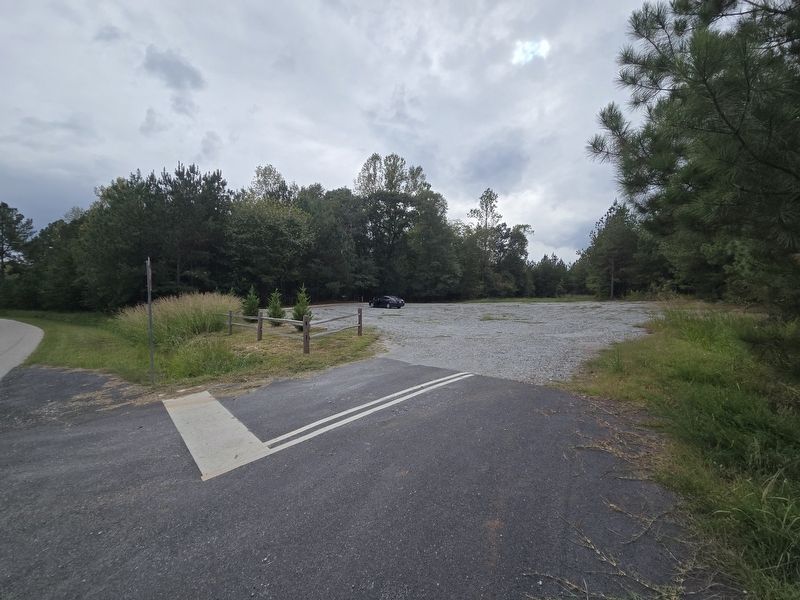
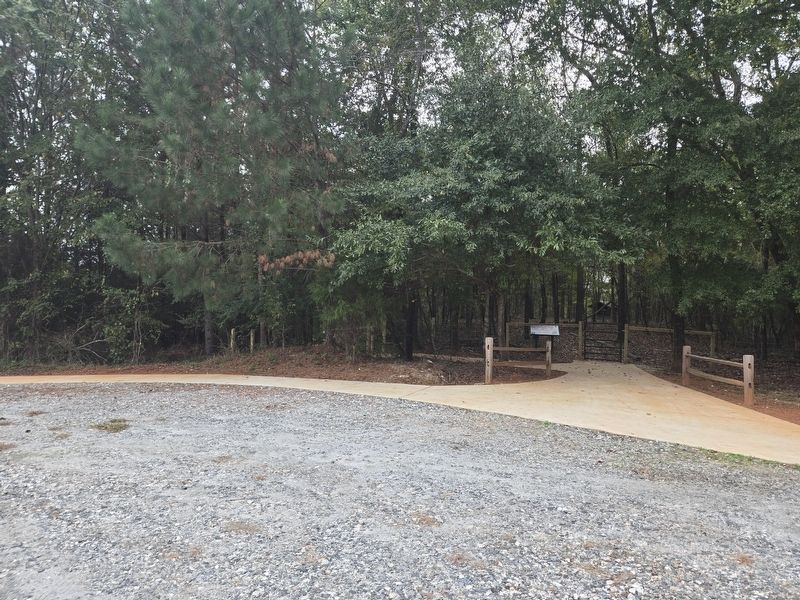
Location. 34° 59.065′ N, 81° 42.716′ W. Marker is near Gaffney, South Carolina, in Cherokee County. It can be reached from 184 State Rd S-11-584 (State Road S-11-5) 0.2 miles south of Goucher School Road, on the right when traveling south. Look for a gravel parking lot on your right. From there, take the paved walk down the trail to the fort remnants. Touch for map. Marker is at or near this postal address: 184 State Rd S-11-584, Gaffney SC 29340, United States of America. Touch for directions.

Regionally, this marker is in Upstate and in the Foothills. It is also in the American South, specifically in the Deep South, in Appalachia, and specifically in Southern Appalachia. Globally, it is in North America, the Western Hemisphere, the Western World, and the Anglosphere. Historically, it finds itself in what was once the original Cherokee Nation, the territory of the Mississippian Culture, one of the original Thirteen Colonies, one of the Confederate States of America, and the Antebellum
Photographed by Mark Parker, October 5, 2025
3. Gravel parking lot off State Road S-11-584. Follow the paved trail to the marker
Other nearby markers. At least 8 other markers are within 5 miles of this marker, measured as the crow flies: Road to Kings Mountain and Cowpens (a few steps from this marker); Thicketty Fort Project (a few steps from this marker); A Bloodless Victory (within shouting distance of this marker); A Loyalist Base (about 300 feet away, measured in a direct line); Welcome to Fort Thicketty (about 300 feet away); Goucher Baptist Church (approx. 0.9 miles away); Whig Hill (approx. 3.6 miles away); Nuckolls-Jefferies House (approx. 4.9 miles away). Touch for a list and map of all markers in Gaffney.
Also see . . . Fort Thicketty. The Liberty Trail
Fort Thicketty—officially known as Fort Anderson—was built around the time of the First Cherokee War (1759–1761) by settlers from the Grindal Shoals community. Named for nearby Thicketty Creek, the fort served as a refuge during conflicts with the Cherokee and Muscogee, whose resistance to English encroachment escalated after years of broken alliances and violence. By the Revolutionary War, Fort Thicketty had become a Loyalist stronghold, used as a base to raid nearby Patriot farms(Submitted on October 5, 2025, by Mark Parker of Hickory, North Carolina.)for food and supplies. After Charleston fell to the British in 1780, Captain Patrick Moore garrisoned nearly 100 Loyalist troops here, believing the fort to be secure behind its stockade and sharpened stakes.Photographed by Mark Parker, October 5, 20254. Start of the trail at the parking lot. Follow it to the end to reach A Colonial Fortification Marker
Credits. This page was last revised on October 8, 2025. It was originally submitted on October 5, 2025, by Mark Parker of Hickory, North Carolina. This page has been viewed 157 times since then and 95 times this year. Photos: 1, 2, 3, 4. submitted on October 5, 2025, by Mark Parker of Hickory, North Carolina. • Bernard Fisher was the editor who published this page.
