Near Huff in Morton County, North Dakota — The American Midwest (Upper Plains)
The Cache Pit and Village Subsistence
Huff Indian Village State Historic Site

Photographed by Barry Swackhamer, July 21, 2025
1. The Cache Pit and Village Subsistence Marker
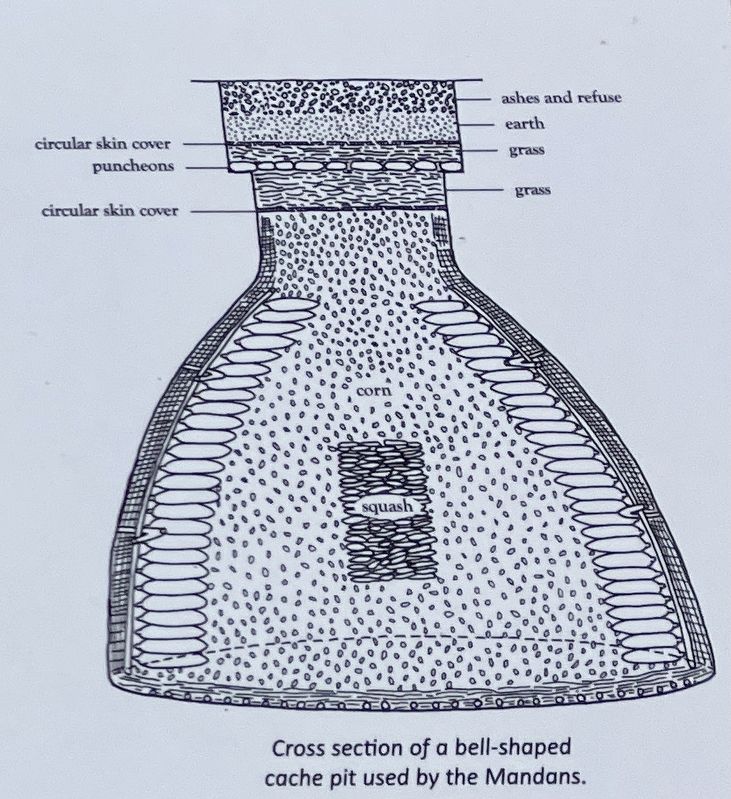
Captions: (bottom left) Photograph of Test unit A and illustration showing storage pit profile; (upper center) Model of a cache pit; (upper right) Cross section of a bell-shaped cache pit use by the Mandans.; (bottom right) All sediment excavated by approximately 6 inch (15 cm) levels was processed over 16-per-inch mesh screen. After water screening, any remaining material on the screen was lauded out to dry on canvas cots. All of this material was processed, sorted, and analyzed in the archaeology lab..
The drawing to the left shows a cross section through the pit beneath the ground at this location, This pit was typical in size and capable of holding 34 bushels. The estimated 1,700 storage pits in Huff Village reflect a combined storage capacity of 56,000 bushels - used over the life of the village. The pit cross section records the history of this feature. When originally excavated, soil was thrown from the pit onto the surrounding ground surface. Sometime during use, one edge of the pit caved in. Later,
this page online
Two cache pits were partially excavated in 1999. Archaeologists used fine-screening (see photo at right) to recover a sample of village subsistence remains (mostly animal bones and charred botanical remains). This work was successful yielding many hundreds of identified bones, as well as charred corn suitable for radiocarbon dating. The fine-screen recovery revealed a broad-based use of wild fruit and seed-producing plants. More than 120 pounds of animal bones were found in the trash.
Topics. This historical marker is listed in these topic lists: Anthropology & Archaeology • Indigenous Peoples and Communities.
Location. 46° 37.091′ N, 100° 38.557′ W. Marker is near Huff, North Dakota, in Morton County. It can be reached from State Highway 1806 near 11th Avenue, on the right when traveling north. Touch for map. Marker is at or near this postal address: 5525 Highway 1806, Mandan ND 58554, United States of America. Touch for directions.

Regionally, this

Photographed by Barry Swackhamer, July 21, 2025
2. The Cache Pit and Village Subsistence Marker (detail)
illustration showing storage pit profile.
Other nearby markers. At least 8 other markers are within walking distance of this marker: Animal Remains Found in Cache Pits (here, next to this marker); Remote Sensing (within shouting distance of this marker); Non-Destructive Ways to See Underground (within shouting distance of this marker); Plaza and Ceremonial Lodge (within shouting distance of this marker); Archaeological Excavations of Houses (about 300 feet away, measured in a direct line); a different marker also named Archaeological Excavations of Houses (about 300 feet away); Village Fortifications and Human Conflict (about 300 feet away); a different marker also named Village Fortifications and Human Conflict (about 300 feet away). Touch for a list and map of all markers in Huff.
Photographed by Barry Swackhamer, July 21, 2025
3. The Cache Pit and Village Subsistence Marker (detail)
Cross section of a bell-shaped cache pit used by the Mandans.;

Photographed by Barry Swackhamer, July 21, 2025
4. The Cache Pit and Village Subsistence Marker

Photographed by Barry Swackhamer, July 21, 2025
5. The Cache Pit and Village Subsistence Marker
Credits. This page was last revised on October 10, 2025. It was originally submitted on October 9, 2025, by Barry Swackhamer of Brentwood, California. This page has been viewed 85 times since then and 21 times this year. Photos: 1. submitted on October 9, 2025, by Barry Swackhamer of Brentwood, California. 2, 3, 4, 5. submitted on October 10, 2025, by Barry Swackhamer of Brentwood, California.
