Cannonville in Garfield County, Utah — The American Mountains (Southwest)
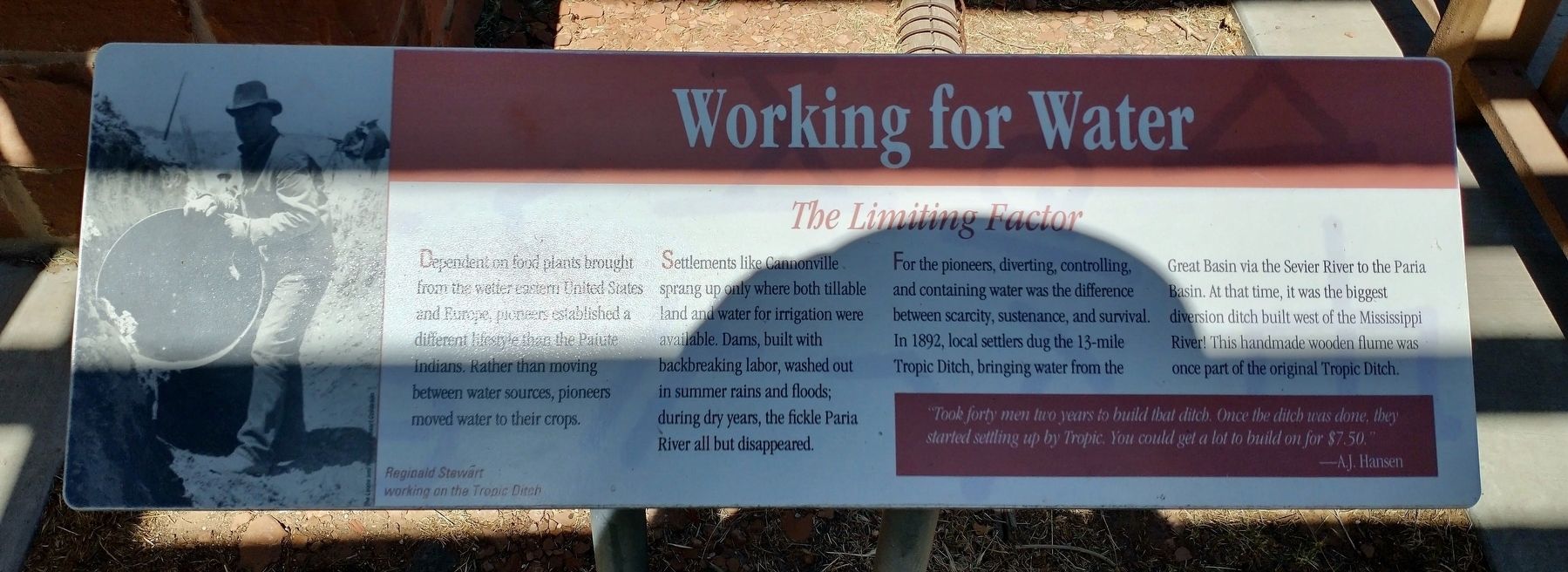
Working for Water
The Limiting Factor
Photographed by Tom Bosse, June 12, 2025
1. Working for Water Marker
Dependent on food plants brought from the wetter eastern United States and Europe, pioneers established a different lifestyle than the Paiute Indians. Rather than moving between water sources, pioneers moved water to their crops. Settlements like Cannonville sprang up only where both tillable land and water for irrigation were available. Dams, built with backbreaking labor, washed out in summer rains and floods; during dry years, the fickle Paria River all but disappeared.
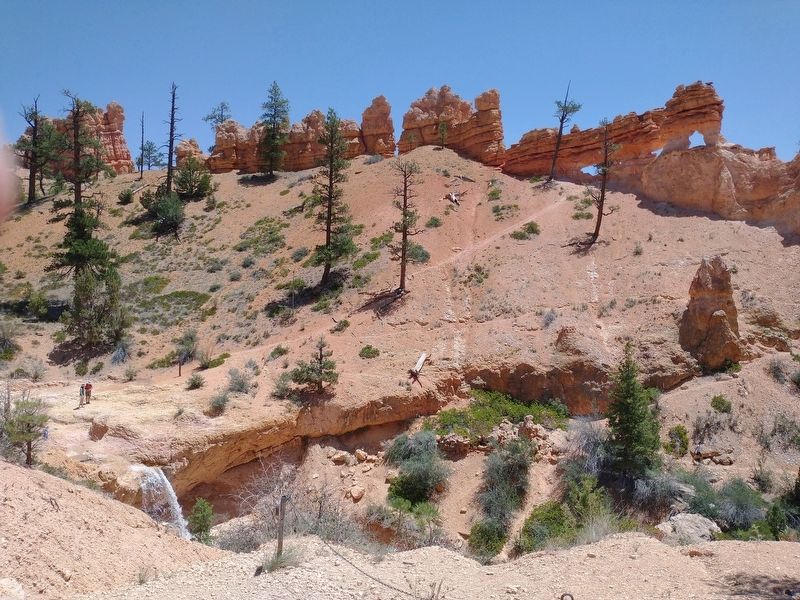
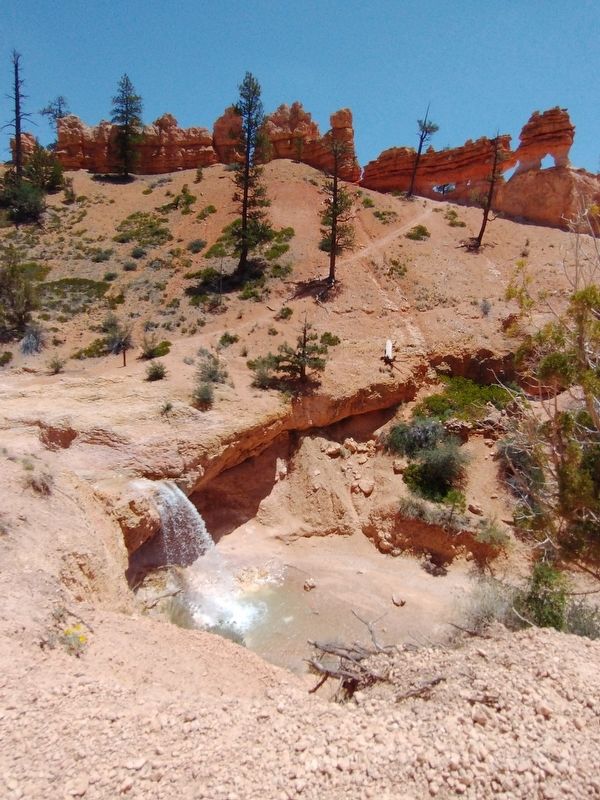
For pioneers, diverting, controlling, and containing water was the difference between scarcity, sustenance, and survival. In 1892, local settlers dug the 13-mile Tropic Ditch, brining water from the Great Basin via Sevier River to the Paria Basin. At that time, it was the biggest diversion ditch built west of the Mississippi River! This handmade wooden flume was once part of the original Tropic Ditch.
[Insert]: "Took forty men two years to build that ditch. Once the ditch was done, they started settling up by the Tropic. You could get a lot to build on for $7.50". - A.J. Hansen
[Caption]: Reginald Stewart working on the Tropic Ditch
Topics and series.
this page online
Location. 37° 34.028′ N, 112° 3.268′ W. Marker is in Cannonville, Utah, in Garfield County. It can be reached from the intersection of West Center Street and Main Street / Kodachrome Road, on the right when traveling west. Marker is located at the Cannonville Visitor Center. Touch for map. Marker is at or near this postal address: 10 W Center St, Cannonville UT 84718, United States of America. Touch for directions.

Regionally, this marker is in Canyon Country and specifically in Color Country. It is also in the American Mountain West, on the Colorado Plateau, and at the Four Corners. Globally, it is in North America, the Western Hemisphere, the Western World, and the Anglosphere. Historically, it finds itself in what was once New Spain and also Mexico’s Alta California.

Other nearby markers. At least 8 other markers are within walking distance of this marker: A Glass of Water Was a Load of Work

Photographed by Tom Bosse, June 12, 2025
2. Working for Water Marker
Marker is on the left.

Photographed by Tom Bosse, June 12, 2025
3. Tropic Ditch
Photographed by Tom Bosse, June 12, 2025
4. Tropic Ditch Falls
Photographed by Tom Bosse, June 12, 2025
5. Tropic Ditch Falls
Credits. This page was last revised on October 15, 2025. It was originally submitted on October 12, 2025, by Tom Bosse of Jefferson City, Tennessee. This page has been viewed 53 times since then and 14 times this year. Photos: 1, 2, 3, 4, 5. submitted on October 12, 2025, by Tom Bosse of Jefferson City, Tennessee. • Andrew Ruppenstein was the editor who published this page.
