Parks in St. Martin Parish, Louisiana — The American South (West South Central)
Welcome to Parks
Photographed by Cajun Scrambler, September 12, 2025
1. Welcome to Parks Marker
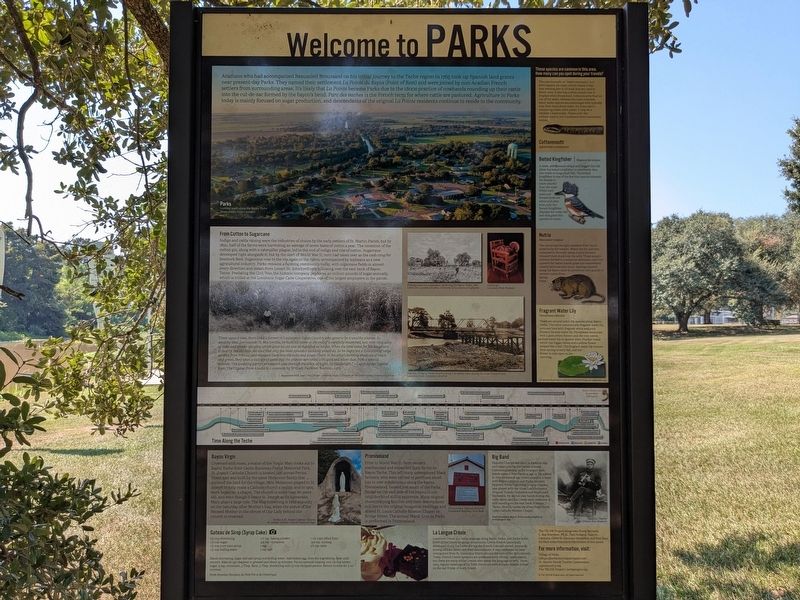
Acadians who had accompanied Beausoleil Broussard on his initial journey to the Teche region in 1765 took up Spanish land grants near present-day Parks. They named their settlement La Pointe du Repos (Point of Rest) and were joined by non-Acadian French settlers from surrounding areas. It's likely that La Pointe became Parks due to the 1800s practice of cowhands rounding up their cattle into the cul-de-sac formed by the bayou's bend. Parc des vaches is the French term for where cattle are pastured. Agriculture in Parks today is mainly focused on sugar production, and descendants of the original La Pointe residents continue to reside in the community.
From Cotton to Sugarcane
Indigo and cattle raising were the industries of choice by the early settlers of St. Martin Parish, but by 1850, half of the farms were harvesting an average of seven bales of cotton a year. The invention of the cotton gin, along with a caterpillar plague, led to the end of indigo and rise of cotton. Sugarcane developed right alongside it, but by the start of World War II, corn had taken over as the cash crop for livestock feed. Sugarcane rose
this page online
"Once upon a time, there lived a farmer in Louisiana's Cajun Country who grew to be a wealthy planter. So wealthy that, just outside St. Martinville, he built his home at the end of a carefully measured, two-mile-long alley of oaks and pines-an alley which grew as old and as dignified as he did. When the time came for his daughters to marry, the old man decided that only the most splendid wedding would do. So he imported a collection of large spiders from France, and released them into the oaks and pines. There, in the alley's looming shadows of black and green, they spun a canopy of webs that the planter sprinkled with gold and silver dust from a special bellows. The wedding party's procession was through the alley, at night, by candlelight."
Photographed by Cajun Scrambler, September 12, 2025
2. Welcome to Parks Marker
Bayou Virgin
Crowned with roses, a statue of the Virgin Mary looks out to Bayou Teche from Cecile Rousseau Poche Memorial Park. St. Joseph Catholic Church is located just across Periou Street and was built by the same Melancon family that donated the land for the village. Mrs. Melancon prayed to St. Joseph to help make a Catholic church a reality, and in 1905 work began on a chapel. The church is more than 80 years old, and even though it bears St. Joseph as its namesake, Mary plays a large role. The May Crowning is held annually on the Saturday after Mother's Day, when the statue of the Blessed Mother in the shrine of Our Lady behind the church is crowned.
Gateau de Sirop (Syrup Cake)
1/3 cup shortening
1/3 cup sugar
1/3 cup pure cane syrup
1/3 cup boiling water
1/2 tsp. baking powder
3/4 tsp. cinnamon
1 1/2 cups sifted flour
3/4 tsp. nutmeg
1/2 tsp. soda
1 egg
1 tsp. salt
Blend shortening, sugar and add syrup and boiling water. Add beaten egg, then dry ingredients. Beat until smooth. Bake (at 350 degrees) in greased
Photographed by Cajun Scrambler, September 12, 2025
3. Welcome to Parks Marker
Promiseland
Prior to World War II, farm owners mechanized and expanded their farms on Bayou Teche. This left many unemployed black farmers, who were invited to purchase small lots in new subdivisions along the bayou. Promiseland, located just south of the Parks Bridge on the east side of the bayou, is one neighborhood still in existence. Many original sharecropping families and their descendants still live in the original bungalow dwellings and attend St. Louis Catholic Mission Chapel on Bridge Street. The annual Mardi Gras de Parks is performed in Promiseland.
La Langue Créole
Louisiana Creole is a living language along Bayou Teche, and Parks is the heart of the Creole language community. Creole French historically developed along the Teche during the French Colonial period, primarily among African slaves and their descendants. It was reinforced by later immigrants from St. Domingue (Haiti) around the turn of the 19th century. Today, French Creole speakers are predominantly African descendants, but there are many white Creoles who speak the language as well. Since 2013, regular meetings of La Table Creole are held at Parks Middle School on the last Friday of every month.
Big Band
Hypolite Charles was born in Parks in 1891 and began playing the cornet (a brass instrument similar to the trumpet) with bands around New Iberia at age 15. He moved to New Orleans at age 17 and played in a band with fellow cornetist and Parks resident Hypolite Potier beginning in 1909. Charles also played with the Silver Leaf Orchestra, Original Tuxedo Orchestra and Maple Leaf Orchestra. He led his own bands during the early 1920s, and his Creole-style residence is still standing on the east bank of Bayou Teche, directly across the street from the St. Louis Catholic Mission Chapel.
Find a complete Bayou Teche music playlist at techeproject.org!
The TECHE Project recognizes Shane Bernard, C. Ray Brassieur, Ph.D., Patti Holland, Tami St. Germain, Chloé St. Germain-Vermillion and Erin Bass for their contributions to the content of this panel.
For more information, visit:
Village of Parks villageofparks.municipalimpact.com St. Martin Parish Tourist Commission cajuncountry.org The TECHE Project | techeproject.org
Erected 2021 by The TECHE Project.
Topics. This historical marker is listed in these topic lists: Parks & Recreational Areas • Settlements & Settlers • Waterways & Vessels. A significant historical year for this entry is 1765.
Location. 30° 12.855′ N, 91° 49.716′ W. Marker is in Parks, Louisiana, in St. Martin Parish. It is on Melancon Street near Periou Street. Touch for map. Marker is in this post office area: Saint Martinville LA 70582, United States of America. Touch for directions.

Regionally, this marker is in Louisiana’s Acadiana — Cajun Country and specifically in Bayou Country. It is also in the American South, specifically in the Deep South, and on the Gulf Coast. Globally, it is in North America, a Gulf of Mexico state, the Western Hemisphere, the Western World, and the Anglosphere. Historically, it finds itself in what was once New Spain, Acadia, the territory of the Mississippian Culture, the Louisiana Purchase, one of the Confederate States of America, and the Antebellum South.
Other nearby markers. At least 8 other markers are within 6 miles of this marker, measured as the crow flies: American Alligator (approx. 4.3 miles away); Wetlands (approx. 4.4 miles away); Lake Martin (approx. 4.4 miles away); The Pellerin-Chauffe House (approx. 4½ miles away); Bayou Teche (approx. 5.3 miles away); Maison Olivier (approx. 5.3 miles away); The Valery Thibodeaux House (approx. 5½ miles away); Birthplace of Bishop Jules Jeanmard (approx. 5.9 miles away).
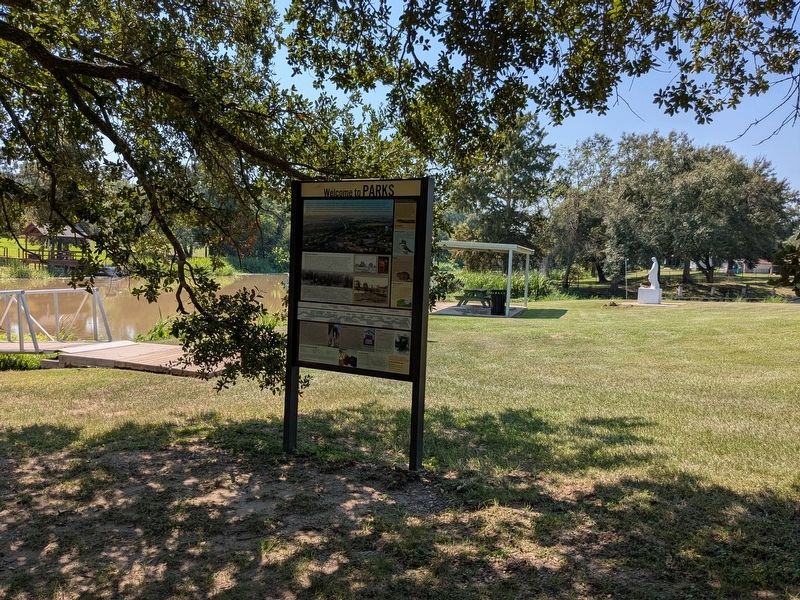
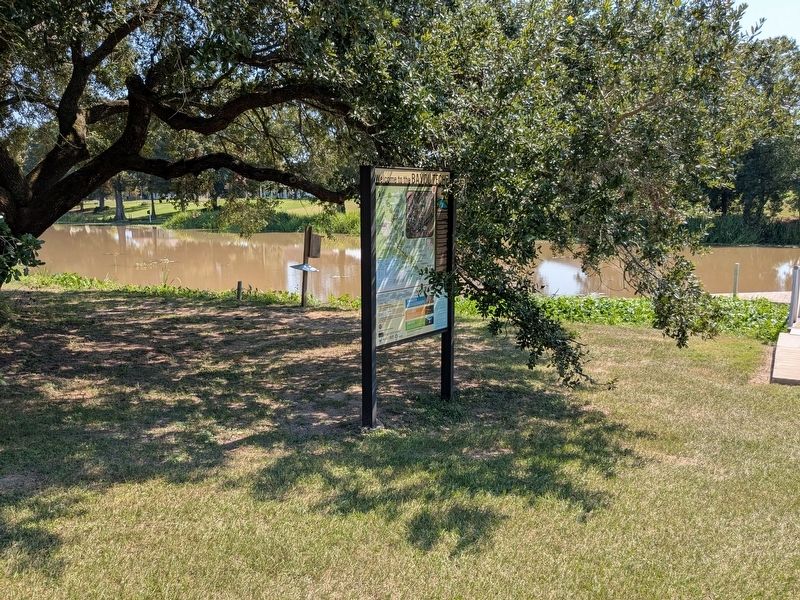
More about this marker. Located at the Parks Canoe/Kayak launch site, in the Cecil R. Poche Memorial Park.
Also see . . . Official Teche Project website. (Submitted on October 14, 2025, by Cajun Scrambler of Assumption, Louisiana.)
Credits. This page was last revised on October 14, 2025. It was originally submitted on October 14, 2025, by Cajun Scrambler of Assumption, Louisiana. This page has been viewed 73 times since then and 31 times this year. Photos: 1, 2, 3. submitted on October 14, 2025, by Cajun Scrambler of Assumption, Louisiana.
