Natchez in Adams County, Mississippi — The American South (East South Central)
Natchez Civil Rights Movement — 1965 — Pivotal Year
Natchez Trails
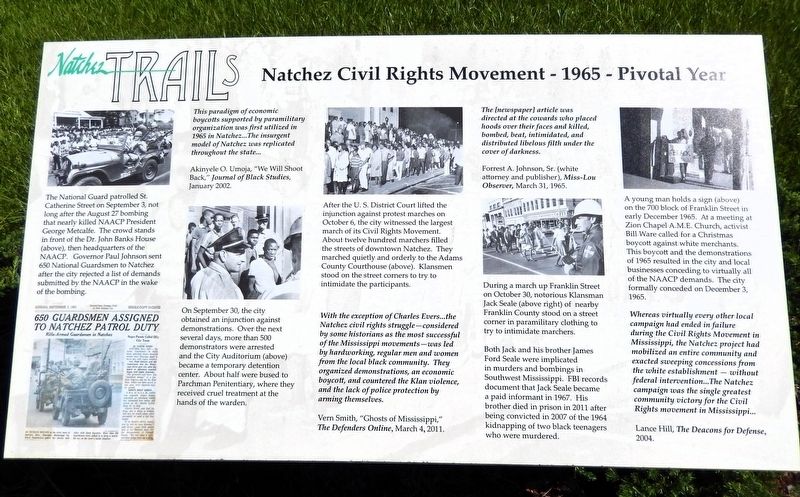
Photographed by Cosmos Mariner, June 24, 2025
1. Natchez Civil Rights Movement — 1965 — Pivotal Year Marker
The National Guard patrolled St. Catherine Street on September 3, not long after the August 27 bombing that nearly killed NAACP President George Metcalfe. The crowd stands in front of the Dr. John Banks House (above), then headquarters of the NAACP. Governor Paul Johnson sent 650 National Guardsmen to Natchez after the city rejected a list of demands submitted by the NAACP in the wake of the bombing.
This paradigm of economic boycotts supported by paramilitary organization was first utilized in 1965 in Natchez... The insurgent model of Natchez was replicated throughout the state...
—Akinyele O. Umoja, “We Will Shoot Back,” Journal of Black Studies, January 2002.
On September 30, the city obtained an injunction against demonstrations. Over the next several days, more than 500 demonstrators were arrested and the City Auditorium (above) became a temporary detention center. About half were bused to Parchman Penitentiary, where they received cruel treatment at the hands of the warden.
After the U. S. District Court lifted the injunction against protest marches on October 6, the city witnessed the largest march of its Civil Rights
this page online
With the exception of Charles Evers... the Natchez civil rights struggle — considered by some historians as the most successful of the Mississippi movements — was led by hardworking, regular men and women from the local black community. They organized demonstrations, an economic boycott, and countered the Klan violence, and the lack of police protection by arming themselves.
—Vern Smith, “Ghosts of Mississippi,” The Defenders Online, March 4, 2011.
The [newspaper] article was directed at the cowards who placed hoods over their faces and killed, bombed, beat, intimidated, and distributed libelous filth under the cover of darkness.
—Forrest A. Johnson, Sr. (white attorney and publisher), Miss-Lou Observer, March 31, 1965.
During a march up Franklin Street on October 30, notorious Klansman Jack Seale (above right) of nearby Franklin County stood on a street corner in paramilitary clothing to try to intimidate marchers.
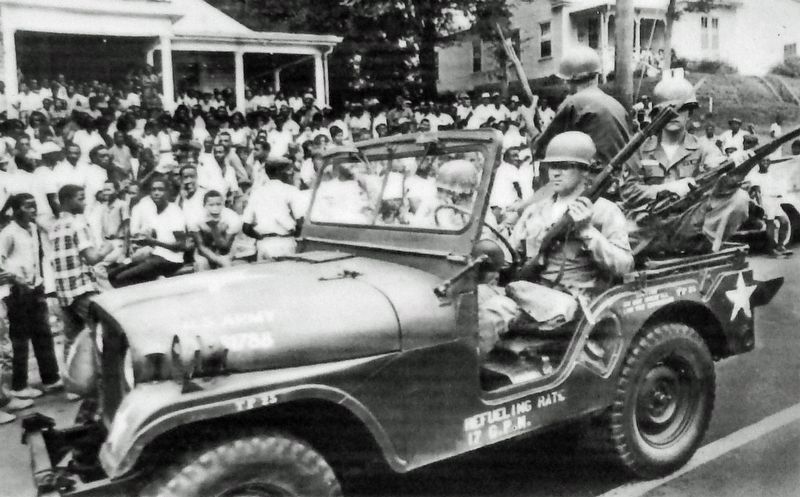
2. Marker detail: National Guard patrolled St. Catherine Street on September 3, 1965
Both Jack and his brother James Ford Seale were implicated in murders and bombings in Southwest Mississippi. FBI records document that Jack Seale became a paid informant in 1967. His brother died in prison in 2011 after being convicted in 2007 of the 1964 kidnapping of two black teenagers who were murdered.
A young man holds a sign (above) on the 700 block of Franklin Street in early December 1965. At a meeting at Zion Chapel A.M.E. Church, activist Bill Ware called for a Christmas boycott against white merchants. This boycott and the demonstrations of 1965 resulted in the city and local businesses conceding to virtually all of the NAACP demands. The city formally conceded on December 3, 1965.
Whereas virtually every other local campaign had ended in failure during the Civil Rights Movement in Mississippi, the Natchez project had mobilized an entire community and exacted sweeping concessions from the white establishment — without federal intervention... The Natchez campaign was the single greatest community victory for the Civil Rights movement in Mississippi…
Lance Hill, The Deacons for Defense, 2004.
Erected by City of Natchez.
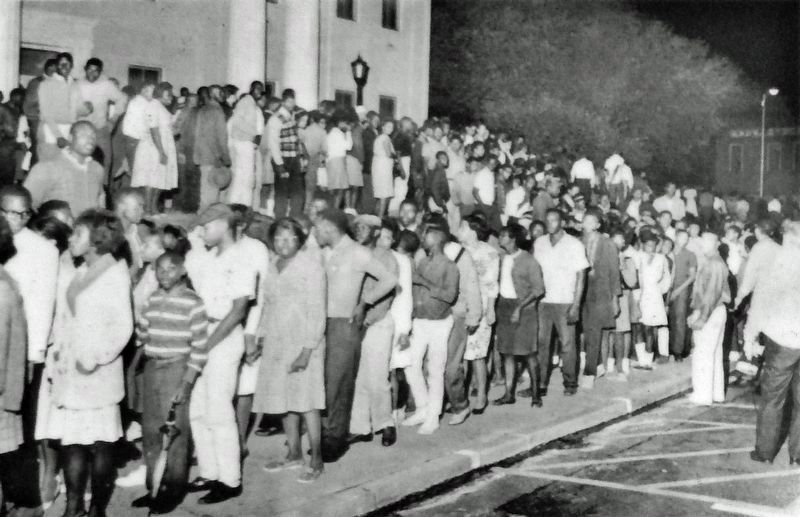
3. Marker detail: About twelve hundred marched quietly and orderly to the Courthouse on October 6, 1965
Topics and series. This historical marker is listed in these topic lists: African Americans • Civil Rights • Law Enforcement. In addition, it is included in the Mississippi - Natchez Trails series list. A significant historical year for this entry is 1965.
Location. 31° 33.792′ N, 91° 24.211′ W. Marker is in Natchez, Mississippi, in Adams County. It is at the intersection of Jefferson Street and North Canal Street, on the right when traveling west on Jefferson Street. The marker is located at the west end of the Natchez City Auditorium driveway. Touch for map. Marker is at or near this postal address: 207 Jefferson Street, Natchez MS 39120, United States of America. Touch for directions.

Regionally, this marker is in Southwest Mississippi and in Natchez Trace Corridor. It is also in the American South, specifically in the Deep South, and in the Great River Road Region. Globally, it is in North America, a Gulf of Mexico state, the Western Hemisphere, the Western World, and the Anglosphere. Historically, it finds itself in what was once New Spain, the Viceroyalty of New France, the territory of the Mississippian
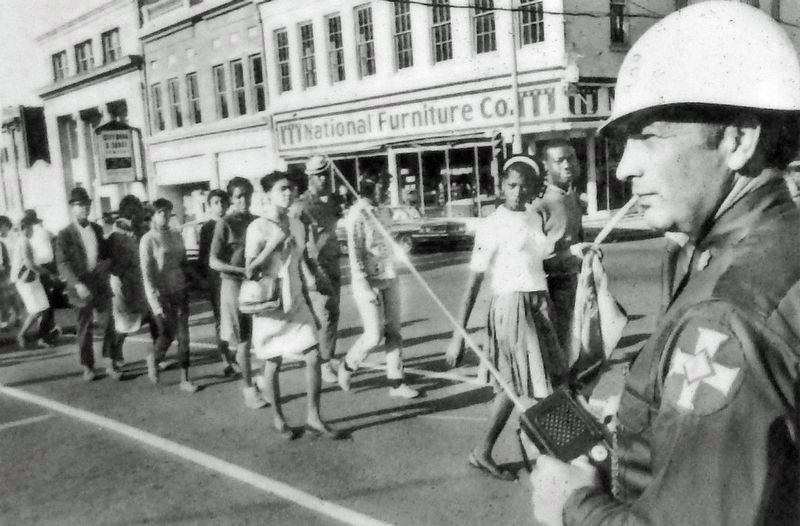
4. Marker detail: Klansman Jack Seale on street corner to intimidate marchers, October 30, 1965
Other nearby markers. At least 8 other markers are within walking distance of this marker: Natchez Civil Rights — Heroines, Heroes, and Martyr (here, next to this marker); Natchez Civil Rights — The Civil Rights Movement (here, next to this marker); The Parchman Ordeal (here, next to this marker); Intersection of North Canal and Jefferson streets (within shouting distance of this marker); House on Ellicott's Hill (within shouting distance of this marker); Andrew Ellicott (within shouting distance of this marker); Intersection of High and North Wall Streets (about 400 feet away, measured in a direct line); Andrew Marschalk (about 500 feet away). Touch for a list and map of all markers in Natchez.
Related markers. Click here for a list of markers that are related to this marker. Natchez Civil Rights Movement

5. Marker detail: Young man with sign on Franklin Street in early December 1965.
Photographed by Cosmos Mariner, June 26, 2025
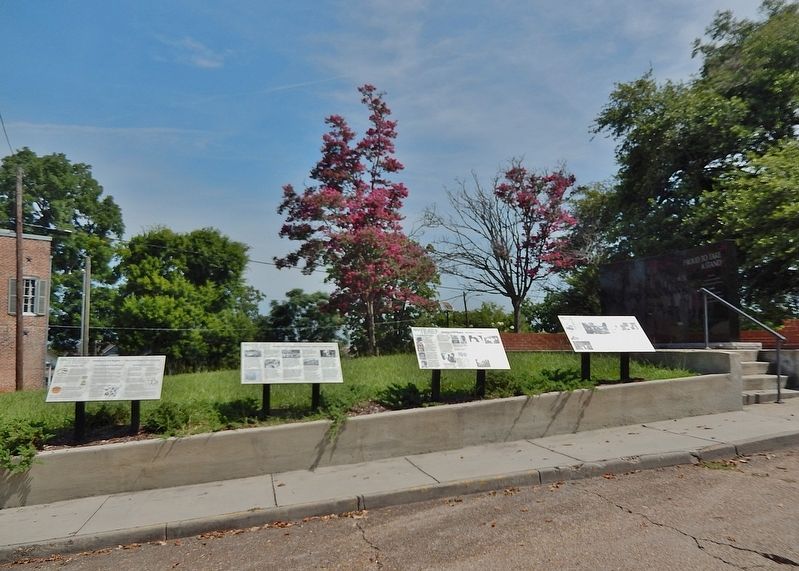
6. Natchez Civil Rights Movement — 1965 — Pivotal Year Marker
Looking north from the west end of the Natchez City Auditorium driveway. This is the 2nd from the left of four related markers at this location.
Credits. This page was last revised on October 16, 2025. It was originally submitted on October 15, 2025, by Cosmos Mariner of Cape Canaveral, Florida. This page has been viewed 67 times since then and 32 times this year. Photos: 1, 2, 3, 4, 5, 6. submitted on October 16, 2025, by Cosmos Mariner of Cape Canaveral, Florida.
