Living Manor in Sullivan County, New York — The American Northeast (Mid-Atlantic)
Borscht Belt - Livingston Manor
| — | Borscht Belt Historical Marker Project | — |

Photographed by Andrew Ruppenstein, October 18, 2025
1. Borscht Belt - Livingston Manor Marker
Borscht Belt – Livingston Manor
During the Borscht Belt’s Golden Age (1940-1965), Livingston Manor was home to about 41 hotels and 12 bungalow colonies. In an area largely dominated by family hotels, some destinations were designed for socialization and romance. The White Roe was a unique resort on a lake with camp-like amenities for people under 35. The Waldemere was a mid-century resort overlooking Shandelee Lake catering to singles and couples of all ages.
Many hotels employed tummlers, a Yiddish word for someone who “stirs up excitement.” Tummlers acted as jesters, entertainers, and emcees, keeping guests amused throughout the day. In 1929, Danny Kaye began his career in comedy as a White Roe tummler before rising to Hollywood stardom. Other notable tummlers were Mel Brooks, Lenny Bruce, Sid Caesar, Jan Murray, and Henny Youngman. Jewish composer Irving Berlin stayed at the Edgewood Inn before moving to Lew Beach where he wrote the song “White Christmas.” Livingston Manor was also home to Capitol, Chan-Al, Lake Rest, Kaplan’s, Kenmore Lake, Menges Lakeside, Paradise Lake, Parkston Hotel, Sand Lake, Sunrise, Switko’s,
this page online
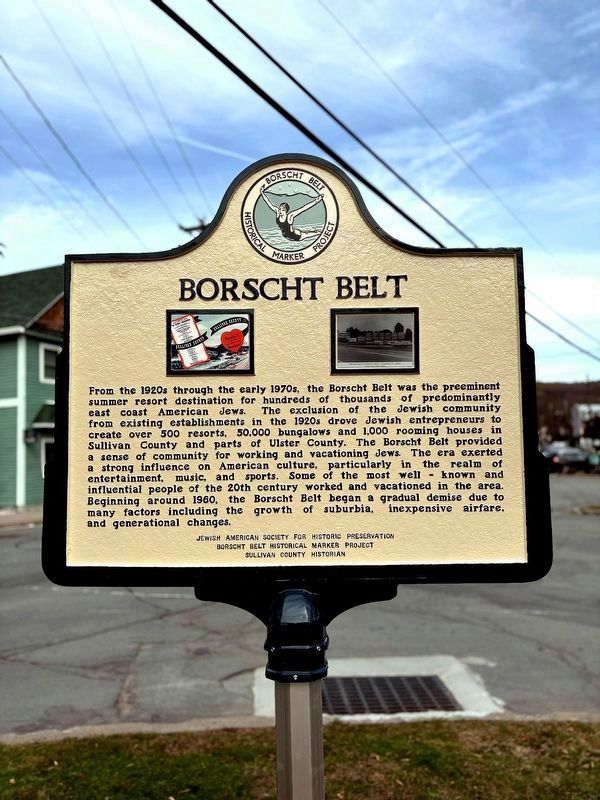
The Borscht Belt
From the early 1920s through the 1970s, the Borscht Belt was the preeminent summer resort destination for hundreds of thousands of predominantly East Coast American Jews. The exclusion of the Jewish community from existing establishments in the 1920s drove Jewish entrepreneurs to create over 500 resorts, 50,000 bungalows, and 1,000 rooming houses in Sullivan County and parts of Ulster County. The Borscht Belt provided a sense of community for working and vacationing Jews. The era exerted a strong influence on American culture, particularly in the realm of entertainment, music, and sports. Some of the most well-known and influential people of the 20th century worked and vacationed in the areas. Beginning around 1960, the Borscht Belt began a gradual demise due to many factors, including the growth of suburbia, inexpensive airfare, and generational changes.
Erected 2025 by Jewish American Society for Historic Preservation, Borscht Belt Historical Marker Project, Sullivan County Historian.
Topics and series. This historical marker is listed in these topic lists: Arts, Letters, Music
Photographed by Jerry Klinger, October 2025
2. Borscht Belt - Livingston Manor Marker
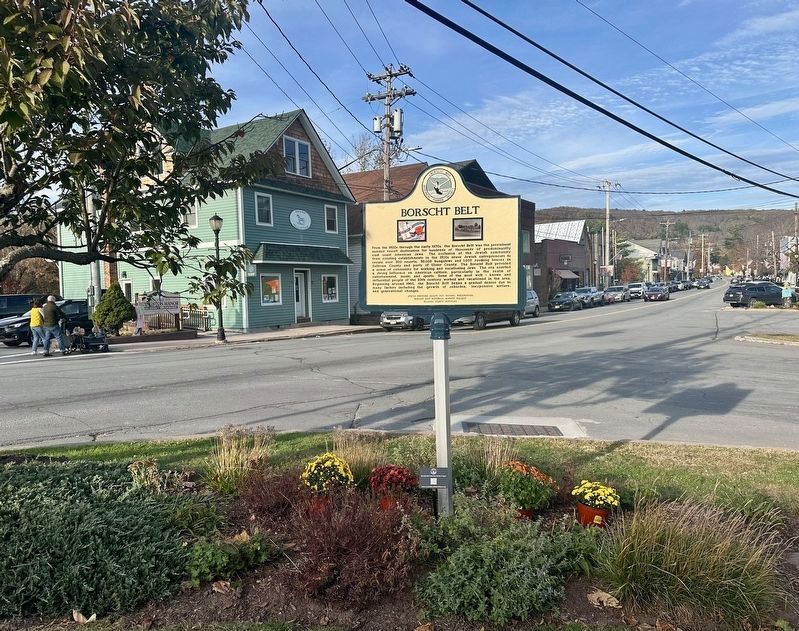
Location. 41° 54.029′ N, 74° 49.698′ W. Marker is in Living Manor, New York, in Sullivan County. It is at the intersection of Pearl Street and Main Street, on the left when traveling north on Pearl Street. Touch for map. Marker is in this post office area: Livingston Manor NY 12758, United States of America. Touch for directions.

Regionally, this marker is in Upstate New York and in the Hudson Valley. It is also in the American Northeast, in the Mid-Atlantic, in Appalachia, and specifically in Northern Appalachia. Globally, it is in North America, the Western Hemisphere, the Western World, and the Anglosphere. Historically, it finds itself in what was once New Netherland and also one of the original Thirteen Colonies.
Other nearby markers. At least 8 other markers are within walking distance of this marker: Livingston Manor Korean War Honor Roll (about 400
Photographed by Marisa Scheinfeld, October 18, 2025
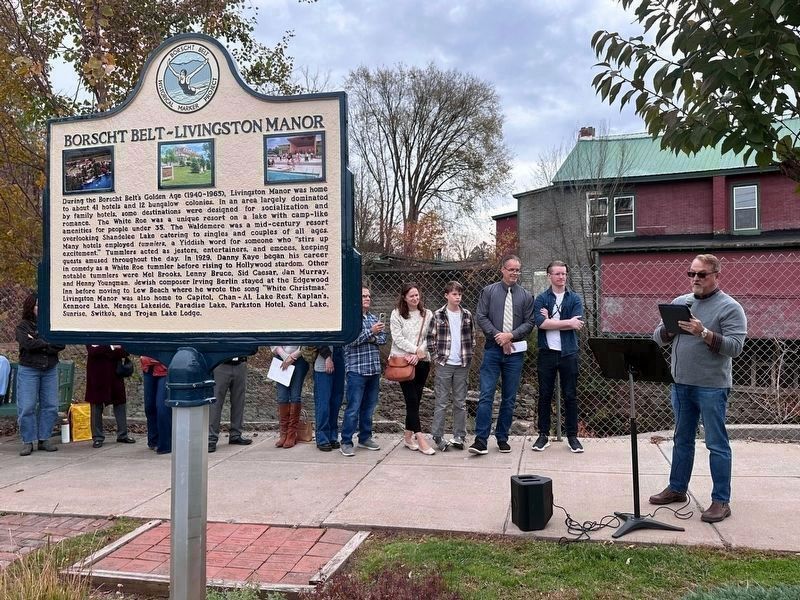
3. Borscht Belt - Livingston Manor Marker - dedication
Also see . . .
1. History of the Borscht Belt.
The Borscht Belt(Submitted on October 19, 2025, by Jerry Klinger of Boynton Beach, Florida.)
The region came to be called the Jewish Alps, Solomon County or more often, simply The Mountains. But another expression, the Borscht Belt, so-named for the hearty beet soup born in Eastern Europe, has had more staying power.
What began as a patchwork of Jewish-owned farms whose proprietors took in summertime boarders to make ends meet grew into a sprawling constellation of all-inclusive resorts, hotels and more modest bungalow colonies and kuchalayns – establishments with shared kitchens. The larger, more successful establishments like Kutsher’s, The Concord and The Nevele had thousands of rooms, nightclubs, indoor pools and ski slopes – and inthe case of Grossinger's, its own airstrip and post office.Photographed by Jerry Klinger, October 18, 20254. Borscht Belt - Livingston Manor Marker - dedication

2. Remembering the Borscht Belt.
An affectionate look back at Borscht Belt Jewish humor in the Catskills.(Submitted on October 19, 2025, by Jerry Klinger of Boynton Beach, Florida.)
In the early 20th century, New York's lower east side had a denser population than Calcutta does today – there were 500 people per acre, and a widely spreading sense of doom and gloom. As Jews climbed into the middle-class, they escaped the stress of city life to summer in the Catskills. And so began the rich heritage of Borscht Belt Jewish humor in the Catskills.
“I just got back from a pleasure trip. I took my mother-in-law to the airport.”
3. Congregation Agudas Achim (Livingston Manor, New York).
Jewish settlement in the Livingston Manor area began in 1882 when what was then known as the New York and Oswego Midland Railroad built a depot there. Local farmers could ship their produce to New York City. Some German Jews who had emigrated to the United States found their way to the Catskills(Submitted on October 19, 2025, by Jerry Klinger of Boynton Beach, Florida.)and developed dairy farms. The railroad provided access to the region for city residents who wanted to get away from the summer heat, leading some farmers and residents to get into the resort and summer camp business. Many resort facilities discriminated against Jews, refusing them as guests.Photographed by Andrew Ruppenstein, October 18, 20255. Borscht Belt - Livingston Manor Marker - wide view, looking east on Main Street
In 1900, with the arrival of a new wave of Jews from Eastern Europe, new resorts were developed that catered specifically to Jewish guests. The first Jewish family settled in Livingston Manor in 1906; the first Jewish resort opened two years later. In those early years antisemitism was overt, with local residents regularly referring to the Jews as "kikes". The first recorded action of the Jewish community in the hamlet was in 1912, when several families banded together to buy land for a cemetery. Local Christian graveyards would not accept Jews.
4. Dedication of the 15th marker of the Borscht Belt Historical Marker Project – Livingston Manor, N.Y.
When Life gives you lemons, make lemonade. And that is exactly what the Jews did when the anti-Semites hung out the signs on their hotels in the early 20th century, No Hebrews Wanted.(Submitted on October 27, 2025, by Jerry Klinger of Boynton Beach, Florida.)
The phrase was first attributed to Elbert Hubbard, who used it in a January 1909 edition of the Literary Digest. Hubbard wrote, “A genius is a man who takes the lemons that Fate hands him and starts a lemonade-stand with them.”
Credits. This page was last revised on October 28, 2025. It was originally submitted on October 19, 2025, by Jerry Klinger of Boynton Beach, Florida. This page has been viewed 230 times since then and 148 times this year. Photos: 1. submitted on October 19, 2025, by Andrew Ruppenstein of Lamorinda, California. 2, 3, 4. submitted on October 19, 2025, by Jerry Klinger of Boynton Beach, Florida. 5. submitted on October 19, 2025, by Andrew Ruppenstein of Lamorinda, California. • Andrew Ruppenstein was the editor who published this page.
