
Central Office District in Richmond, Virginia — The American South (Mid-Atlantic)
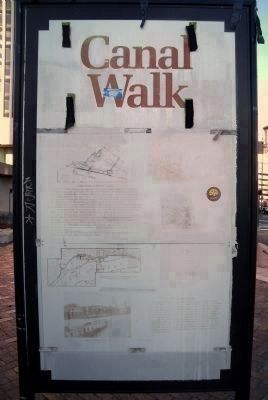
Canal Walk
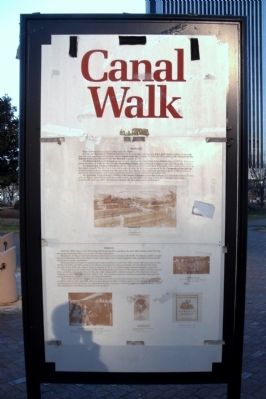
Photographed by Bernard Fisher, January 13, 2010
1. Canal Walk Marker (front panel)
Railroads
Richmond has been a railroad center since the 1830’s.
In 1838, the Richmond & Petersburg Railroad had its main depot and shops at 8th & Byrd streets. A short north-south link, the R&P was the parent company of the Atlantic Coast Line Railroad. In 1967, the ACL merged with Seaboard Air Line Railroad to form the Seaboard Coast Line Railroad, now part of CSX.
The Richmond & Danville Railroad opened its main depot on the James River below Shockoe Slip in 1850. Its shops were across the River. In 1894, the R&D became the Southern Railway which, through mergers, is now part of Norfolk Southern.
The Richmond & Alleghany Railroad bought the right-of-way of the James River & Kanawha Canal and laid its tracks or the canal’s towpath. The first R&A train ran in 1880. In 1888, the R&A was purchased by the Chesapeake & Ohio Railway. A C&O freight yard was developed on the site of the Great Basin in the 1880s, and operated until the 1960’s. In 1981, as part of the Chessie system, C&0 was merged with Seaboard Coast Line Railroad to form CSX.
The Richmond, Fredericksburg & Potomac & Richmond & Petersburg Connection Company line linked Byrd Street Station with the RF&P’s Broad Street yards from 1867 to 1891. At just over a mile long, it included a 900-foot tunnel under Gambles Hill and was called “the shortest railroad with the longest name in the world.”
Tobacco
Until the 1960’s, tobacco was the leading Richmond product, and from the early 18th century until 1970, the area around Kanawha Plaza was a center of tobacco business.
Hogsheads of tobacco sent down the Kanawha Canal were received at the Public Warehouse, which occupied the site of Kanawha Plaza from 1809 to 1865. Here tobacco was stored, inspected, and auctioned. Private dealers traded out of nearby warehouses.
Richmond
this page online
The period from the 1890’s to the 1920’s saw great growth and change in the tobacco industry. Smaller regional firms, including most of the firms in this area, were surpassed by national companies. The American Tobacco Company, in particular, reigned from 1890 to 1911. The cigarette, made by machines, became the main product, and marketing became first national, and then international.
Most of the new Richmond factories in these years were erected along Tobacco Row, to the east of here. One exception came in 1921, when the Allen & Ginter Branch of Liggett & Myers opened a new factory on 7th Street, between Cary and Canal Streets. The Chesterfield Factory remained a Richmond landmark until it closed in 1970. The building has since been renovated for use as offices.
(rear panel)
James River & Kanawha Canal
In 1774,
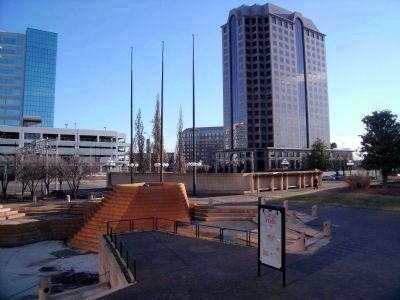
Photographed by Bernard Fisher, January 13, 2010
2. Canal Walk Marker (front panel)
In 1835, the re-organized James River & Kanawha Company, ante-bellum Virginia’s largest corporation, continued work up the James River on a towpath canal designed for horse-and-mule-drawn canal boats. The company’s plan was to link Richmond with the Kanawha River (in what is now West Virginia), and from there link up with the Ohio River.
In 1837, 3,300 workers were building the Canal. By 1840, the Richmond section was entirely rebuilt, and the Canal reached Lynchburg, Virginia in 1860. A turnpike over the mountains then connected the end of the Canal with the Kanawha River.
In 1854, the Tidewater Connection, a series of locks, allowed boats to pass
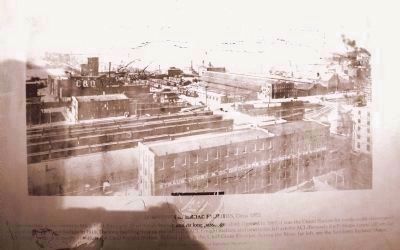
January 13, 2010
3. Downtown Railroad Facilities, Circa 1905
The intersection at the center is 9th & Byrd. Far right, Byrd Street Station and its long passenger shed. Opened in 1887, it was the Union Station for north-south routes until replaced by Broad Street Station in 1919. The long building next on the left is the ACL Freight Station, and next to the left are the ACL (formerly R&P) Shops. Lower left are the C&O freight yards and partly visible is the C&O Freight Station. Behind them is the C&O Grain Elevator. Across the River, far left, are the Southern Railway Shops. (Photo by Cook, Courtesy of Valentine Museum)
The best days of the Canal were the 1850s. Hard times and railroads weakened the Canal Company after 1865, and it folded in 1880.
The Great Basin
Finished in 1800, the Great Basin was the eastern terminus of the Canal. It was a block wide and three blocks long and was located between Cary and Canal, and 8th and 12th Streets. The Basin was up to 50 feet deep and was probably made by damming a stream valley at its east end (12th Street). Warehouses and trading firms surrounded the Basin and the docks along its stone walls were active. In addition to allowing the long, narrow canalboats to turn around for the trip back up the Canal, the Basin supplied water to various mills around its edge. Railroad yards covered half the Basin in the 1880’s. By the 1920s the Basin had been completely covered over. Construction excavation on the site for the James center in 1983-86 yielded the hulls of batteaux, canalboats, and other artifacts of the canal era, some of which have been saved.
Topics. This historical marker is
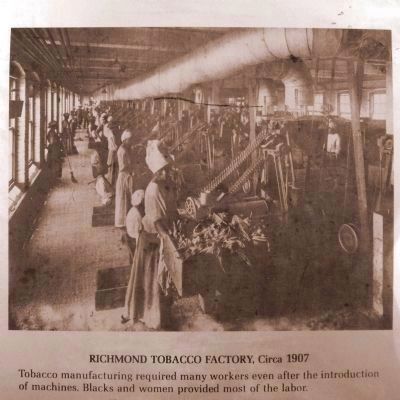
January 13, 2010
4. Richmond Tobacco Factory, Circa 1907
Tobacco manufacturing required many workers even after the introduction of machines. Blacks and women provided most of the labor. (Photo by Cook, Courtesy of Valentine Museum)
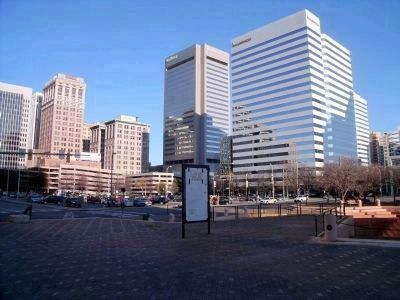
Location. Marker has been reported missing. It was located near 37° 32.206′ N, 77° 26.348′ W. Marker was in Richmond, Virginia. It was in the Central Office District. It could be reached from East Canal Street near South 8th Street. This panel was located in Kanawha Plaza but has been removed. Touch for map. Marker was in this post office area: Richmond VA 23219, United States of America. Touch for directions.

Regionally, this marker was in Central Virginia. It was also in the American South and specifically in the Upper South. Globally, it was in North America, the Western Hemisphere, the Western World, and the Anglosphere. Historically, it found itself in what was once the territory of the Mississippian Culture, one of the original Thirteen Colonies, one of the Confederate States of America, and the Antebellum South.
Other nearby markers. At least 8 other markers are within walking distance of this location: Kanawha Plaza (a few steps from
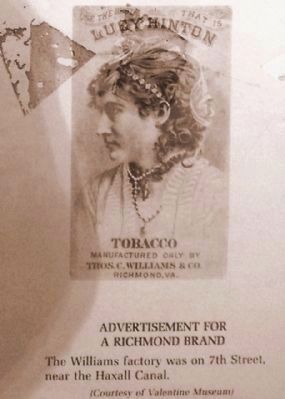
January 13, 2010
5. Advertisement For A Richmond Brand
The Williams factory was on 7th Street, near Haxall canal. (Courtesy of Valentine Musem)
Other markers no longer nearby. Basin Race (was within shouting distance of this marker but has been confirmed missing); Downtown Richmond Millsites (was within shouting distance of this marker but has been confirmed missing); Evacuation of Richmond (was about 400 feet away, measured in a direct line but has been confirmed missing); Evacuation Fire (was about 400 feet away but has been confirmed missing).
More about this marker. These panels are in extremely poor condition. Several of the images are completely faded and the captions are illegible including: Packet Station at 7th Street, Lynchburg was a 33-hour trip. The artist made his sketch from the… (Print from W.L. Sheppard drawing, Courtesy of Valentine Museum)
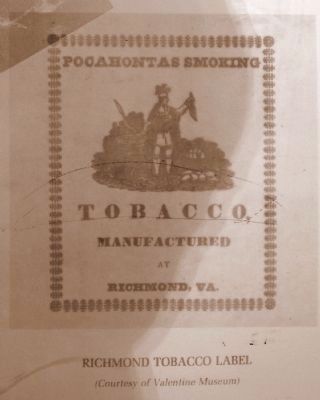
January 13, 2010
6. Richmond Tobacco Label
(Courtesy of Valentine Museum)
Also see . . .
1. Riverfront Canal Walk in Richmond. Venture Richmond (Submitted on November 11, 2021.)
2. James River and Kanawha Canal Historic District. National Register of Historic Places (Submitted on January 18, 2010.)
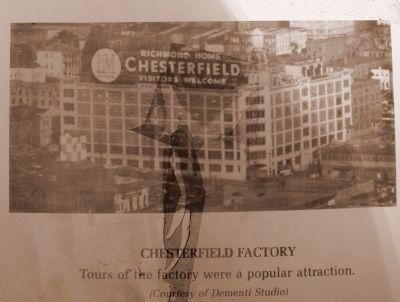
January 13, 2010
7. Chesterfield Factory
Tours of the factory were a popular attraction. (Courtesy of Dementi Studio)
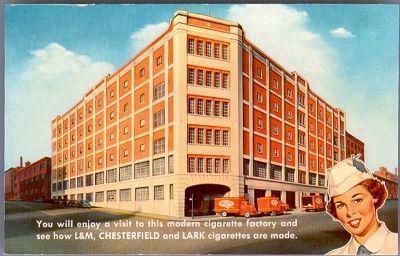
Photographed by Colourpicture Publishers, Inc. Boston
8. L&M, Chesterfield, and Lark cigarette factory
[on front]: You will enjoy a visit to this modern cigarette factory and see how L&M, Chesterfield and Lark Cigarettes are made. [on back]: Richmond, VA. You are invited to take a hostess-conducted tour through this modern cigarette factory conveniently located at Sixth & Cary Streets. Visiting hours 8:00 to 11:15 A.M. and 12:30 to 3:30 P.M. Monday through Friday. VCU Libraries Digital Collections - Rarely Seen Richmond
Photographed by Bernard Fisher, January 13, 2010
9. Canal Walk Marker (rear panel)
Photographed by Bernard Fisher, January 13, 2010
10. Canal Walk Marker (rear panel)
January 13, 2010
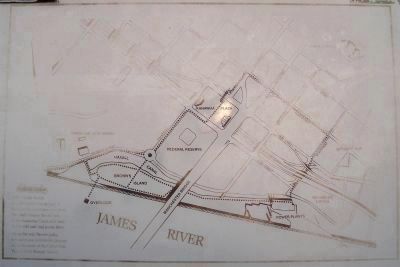
11. The Canal Walk
The Canal Walk is a self-guided history tour of Richmond’s downtown riverfront. The Walk crosses the old bed of the Kanawha Canal, and leads to the wild and vital James River.
Along the way, banner poles, special bricks, and historic plaques mark the route of the Canal Walk. Take a stroll through history.
Photographed by J.R. Hamilton, October 14, 1865
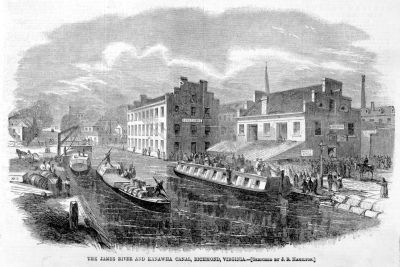
12. Packet Station at 7th Street (caption illegible)
The James River and Kanawha Canal, Richmond, Virginia. Illustration in Harper's Weekly, v.9, no.459 (1865 October), p.653. Library of Congress [LC-USZ62-133833]
January 13, 2010
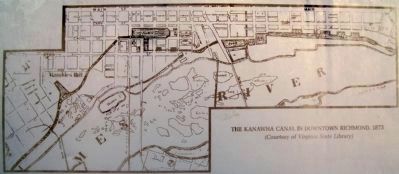
13. The Kanawha Canal In Downtown Richmond, 1873
(Courtesy Virginia State Library)
1865
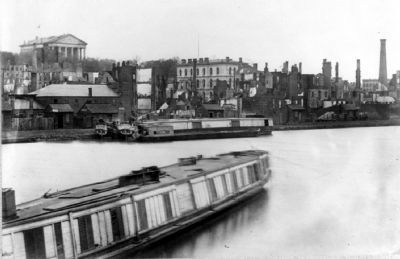
14. Basin View Towards Northeast, 1865
Richmond, Va. 1865. Burnt district. Courtesy of Library of Congress [LC-USZ62-93447]
January 13, 2010
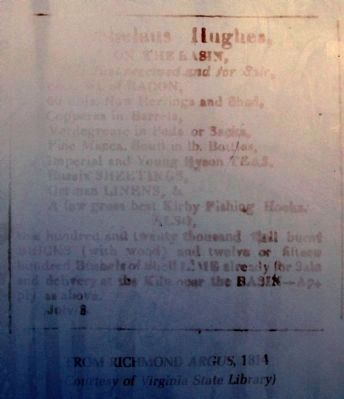
15. From Richmond Argus, 1814
(Courtesy Virginia State Library)
Credits. This page was last revised on October 22, 2025. It was originally submitted on January 18, 2010, by Bernard Fisher of Richmond, Virginia. This page has been viewed 2,770 times since then and 199 times this year. Last updated on October 20, 2025, by Evan Dwyer of Richmond, Virginia. Photos: 1, 2, 3. submitted on January 18, 2010, by Bernard Fisher of Richmond, Virginia. 4. submitted on January 18, 2010. 5, 6, 7, 8, 9, 10, 11, 12, 13, 14, 15. submitted on January 18, 2010, by Bernard Fisher of Richmond, Virginia.
