
Kinikinik in Larimer County, Colorado — The American Mountains (Southwest)
An Ancient Connection
Photographed by Cosmos Mariner, July 31, 2025
1. An Ancient Connection Marker
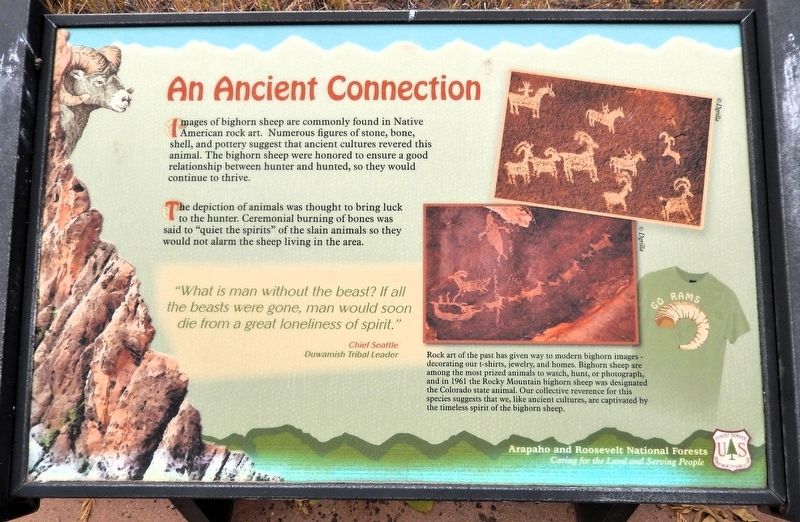
Images of bighorn sheep are commonly found in Native American rock art. Numerous figures of stone, bone, shell, and pottery suggest that ancient cultures revered this animal. The bighorn sheep were honored to ensure a good relationship between hunter and hunted, so they would continue to thrive.
The depiction of animals was thought to bring luck to the hunter. Ceremonial burning of bones was said to “quiet the spirits” of the slain animals so they would not alarm the sheep living in the area.
“What is man without the beast? If all the beasts were gone, man would soon die from a great loneliness of spirit.”
—Chief Seattle
Duwamish Tribal Leader
Rock art of the past has given way to modern bighorn images — decorating our t-shirts, jewelry, and homes. Bighorn sheep are among the most prized animals to watch, hunt, or photograph, and in 1961 the Rocky Mountain bighorn sheep was designated the Colorado state animal. Our collective reverence for this species suggests that we, like ancient cultures, are captivated by the timeless spirit of the bighorn sheep.
Erected by Forest Service, United States Department of Agriculture.
this page online
Topics. This historical marker is listed in these topic lists: Animals • Anthropology & Archaeology • Indigenous Peoples and Communities. A significant historical year for this entry is 1961.
Location. 40° 42.567′ N, 105° 43.542′ W. Marker is in Kinikinik, Colorado, in Larimer County. It can be reached from the intersection of Poudre Canyon Road (State Highway 14 at milepost 83) and Forest Road 297.1, on the right when traveling east. The marker is located at the Big Bend Sheep Viewing Area in Roosevelt National Forest, near Big Bend Campground. Touch for map. Marker is in this post office area: Bellvue CO 80512, United States of America. Touch for directions.

Regionally, this marker is in Colorado’s Front Range. It is also in the American Mountain West. Globally, it is in North America, the Rocky Mountains, the Western Hemisphere, the Western World, and the Anglosphere. Historically, it finds itself in what was once the Louisiana Purchase.
Other nearby markers. At least 8 other markers are within 16 miles of this marker, measured as the crow flies: Where do Big Horn Sheep Live? (here, next to this marker);
Photographed by Cosmos Mariner, July 31, 2025
2. An Ancient Connection Marker
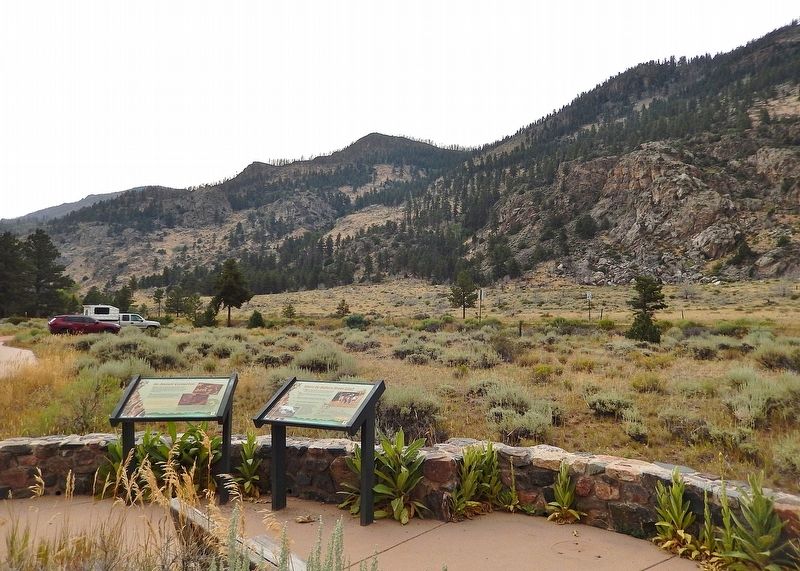
Looking southeast from the Big Bend Sheep Viewing Area. The parking lot is in the background. This marker is the leftmost of two related interpretive panels at this location.
Related markers. Click here for a list of markers that are related to this marker.
Also see . . .
1. Bighorn sheep (Wikipedia).
Excerpt: Bighorn sheep were among the most admired animals of the Apsaalooka (Crow) people, and what is today called the Bighorn Mountain Range was central to the Apsaalooka tribal lands. The Rocky Mountain bighorn sheep is the provincial mammal of Alberta and the state animal of Colorado and, as such, is incorporated into the symbol for the Colorado Division of Parks and Wildlife.(Submitted on October 22, 2025, by Cosmos Mariner of Cape Canaveral, Florida.)
2. Bighorn Sheep History in Rocky Mountain National Park (National Park Service).
Excerpt: The recent history of bighorn sheep in Rocky Mountain National Park is a dramatic story of near extinction and encouraging recovery. In the mid-1880's and early 1900's, the bighorn population declined rapidly. Initially, market hunters shot bighorn by the hundreds to receive high payment for then prized horns and meat. When ranchers moved into the mountain valleys, they altered important bighorn habitat and introduced domestic sheep. The domestic sheep carried scabies and pneumonia, which proved fatal to large numbers of bighorn sheep.(Submitted on October 22, 2025, by Cosmos Mariner of Cape Canaveral, Florida.)
Under the pressure of disease, hunting and habitat alteration, the bighorn population declined until the middle of the 20th century. Research in the 1950's indicated that about 150 bighorn remained in the area of the national park. Their range was limited to isolated, high country regions of the Mummy and Never Summer mountain ranges, and along the Continental Divide. The migrating, low-country herds were gone.
As the pressure of hunting and disease declined in the 1960's and 1970's, bighorn populations began rebounding. In an effort to stimulate population growth and promote diversity, wildlife managers reintroduced bighorn sheep to their historic ranges along Cow Creek and the North St. Vrain River in 1978 and 1980.
These new herds of bighorn along the eastern boundary of the park and the surviving native herds have continued to grow. Today, approximately 300-400 bighorn sheep live in the Rocky Mountain National Park area.
Credits. This page was last revised on March 24, 2026. It was originally submitted on October 20, 2025, by Cosmos Mariner of Cape Canaveral, Florida. This page has been viewed 80 times since then and 43 times this year. Photos: 1, 2. submitted on October 22, 2025, by Cosmos Mariner of Cape Canaveral, Florida.
