Blackwood Village, North Abaco, The Bahamas — North Atlantic (Lucayan Archipelago of the West Indies)
The American Loyalists
Photographed by Tracy Andersen Roberts, October 22, 2025
1. The American Loyalists Marker
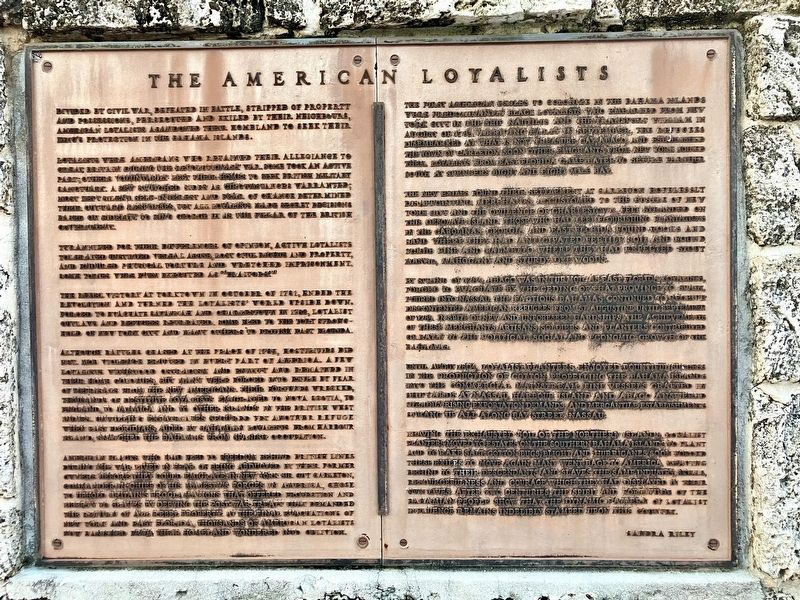
Divided by civil war, defeated in battle, stripped of property and possessions, persecuted and exiled by their neighbors, American loyalists abandoned their homeland to seek their King’s protection in the Bahama Islands.
Loyalists were Americans who retained their allegiance to Great Britain during the Revolutionary War. Some took an active part; others voluntarily left their homes to seek British military sanctuary. A few switched sides as circumstances warranted; most kept silent. Self interest amid fear of change determined their outward responses, yet all Loyalists made secret decisions based on fidelity to King George III as the pillar of the British government.
Tyrannized for their differences of opinion, active Loyalists tolerated unstinted verbal abuse, lost civil rights and property, and endured physical torture and wretched imprisonment. Some Tories were even executed as “traitors.”
The rebel victory at Yorktown in October 1871 ended the Revolution and turned the Loyalists’ world upside down. Forced to evacuate Savannah and Charlestown in 1782, Loyalist outlaws and refugees retreated. Some fled
this page online
Although battles ceased at the Peace of 1785, hostilities did not. Mob violence erupted in every part of America. A few Loyalists withstood ostracism and enmity and remained in their home colonies, but many were forced into exile by fear of reprisals from the new Americans. Their fortunes wrecked, thousands of destitute Loyalists emigrated to Nova Scotia, to England, to Jamaica, and to other islands in the British West Indies. Unwilling expatriates secured another refuge when East Floridians aided by Bahamian Loyalists from Harbour Island snatched the Bahamas from Spanish occupation.
American Blacks who had fled to freedom behind British lines during the War, lived in fear of being abducted by their former owners before they could emigrate. In New York, Sir Guy Carleton, Commander-In-Chief of His Majesty’s forces in America, chose to uphold Britain’s proclamations that offered protection and liberty to slaves by defying the post-war treaty that demanded the return of all rebel property. At the final evacuations of New York and East Florida, thousands
Photographed by Tracy Andersen Roberts, October 22, 2025
2. The American Loyalists Marker
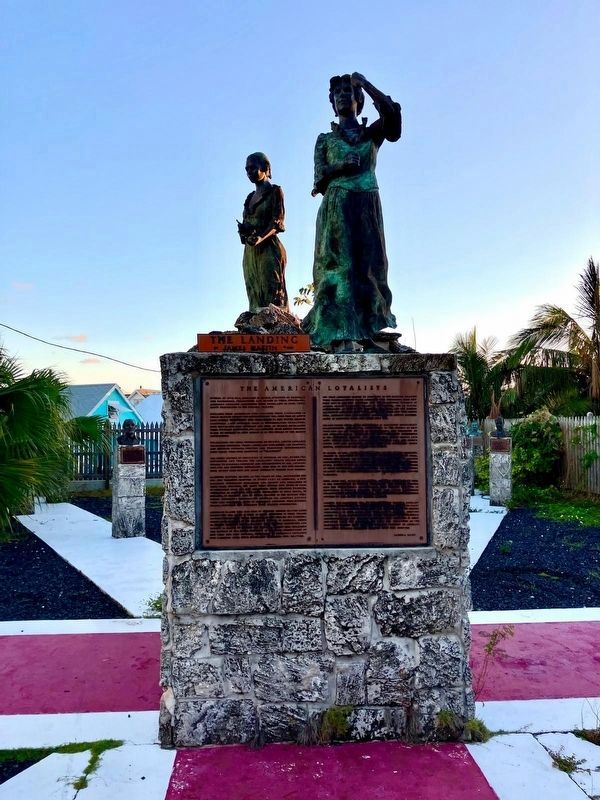
The first American exiles to colonize in the Bahama Islands were predominantly Black loyalists who embarked from New York City in the ship Nautilus and the transport William in August of 1783. Arriving early in September, the refugees disembarked at what is now Treasure Cay, Abaco and established the town of Carleton. Soon other immigrants from New York joined them. Loyalists from East Florida came later to settle further south at Spencer‘s Bight and Eight Mile Bay.
The new exiles found their settlement at Carleton hopelessly disappointing. Merchants, accustomed to the busy bustle of New York City and the opulence of Charlestown, felt stranded on the desolate island. Those who had left flourishing plantations in the Carolinas, Georgia and East Florida, found rocks and sand where they had anticipated fertile soil and found scrub pine and palmetto where they had expected stout mastic, mahogany and sturdy dye woods.
By spring of 1784, Abaco was in turmoil as East Florida Loyalists, forced to evacuate by the ceding of that province to Spain,
Photographed by Tracy Andersen Roberts, October 22, 2025
3. Loyalist Memorial Sculpture Garden
Until about 1804, Loyalist planters enjoyed bountiful success in the production of cotton, propelling the Bahama Islands into the commercial mainstream. Fine vessels crafted in shipyards at Nassau, Harbour Island and Abaco answered steadily rising exportation demands, and mercantile establishments sprang up all along Bay Street, Nassau.
Leaving the exhausted soil of the northern islands, Loyalist planters moved to estates on the southern Bahama Islands to plant and to rake salt. Cotton bugs, blight and hurricanes soon forced these exiles to move again. Many went back to America, leaving behind to their descendants and slaves the same industry, resourcefulness and courage which they had displayed in their own lives after two centuries. The spirit and fortitude of the Bahamian people show that the dynamic pattern of Loyalist influence remains indelibly stamped upon this country. Sandra Riley
Erected by New Plymouth Historical Society.
Topics. This historical marker is listed in these topic lists: African Americans • Colonial Era • Immigration • War, US Revolutionary. A significant historical month for this entry is September 1783.
Location. 26° 45.523′ N, 77° 19.749′ W. Marker is in Blackwood Village, North Abaco. It is at the intersection of Parliament Street and New Plymouth Street, on the right when traveling west on Parliament Street. Touch for map. Touch for directions.

Regionally, it is on the Atlantic Ocean, in North America, in the Western Hemisphere, and in the Anglosphere. Historically, it finds itself in what was once a British colony.
Other nearby markers. At least 8 other markers are within walking distance of this marker: Haziel Laverne Roberts (here, next to this marker); Charles Mennon Harris, O.B.E. (here, next to this marker); James Rispah Lowe, O.B.E. (here, next to this marker); William Roy Lowe, M.B.E. (here, next to this marker); The Reverend Charles C. Curry (here, next to this marker); Right Rev. Donald Roland Knowles, O.B.E. (here, next to this marker); Captain Robert Sherwin Archer (here, next to this marker); Albert William Lowe (here, next to this marker). Touch for a list and map of all markers in Blackwood Village.
Also see . . .
1. Loyalist Memorial Sculpture Garden - Sea Turtle Creative.
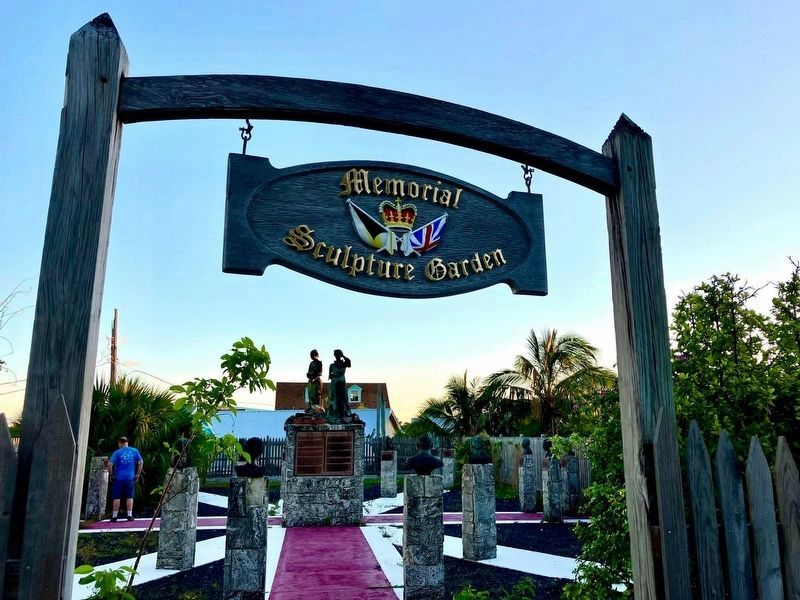
Tucked in the heart of historic New Plymouth on Green Turtle Cay, the Loyalist Memorial Sculpture Garden is one of the most culturally significant and visually striking landmarks in The Bahamas. Designed by acclaimed Bahamian artist Alton Lowe and American historian Mary Moseley, this open-air garden honors the Loyalist settlers who fled the American Revolution and arrived in the Abacos in the late 1700s.(Submitted on October 22, 2025, by Tracy Andersen Roberts of Atlanta, Georgia.)
2. Loyalist Memorial Sculpture Garden - Uncommon Caribbean.
This garden, located not far from the Albert Lowe Museum in Green Turtle Cay, is also the brainchild of Alton Lowe, and was built with funds raised by the New Plymouth Historical Society. The garden is a monumental tribute to those who played a significant role in the history of The Abacos, the Loyalists and their slaves, who despite hard times, survived and made a new life in The Bahamas.(Submitted on October 22, 2025, by Tracy Andersen Roberts of Atlanta, Georgia.)
3. Loyalist Memorial Sculpture Garden - Bahamas Ministry of Tourism.
Artist James Mastin sculptured the busts and two large figures. The figures represent a new beginning in The Bahamas for the thousands of Loyalists of the American Revolution in 1783.(Submitted on October 22, 2025, by Tracy Andersen Roberts of Atlanta, Georgia.)
Credits. This page was last revised on December 20, 2025. It was originally submitted on October 22, 2025, by Tracy Andersen Roberts of Atlanta, Georgia. This page has been viewed 99 times since then and 43 times this year. Photos: 1, 2, 3. submitted on October 22, 2025, by Tracy Andersen Roberts of Atlanta, Georgia. • Michael Herrick was the editor who published this page.
