Old Pasadena in Los Angeles County, California — The American West (Pacific Coastal)
Exploring Pasadena's Past
Photographed by Duane and Tracy Marsteller, September 27, 2025
1. Exploring Pasadena's Past Marker
Click on image for a larger view.
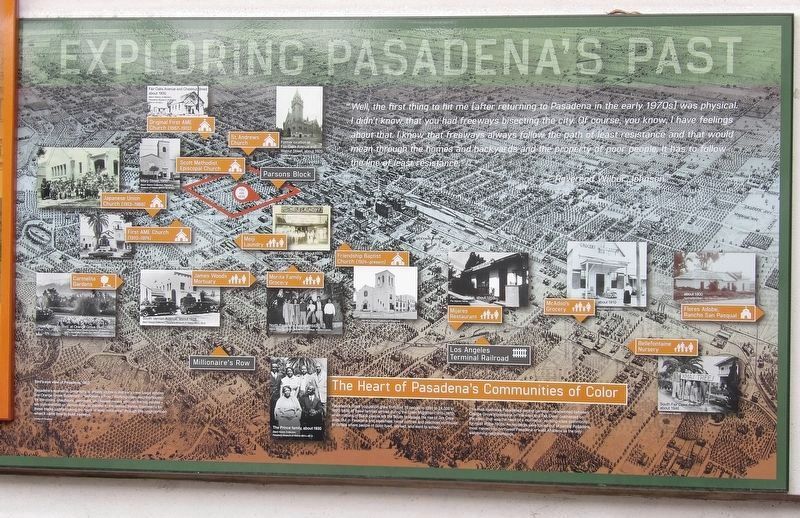
“Well, the first thing to hit me [after returning to Pasadena in the early 1970s] was physical. I didn't know that you had freeways bisecting the city. Of course, you know, I have feelings about that. I know that freeways always follow the path of least resistance and that would mean through the homes and backyards and the property of poor people. It has to follow the line of least resistance.”– Reverend Wilbur Johnson
The Heart of Pasadena's Communities of Color
Pasadena's Black population grew from just 75 people in 1890 to 24,000 in 1990. Most of these families arrived during the Great Migration (1915-1970), when millions of Black people left the South to escape the rise of Jim Crow laws. But in Pasadena and elsewhere, racist policies and practices continued to dictate where people of color lived, worked, and went to school.
This map illustrates Pasadena's central corridor – sandwiched between Orange Grove's mansions on the west and Fair Oak's businesses on the east – that was the heart of a multiracial, working-class community for most of the 1900s. As residents were forced out of central Pasadena, most moved
this page online
Bird's-eye view of Pasadena, 1903
Pasadena's economic geography is already visible in this early view. Large estates line Orange Grove Boulevard – “Millionaire's Row.” Working-class neighborhoods – for the cooks, chauffeurs, gardeners, and housekeepers who ran the big estates – are concentrated on Vernon Avenue, parallel to the railroad tracks. Easements for these tracks justified taking the “path of least resistance” through this neighborhood when it came time to build freeways. Library of Congress
Topics. This historical marker is listed in these topic lists: African Americans • Civil Rights • Roads & Vehicles. A significant historical year for this entry is 1890.
Location. 34° 8.852′ N, 118° 9.132′ W. Marker is in Pasadena, California, in Los Angeles County. It is in Old Pasadena. It is at the intersection of Leonard J Pieroni Street and Holly Street, on the right when traveling north on Leonard J Pieroni Street. Touch for map. Marker is in this post office area: Pasadena CA 91124, United States of America. Touch for directions.

Regionally, this
Photographed by Duane and Tracy Marsteller, September 27, 2025
2. Exploring Pasadena's Past Marker
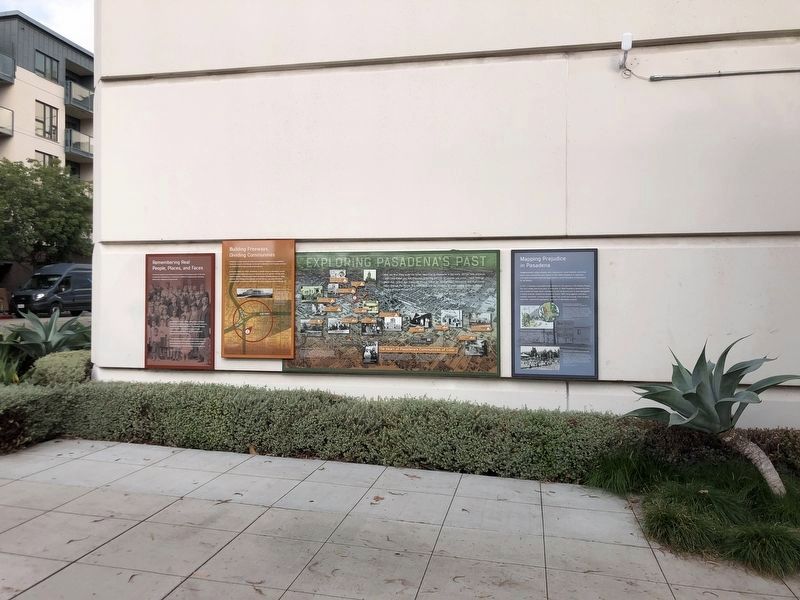
This marker is the second one from the right.
Other nearby markers. At least 8 other markers are within walking distance of this marker: Building Freeways, Dividing Communities (here, next to this marker); Mapping Prejudice in Pasadena (here, next to this marker); At Home in Old Pasadena (within shouting distance of this marker); Bonham Alley (about 400 feet away, measured in a direct line); Pioneers & Entrepreneurs (about 400 feet away); Christensen Alley (about 500 feet away); Hugus Alley (about 500 feet away); Places Change, People Endure (about 600 feet away). Touch for a list and map of all markers in Pasadena.
Credits. This page was last revised on November 6, 2025. It was originally submitted on November 5, 2025, by Duane and Tracy Marsteller of Murfreesboro, Tennessee. This page has been viewed 48 times since then and 18 times this year. Photos: 1, 2. submitted on November 5, 2025, by Duane and Tracy Marsteller of Murfreesboro, Tennessee.
