Gambles Hill in Richmond, Virginia — The American South (Mid-Atlantic)
President Lincoln Visits Richmond
April 4-5, 1865
| — | Richmond National Battlefield Park | — |
Courtesy of Thomas P. Martin, April 22, 2017
1. President Lincoln Visits Richmond Marker
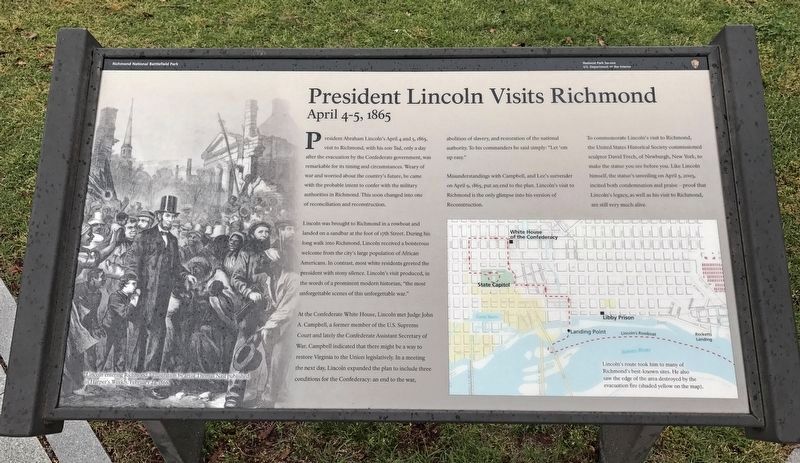
President Abraham Lincoln's April 4 and 5, 1865 visit to Richmond, with his son Tad, only a day after the evacuation by the Confederate government, was remarkable for its timing and circumstances. Weary of war and worried about the country's future, he came with the probable intent to confer with the military authorities in Richmond. This soon changed into one of reconciliation and reconstruction.
Lincoln was brought to Richmond in a rowboat and landed on a sandbar at the foot of 17th Street. During his long walk into Richmond, Lincoln received a boisterous welcome from the city's large population of African Americans. In contrast, most white residents greeted the president with stony silence. Lincoln's visit produced, in the words of a prominent modern historian, “this most unforgettable scenes of this unforgettable war.”
At the Confederate White House, Lincoln met Judge John A. Campbell, a former member of the U.S. Supreme Court and lately the Confederate Assistant Secretary of War. Campbell indicated that there might be a way to restore Virginia to the Union legislatively. In a meeting the next day, Lincoln expanded
this page online
Misunderstandings with Campbell, and Lee's surrender on April 9, 1865, put an end to the plan. Lincoln's visit to Richmond is the only glimpse into his version of Reconstruction.
To Commemorate Lincoln's visit to Richmond, the United States Historical Society commissioned sculptor David Frech, of Newburgh, New York, to make the statue you see before you. Like Lincoln himself, the statue's unveiling on April 5, 2003, incited both condemnation and praise – proof that Lincoln's legacy, as well as his visit to Richmond, are still very much alive.
[Caption:]
Lincoln's route took him to many of Richmond's best-known sites. He also saw the edge of the area destroyed by the evacuation fire (shaded yellow on the map).
Erected by National Park Service, U.S. Department of the Interior.
Topics. This historical marker is listed in this topic list: War, US Civil. A significant historical date for this entry is April 4, 1865.
Location. Marker has been permanently removed. It was located near 37° 32.136′ N, 77° 26.766′ W. Marker was in Richmond, Virginia. It was in Gambles Hill. It could be reached from Tredegar Street east of Brown's Island Way, on the left when traveling east. Marker is at the Tredegar Iron Works site in Richmond National Battlefield Park. Touch for map. Marker was at or near this postal address: 470 Tredegar St, Richmond VA 23219, United States of America.
We have been informed that this marker is no longer there and will not be replaced. This page is an archival view of what was.
Regionally, this marker was in Central Virginia. It was also in the American South and specifically in the Upper South. Globally, it was in North America, the Western Hemisphere, the Western World, and the Anglosphere. Historically, it found itself in what was once the territory of the Mississippian Culture, one of the original Thirteen Colonies, one of the Confederate States of America, and the Antebellum South.

Other nearby markers. within walking distance of this location: Touch for a list and map of all markers in Richmond.
Other markers no longer nearby. President Lincoln Visits Richmond (was a few steps from this marker but has been confirmed missing); Raceways (was a few steps from this marker but has been permanently removed); Francis Turbine (was within shouting distance of this marker but has been permanently removed); Adapting Power (was within shouting distance of this marker but has been permanently removed); Tredegar in 1951 (was within shouting distance of this marker but has been permanently removed); The Bulldozer Press (was within shouting distance of this marker but has been permanently removed); Early Industrial Patterns (was within shouting distance of this marker but has been permanently removed); Belle Isle and Old Dominion Iron and Nail Works (was within shouting distance of this marker but has been permanently removed); Toledo 1000-ton Press (was within shouting distance of this marker but has been permanently removed); Historic Tredegar (was within shouting distance of this marker but has been permanently removed); Tredegar Spike Mill (was within shouting distance of this marker but has been permanently removed); Belle Isle Prison (was within shouting distance of this marker but has been permanently removed); Rutherfoord’s Mill (was within shouting distance of this marker but has been permanently removed); The Cupola Furnace and Foundry (was within shouting distance of this marker but has been permanently removed); Cupolas from the Virginia State Penitentiary (was within shouting distance of this marker but has been permanently removed); Tredegar Iron Works (was within shouting distance of this marker but has been permanently removed).
Credits. This page was last revised on November 10, 2025. It was originally submitted on March 18, 2023, by Duane and Tracy Marsteller of Murfreesboro, Tennessee. This page has been viewed 503 times since then and 22 times this year. Last updated on November 9, 2025, by Evan Dwyer of Richmond, Virginia. Photo 1. submitted on March 18, 2023, by Duane and Tracy Marsteller of Murfreesboro, Tennessee. • Bernard Fisher was the editor who published this page.
