
Gambles Hill in Richmond, Virginia — The American South (Mid-Atlantic)
The Richmond-Petersburg Railroad Bridge
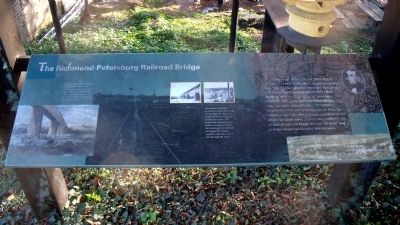
Photographed by Bernard Fisher, November 3, 2009
1. The Richmond-Petersburg Railroad Bridge Marker
The expansion of railroads in the 1830s fueled the growth of iron works like Tredegar, and by the Civil War, five railroads had come into Richmond. The Richmond-Petersburg was the first railroad bridge in the city. It was built by Moncure Robinson, a Virginia native who engineered many early American railroad lines. Completed to Manchester, now part of Richmond, in 1838, the structure was 2,844 feet in length and stood 60 feet above the James River. Constructed primarily out of pine planks, the bridge seemed “air built,” and perhaps dangerous to many Richmonders.
Topics. This historical marker is listed in these topic lists: Railroads & Streetcars • War, US Civil. A significant historical year for this entry is 1838.
Location. Marker has been permanently removed. It was located near 37° 32.176′ N, 77° 26.723′ W. Marker was in Richmond, Virginia. It was in Gambles Hill. It could be reached from Tredegar Street 0.1 miles west of South 5th Street. This marker is located outside the Civil War Visitor Center at Tredegar Iron Works. Touch for map. Marker was at or near this postal address: 470 Tredegar Street, Richmond VA 23219, United States of America.
We have been informed that this marker is no longer there and will not be replaced. This page is an archival view of what was.
Regionally, this marker was in Central Virginia. It was also in the American South and specifically in the Upper South. Globally, it was in the North Atlantic Region, North America, the Western Hemisphere, the Western World, and the Anglosphere. Historically, it found itself in what was once the territory of the Mississippian Culture, one of the original Thirteen Colonies, one of the Confederate States of America, and the Antebellum South.

Other nearby markers. At least one other marker
this page online
Other markers no longer nearby. Company Store (was within shouting distance of this marker but has been permanently removed); Cupolas from the Virginia State Penitentiary (was within shouting distance of this marker but has been permanently removed); Rutherfoord’s Mill (was within shouting distance of this marker but has been permanently removed); Tredegar Iron Works (was within shouting distance of this marker but has been permanently removed); Tredegar Spike Mill (was within shouting distance of this marker but has been permanently removed); Raceways (was about 300 feet away, measured in a direct line but has been permanently removed); The Cupola Furnace and Foundry (was about 300 feet away but has been permanently removed); Rail Lines at Tredegar (was about 300 feet away but has been permanently removed); The Canal and the Civil War (was about 300 feet away but has been permanently removed); Enterprise and Iron (was about 300 feet away but
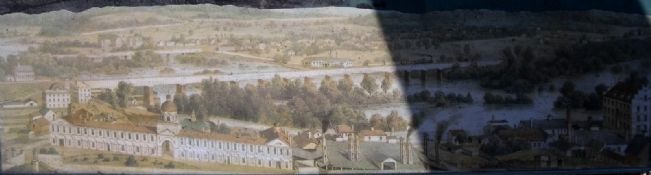
Photographed by Bernard Fisher, November 8, 2009
2. View of the Richmond-Petersburg Railroad Bridge over the James River
More about this marker. On the left and center are images of the R&P Railroad Bridge with the caption, "The first bridge burned during the evacuation fire in 1865. You can see its large stone pilings in the viewer. The 1873 photograph to the right shows the rebuilt bridge, looking back toward Richmond."
In the center are two smaller photographs with the caption, "Sparks from a passing locomotive caused the bridge to burn again in 1882, and a steel structure was erected on the stone piers. The fourth and final bridge was built in the early 1900s on the smaller concrete pilings just beside the original location, which also can be seen through the viewer."
On the right are a portrait of Moncure Robinson and a painting
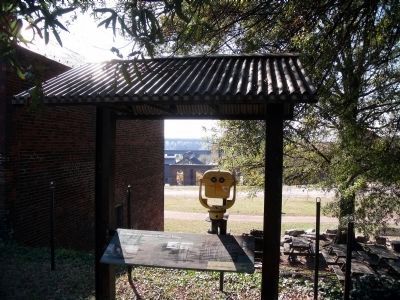
Photographed by Bernard Fisher, November 8, 2009
3. The Richmond-Petersburg Railroad Bridge Marker at Tredegar
Also see . . . Richmond & Petersburg Railroad. Confederate Railroads (Submitted on November 11, 2009.)
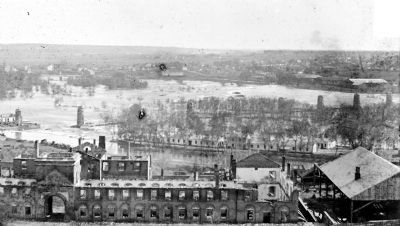
Photographed by Alexander Gardner, 1865
4. Ruins of State Arsenal and Richmond & Petersburg Railroad Bridge
Library of Congress [LC-B817- 7236]
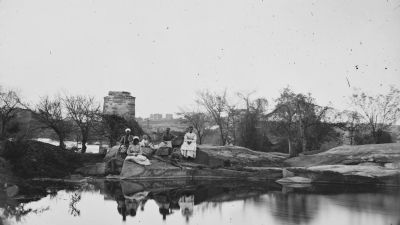
Photographed by Alexander Gardner, Apr 1865
5. Ruins of Richmond & Petersburg Railroad Bridge from island in James River
Library of Congress [LC-B815- 846]
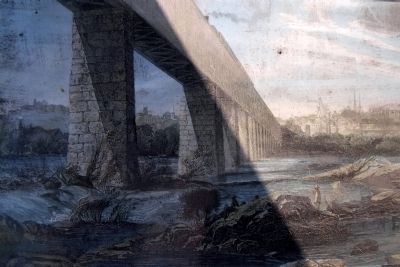
Photographed by Bernard Fisher, November 8, 2009
6. The First Richmond-Petersburg Railroad Bridge
Credits. This page was last revised on January 20, 2026. It was originally submitted on November 11, 2009, by Bernard Fisher of Richmond, Virginia. This page has been viewed 2,255 times since then and 53 times this year. Last updated on January 19, 2026, by Evan Dwyer of Richmond, Virginia. Photos: 1, 2, 3, 4, 5, 6. submitted on November 11, 2009, by Bernard Fisher of Richmond, Virginia. • Devry Becker Jones was the editor who published this page.
