Old Bethpage in Nassau County, New York — The American Northeast (Mid-Atlantic)
Long Island During the Cold War
Photographed by Ian Lefkowitz, October 26, 2025
1. Long Island During the Cold War Marker
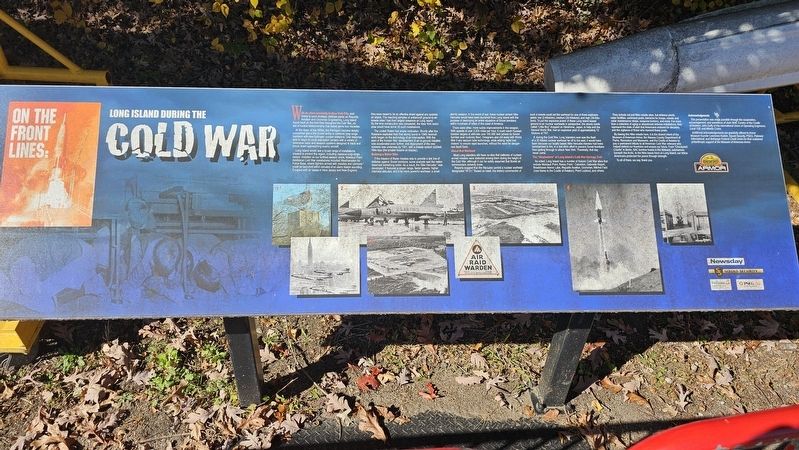
With its close proximity to New York City, and home to such strategic defense plants as Republic Aviation and Grumman Engineering, Long Island found itself on the front lines throughout the Cold War…an era of nuclear brinksmanship that lasted some four decades.
At the dawn of the 1950s, the Pentagon became deeply concerned about the Soviet ability to combine long-range bombers with new hydrogen nuclear weapons. One response was to begin to circle population centers with a variety of defensive radars and weapon systems designed to track and knock down approaching enemy aircraft.
Long Island would see a broad range of installations created to protect the region, including massive long-range radars installed on our furthest eastern shore, Montauk Point. Additional Cold War installations included Westhampton Air Force Base, where fighters armed with missiles and cannons could be launched within minutes of an alarm klaxon sounding. Coupled with air bases in New Jersey and New England, they were meant to be an effective shield against any surprise air attack. The resulting complex of antiaircraft ground-to-air missile sites
this page online
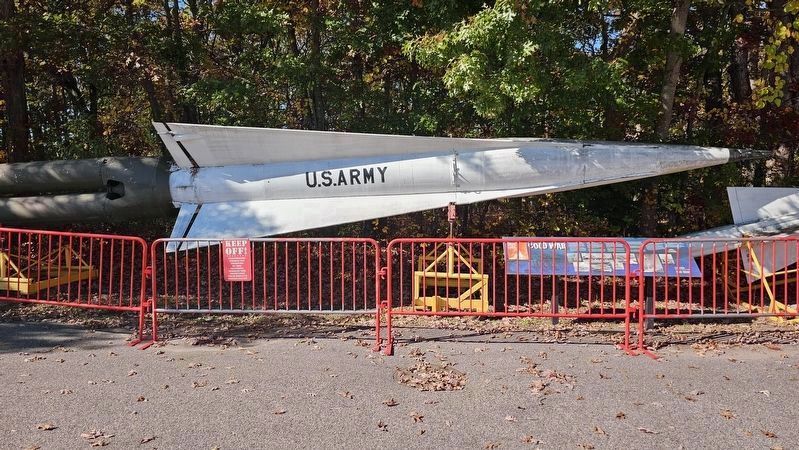
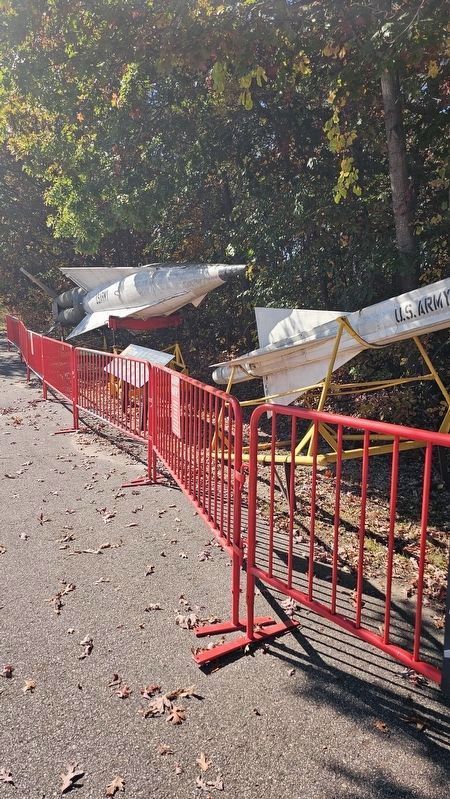
The United States had ample motivation. Shortly after the Russians exploded their first atomic bomb in 1949, feverish work began on the technology of air interception. With the start of the Korean War, development of air-to-ground missiles was accelerated even further, and deployment of the new systems was underway by 1951, with a missile system dubbed Nike Ajax (the smaller missile on display).
Building a Better Nike
If the mission of these missiles was to provide a last line of defense against Soviet bombers, some analysts said the nation deserved something better. As a result, the Nike Hercules was developed. It featured a longer range, faster speeds, higher intercept altitudes, and a far more powerful warhead: a small atomic weapon. In the event of war, these nuclear-armed Nike Hercules would have been launched from Long Island with the purpose of destroying an entire squadron of Soviet bombers within hundreds of miles of the coast of America.
There were other, more subtle improvements
Photographed by Ian Lefkowitz, October 26, 2025
2. Long Island During the Cold War Marker
About that Warhead
Most Long Islanders still have no idea that batteries of nuclear-armed missiles were stationed among them during the height of the Cold War, although it can be safely assumed that Soviet air commanders certainly knew.
Reports suggest that the Hercules carried a nuclear warhead designated “W-31.” Based on need, the battery commander of such a missile could set the warhead for one of three explosive yields: low (2-Kilotons); medium (20-Kilotons); and high (30-Kilotons). To put the explosive power of these Long Island based ground-to-air nuclear warheads in perspective, the atomic bomb called “Little Boy” dropped on Hiroshima, Japan, to help end the Second World War, had an explosive yield of approximately 12 Kilotons of TNT.
If, during the Cold War, Long Islanders ever saw the
Photographed by Ian Lefkowitz, October 26, 2025
3. Nike Ajax and Nike Hercules Missiles
The “Headwaters” of Long Island’s Cold War Heritage Trail
As noted, Long Island has a number of historic Cold War sites that include Montauk Point, Rocky Point, Calverton, Gabreski Airport, Brookhaven Atomic Labs, Republic Aviation, Grumman, Mitchel Field (now home to the Cradle of Aviation), Point Lookout, and others.
They include not just Nike missile sites, but defense plants, radar facilities, command posts, barracks for troops, missile and radar maintenance shops, weapons bunkers, and more. Far more than a collection of some of abandoned defense installations, they represent the state of alert that Americans endured for decades, and the vigilance of those who manned these posts.
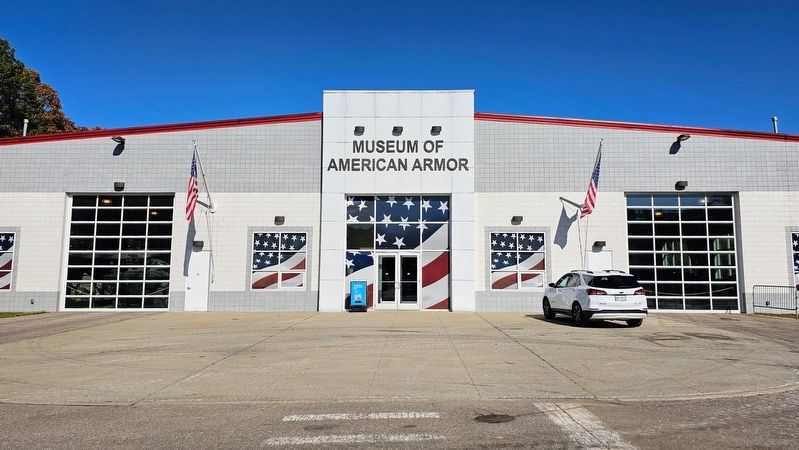
By basing this Nike missile site, it is the shared intent of the Museum of American Armor, the Nassau County Department of Parks, Recreation and Museums, and the Cradle of Aviation
Photographed by Ian Lefkowitz, October 26, 2025
4. Museum of American Armor
To all of them, we say, thank you.
Acknowledgments
This presentation was made possible through the cooperation, encouragement, and assistance of Josh Stoff, Curator of the Cradle of Aviation; John Duffy of the International Union of Operating Engineers, Local 138; and Atlantic Crane.
Additional acknowledgements are gratefully offered to Armor Museum founder Lawrence Kadish, Squad Security, PSEG, Polimeni International, and Bethpage Federal Credit Union for their sustained philanthropic support of the Museum of American Armor.
Erected by Museum of American Armor.
Topics. This historical marker is listed in these topic lists: Air & Space • Science & Medicine • War, Cold. A significant historical year for this entry is 1951.
Location. 40° 46.538′ N, 73° 26.79′ W. Marker is in Old Bethpage, New York, in Nassau County. It can be reached from Round Swamp Road north of Locust Road, on the right when traveling north. Located at the Museum of American Armor. Touch for map. Marker is at or near this postal address: 1303 Round Swamp Rd, Old Bethpage NY 11804, United States of America. Touch for directions.

Regionally, this marker is in the New York City Metropolitan Area and on Long Island. It is also in the American Northeast, in the Mid-Atlantic, and on the Eastern Seaboard. Globally, it is in the North Atlantic Region, North America, the Western Hemisphere, the Western World, and the Anglosphere. Historically, it finds itself in what was once New Netherland and also one of the original Thirteen Colonies.
Other nearby markers. At least 8 other markers are within walking distance of this marker: The Higgins Boat (a few steps from this marker); The U.S. M1 155mm Gun (within shouting distance of this marker); T-72 Main Battle Tank (within shouting distance of this marker); M60 MBT (within shouting distance of this marker); BA-64 Armored Scout Car (within shouting distance of this marker); M42B1 Sherman Flamethrower (within shouting distance of this marker); M47 Patton Tank (within shouting distance of this marker); M110 Howitzer (about 300 feet away, measured in a direct line). Touch for a list and map of all markers in Old Bethpage.
Also see . . .
1. Museum of American Armor. (Submitted on November 16, 2025, by Michael Herrick of Southbury, Connecticut.)
2. MIM-3 Nike Ajax (Wikipedia). (Submitted on November 16, 2025, by Michael Herrick of Southbury, Connecticut.)
3. Nike Hercules (Wikipedia). (Submitted on November 16, 2025, by Michael Herrick of Southbury, Connecticut.)
Credits. This page was last revised on November 17, 2025. It was originally submitted on November 9, 2025, by Ian Lefkowitz of New York, New York. This page has been viewed 151 times since then and 96 times this year. Photos: 1, 2, 3, 4. submitted on November 9, 2025, by Ian Lefkowitz of New York, New York. • Michael Herrick was the editor who published this page.
