Gettysburg in Adams County, Pennsylvania — The American Northeast (Mid-Atlantic)
Baltimore Street: An Historic Corridor
Photographed by Eric Milask, July 1, 2013
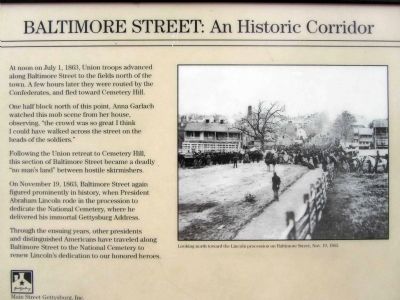
1. Baltimore Street - An Historic Corridor
At noon on July 1, 1863, Union troops advanced along Baltimore Street to the fields north of the town. A few hours later they were routed by the Confederates, and fled toward Cemetery Hill.
One half block north of this point, Anna Garlach watched this mob scene from her house, observing, "the crowd was so great I think I could have walked across the street on the heads of the soldiers."
Following the Union retreat to Cemetery Hill this section of Baltimore Street became a deadly "no man's land" between hostile skirmishes.
On November 19, 1863, Baltimore Street again figured prominently in history, when President Abraham Lincoln rode in the procession to dedicate the National Cemetery, where he delivered his immortal Gettysburg Address.
Through the ensuing years, other presidents and distinguished Americans have traveled along Baltimore Street to the National Cemetery to renew Lincoln's dedication to our honored heroes.
Erected by Main Street Gettysburg.
Topics. This historical marker is listed in these topic lists: Roads & Vehicles • War, US Civil. A significant historical month for this entry is July 1967.
Location. 39° 49.514′ N,
this page online

Regionally, this marker is in South-Central Pennsylvania. It is also in the American Northeast, in the Mid-Atlantic, in Appalachia, and specifically in Northern Appalachia. Globally, it is in North America, the Western Hemisphere, the Western World, and the Anglosphere. Historically, it finds itself in what was once the Haudenosaunee (Iroquois) Confederacy and also one of the original Thirteen Colonies.
Other nearby markers. At least 8 other markers are within walking distance of this marker: The Evolution of Gettysburg's "Common School" (here, next to this marker); "if anyone showed himself…" (a few steps from this marker); ...Lincoln passed by...
Photographed by Eric Milask, July 1, 2013
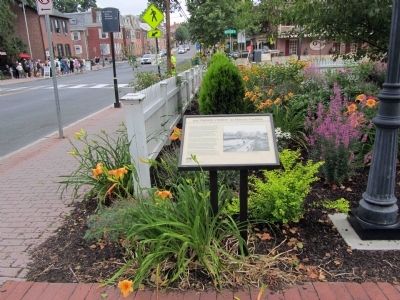
2. Baltimore Street - An Historic Corridor
More about this marker.
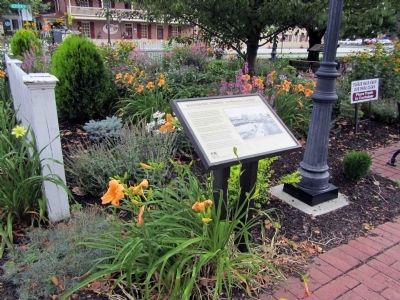
The small, yellowish, rectangular sign is contained in a dark black, metal stand stuck into the ground bordering the dedicated pavers inside the park.
Regarding Baltimore Street: An Historic Corridor.
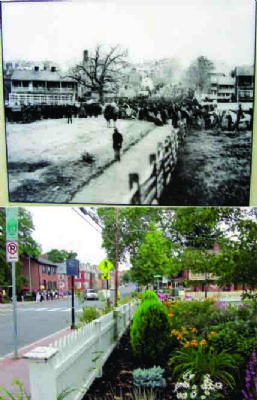
Concerning the picture: On the morning of November 19, 1863, Lincoln left the David Wills House and traveled via horse down Baltimore Street in Gettysburg (pictured). Giving a short, two minute speech at the dedication of the unfinished Soldiers’ National Cemetery, the President changed how Americans viewed the American Civil War, and helped transform Gettysburg from a battleground into a national icon
Photographed by Eric Milask, July 1, 2013
3. Baltimore Street - An Historic Corridor (1963 - 2013)
Photographed by Eric Milask, July 1, 2013
4. Baltimore Street - An Historic Corridor
Credits. This page was last revised on November 10, 2025. It was originally submitted on July 2, 2013, by Eric Milask of Cherry Hill, New Jersey. This page has been viewed 2,463 times since then and 154 times this year. Last updated on November 10, 2025, by Carl Gordon Moore Jr. of North East, Maryland. Photos: 1, 2, 3, 4. submitted on July 2, 2013, by Eric Milask of Cherry Hill, New Jersey. • Devry Becker Jones was the editor who published this page.
