
North End East in Sioux Falls in Minnehaha County, South Dakota — The American Midwest (Upper Plains)
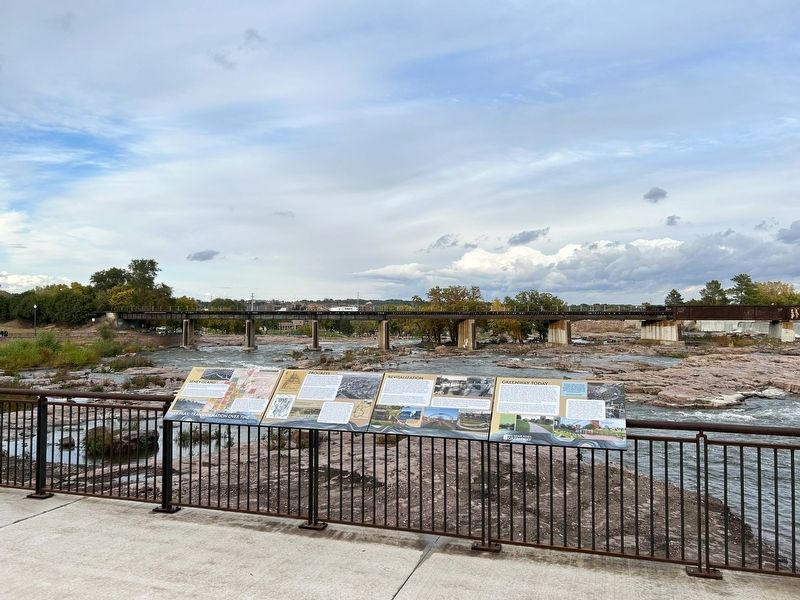
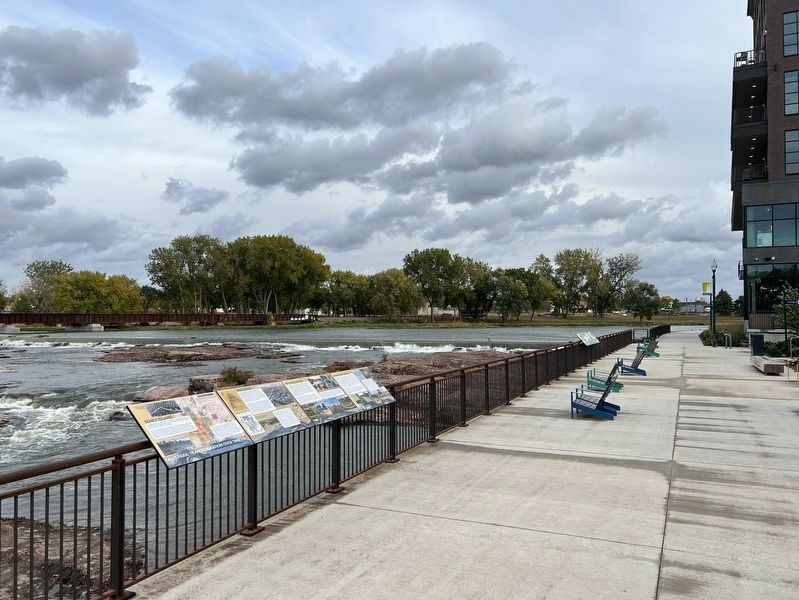
Falls Park: Transformation Over Time
Seney Island
⎯⎯⎯
Progress
⎯⎯⎯
Revitalization
⎯⎯⎯
Greenway Today
| — | Big Sioux River Greenway | — |
October 18, 2025
1. Seney Island | Falls Park: Transformation Over Time Marker
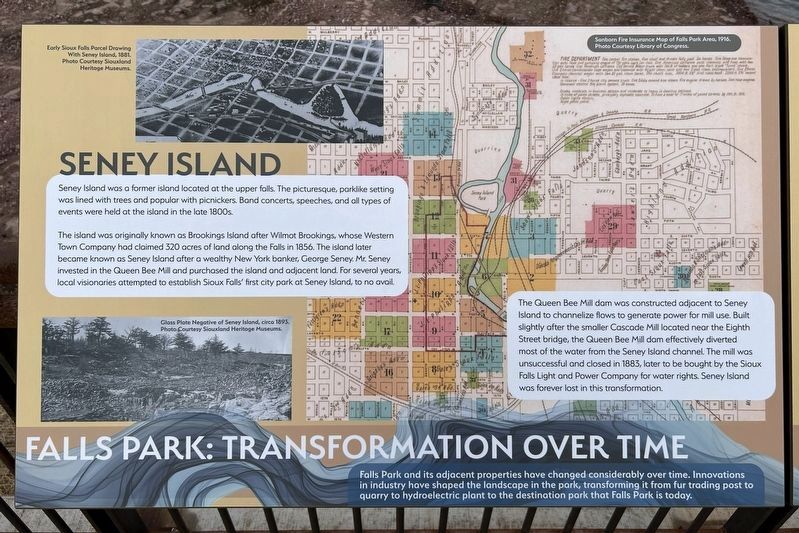
Seney Island
Seney Island was a former island located at the upper falls. The picturesque, parklike setting was lined with trees and popular with picnickers. Band concerts, speeches, and all types of events were held at the island in the late 1800s.
The island was originally known as Brookings Island after Wilmot Brookings, whose Western Town Company had claimed 320 acres of land along the Falls in 1856. The island later became known as Seney Island after a wealthy New York banker, George Seney. Mr. Seney invested in the Queen Bee Mill and purchased the island and adjacent land. For several years, local visionaries attempted to establish Sioux Falls' first city park at Seney Island, to no avail.
The Queen Bee Mill dam was constructed adjacent to Seney Island to channelize flows to generate power for mill use. Built slightly after the smaller Cascade Mil located near the Eighth Street bridge, the Queen Bee Mill dam effectively diverted most of the water from the Seney Island channel. The mill was unsuccessful and closed in 1883,
this page online
Early Sioux Falls Parcel Drawing With Seney Island, 1881. Photo Courtesy Siouxland Heritage Museums
Glass Plate Negative of Seney Island, circa 1893. Photo Courtesy Siouxland Heritage Museums.
Sanborn Fire Insurance Map of Falls Park Area, 1916. Photo Courtesy Library of Congress.
Progress
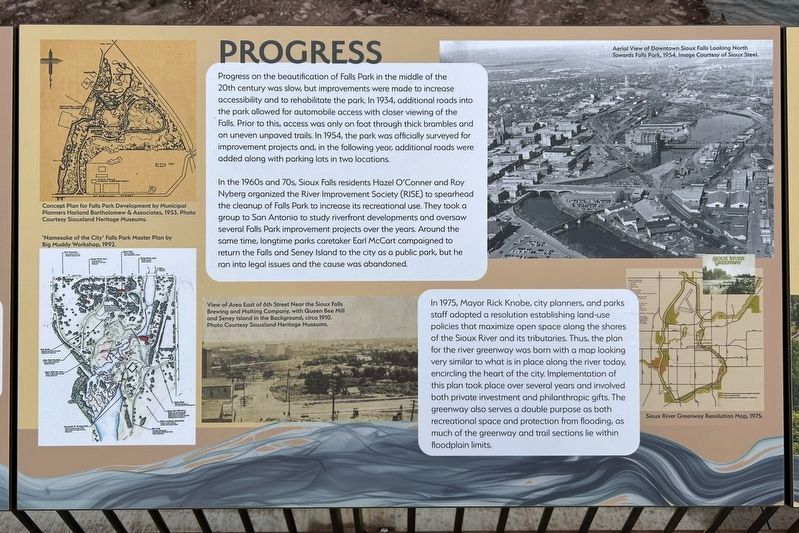
Progress on the beautification of Falls Park in the middle of the 20th century was slow, but improvements were made to increase accessibility and to rehabilitate the park. In 1934, additional roads into the park allowed for automobile access with closer viewing of the Falls. Prior to this, access was only on foot through thick brambles and on uneven unpaved trails. In 1954, the park was officially surveyed for improvement projects and, in the following year, additional roads were added along with parking lots in two locations.
In the 1960s and 70s, Sioux Falls residents Hazel O'Conner and Roy Nyberg organized the River Improvement Society (RISE) to spearhead the cleanup of Falls Park to increase its recreational use. They took a group to San Antonio to study riverfront developments and oversaw several Falls Park improvements projects over the years. Around the same time, longtime
October 18, 2025
2. Progress | Falls Park: Transformation Over Time Marker
In 1975, Mayor Rick Knobe, city planners, and parks staff adopted a resolution establishing land-use policies that maximize open space along the shores of the Sioux River and its tributaries. Thus, the plan for the river greenway was born with a map looking very similar to what is in place along the river today, encircling the heart of the city. Implementation of this plan took place over several years and involved both private investment and philanthropic gifts. The greenway also serves a double purpose as both recreational space and protection from flooding, as much of the greenway and trail sections lie within floodplain limits.
Concept Plan for Falls Park Development by Municipal Planners Harland Bartholomew & Associates, 1953. Photo Courtesy Siouxland Heritage Museums.
'Namesake of the City' Falls Park Master Plan by Big Muddy Workshop, 1992.
View of Area East of 6th Street Near the Sioux Falls Brewing and Malting Company, with Queen Bee Mill and Seney Island in the Background, circa 1910. Photo Courtesy Siouxland Heritage Museums.
Aerial View of Downtown Sioux Falls Looking North Towards Falls Park, 1954. Image Courtesy of Sioux Steel.
Sioux River Greenway
October 18, 2025
3. Revitalization | Falls Park: Transformation Over Time Marker
Revitalization
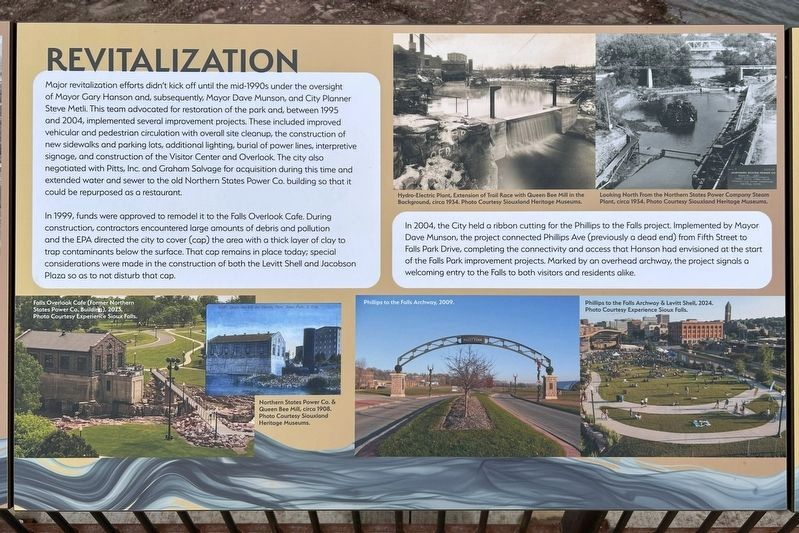
Major revitalization efforts didn't kick off until the mid-1990s under the oversight of Mayor Gary Hanson and, subsequently, Mayor Dave Munson, and City Planner Steve Metli. This team advocated for restoration of the park and, between 1995 and 2004, implemented several improvement projects. These included improved vehicular and pedestrian circulation with overall site cleanup, the construction of new sidewalks and parking lots, additional lighting, burial of power lines, interpretive signage, and construction of the Visitor Center and Overlook. The city also negotiated with Pitts, Inc. and Graham Salvage for acquisition during this time and extended water and sewer to the old Northern States Power Co. building so that it could be repurposed as a restaurant.
In 1999, funds were approved to remodel it to the Falls Overlook Cafe. During construction, contractors encountered large amounts of debris and pollution and the EPA directed the city to cover (cap) the area with a thick layer of clay to trap contaminants below the surface. That cap remains in place today; special considerations were made in the construction of both the Levitt Shell and Jacobson Plaza so as to not disturb that cap.
In 2004, the City held a ribbon cutting for the Phillips to the Falls project. Implemented by Mayor
October 18, 2025
4. Greenway Today | Falls Park: Transformation Over Time Marker
Falls Overlook Cafe (Former Northern States Power Co. Building), 2023. Photo Courtesy Experience Sioux Falls.
Northern States Power Co. & Queen Bee Mill, circa 1908. Photo Courtesy Siouxland Heritage Museums.
Hydro-Electric Plant, Extension of Trail Race with Queen Bee Mill in the Background, circa 1934. Photo Courtesy Siouxland Heritage Museums.
Looking North From the Northern States Power Company Steam Plant, circa 1934. Photo Courtesy Siouxland Heritage Museums.
Phillips to the Falls Archway, 2009.
Phillips to the Falls Archway & Levitt Shell, 2024. Photo Courtesy Experience Sioux Falls.
Greenway Today
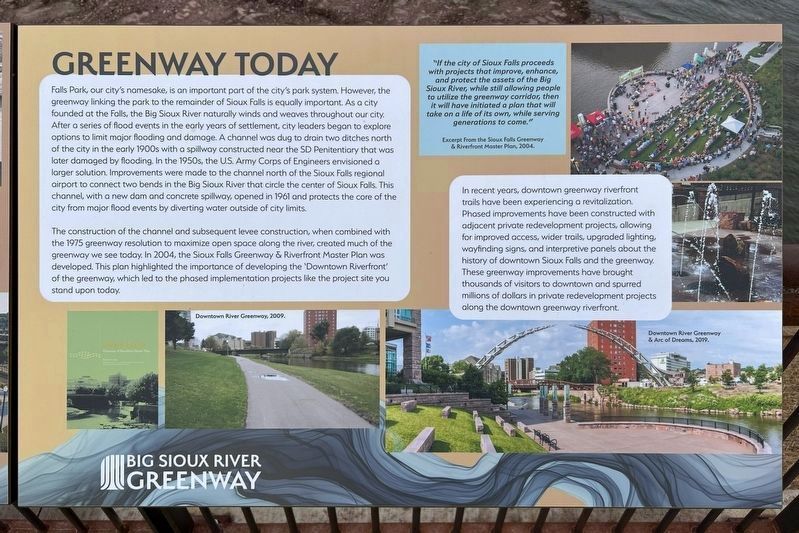
Falls Park, our city's namesake, is an important part of the city's park system. However, the greenway linking the park to the remainder of Sioux Falls is equally important. As a city founded at the Falls, the Big Sioux River naturally winds and weaves throughout our city. After a series of flood events in the early years of settlement, city
October 18, 2025
5. Falls Park: Transformation Over Time Marker
The construction of the channel and subsequent levee construction, when combined with the 1975 greenway resolution to maximize open space along the river, created much of the greenway we see today. In 2004, the Sioux Falls Greenway & Riverfront Master Plan was developed. This plan highlighted the importance of developing the 'Downtown Riverfront' of the greenway, which led to the phased implementation projects like the project site you stand upon today.
In recent years, downtown greenway riverfront trails have been experiencing a revitalization. Phased improvements have been constructed with adjacent private redevelopment projects, allowing for improved access, wider trails, upgraded lighting, wayfinding signs, and interpretive
October 18, 2025
6. Falls Park: Transformation Over Time Markers
"If the city of Sioux Falls proceeds with projects that improve, enhance, and protect the assets of the Big Sioux River, while still allowing people to utilize the greenway corridor, then it will have initiated a plan that will take on a life of its own, while serving generations to come."Excerpt From the Sioux Falls Greenway & Riverfront Master Plan, 2004.
Downtown River Greenway, 2009.
Downtown River Greenway & Arc of Dreams, 2019.
Erected 2025.
Topics. This historical marker is listed in these topic lists: Parks & Recreational Areas • Waterways & Vessels. A significant historical year for this entry is 1856.
Location. 43° 33.281′ N, 96° 43.481′ W. Marker is in Sioux Falls, South Dakota, in Minnehaha County. It is in North End East. It can be reached from East 4th Place east of North Phillips Avenue. Located along the riverside walkway between Jacobson Plaza and Lloyd Landing. Touch for map. Marker is at or near this postal address: 120 E 4th Pl, Sioux Falls SD 57104, United States of America. Touch for directions.

Regionally, this marker is in East River. It is also in the American Midwest, in the Lewis & Clark Corridor, in the Corn Belt, on the prairies, and on the Northern Plains. Globally, it is in North America, the Western Hemisphere, the Western World, and the Anglosphere. Historically, it finds itself in what was once Rupert’s Land and also the Louisiana Purchase.
Other nearby markers. At least 8 other markers are within walking distance of this marker: A different marker also named Falls Park: Transformation Over Time (a few steps from this marker); Flandreau Colony (about 400 feet away, measured in a direct line); The Lure of the Falls (about 500 feet away); Remnants of Change: The Railroad Bridge (about 500 feet away); Remnants of Change: The Mill Race & Dam (about 500 feet away); Foundation of the City (about 600 feet away); Beginning of Great Changes (about 600 feet away); The Sioux Quartzite (about 600 feet away). Touch for a list and map of all markers in Sioux Falls.
Credits. This page was last revised on November 11, 2025. It was originally submitted on November 11, 2025. This page has been viewed 69 times since then and 39 times this year. Photos: 1, 2, 3, 4, 5, 6. submitted on November 11, 2025.
