
North End East in Sioux Falls in Minnehaha County, South Dakota — The American Midwest (Upper Plains)
Falls Park: Transformation Over Time
Early History
⎯⎯⎯
Growth
⎯⎯⎯
Disrepair
⎯⎯⎯
Sioux Steel
| — | Big Sioux River Greenway | — |
October 18, 2025
1. Early History | Falls Park: Transformation Over Time Marker
Early History
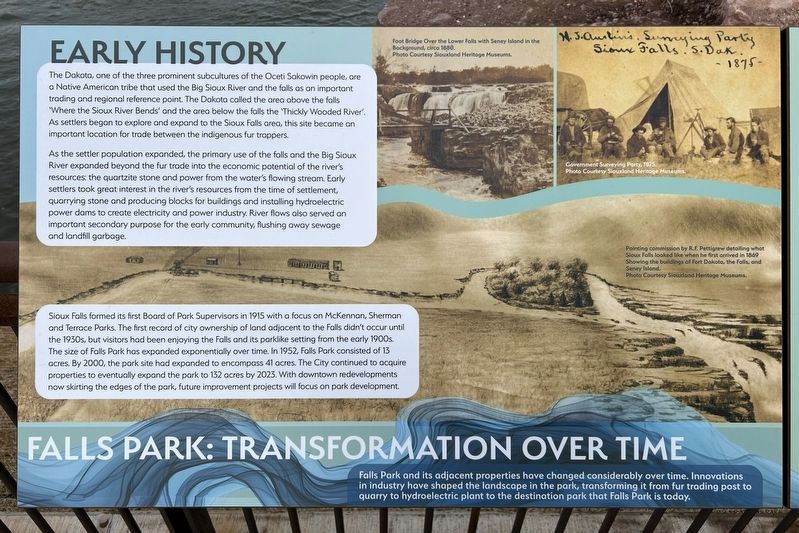
The Dakota, one of the three prominent subcultures of the Oceti Sakowin people, are a Native American tribe that used the Big Sioux River and the falls as an important trading and regional reference point. The Dakota called the area above the falls 'Where the Sioux River Bends' and the area below the falls the 'Thickly Wooded River'. As settlers began to explore and expand to the Sioux Falls area, this site became an important location for trade between the indigenous fur trappers.
As the settler population expanded, the primary use of the falls and the Big Sioux River expanded beyond the fur trade into the economic potential of the river's resources: the quartzite stone and power from the water's flowing stream. Early settlers took great interest in the river's resources from the time of settlement, quarrying stone and producing blocks for buildings and installing hydroelectric power dams to create electricity and power industry. River flows also served an important secondary purpose for the early community, flushing away
this page online
Sioux Falls formed its first Board of Park Supervisors in 1915 with a focus on McKennan, Sherman and Terrace Parks. The first record of city ownership of land adjacent to the Falls didn't occur until the 1930s, but visitors had been enjoying the Falls and its parklike setting from the early 1900s. The size of Falls Park has expanded exponentially over time. In 1952, Falls Park consisted of 13 acres. By 2000, the park site had expanded to encompass 41 acres. The City continued to acquire properties to eventually expand the park to 132 acres by 2023. With downtown redevelopments now skirting the edges of the park, future improvement projects will focus on park development.
Foot Bridge Over the Lower Falls with Seney Island in the Background, circa 1880. Photo Courtesy Siouxland Heritage Museums.
Government Surveying Party, 1875. Photo Courtesy Siouxland Heritage Museums.
Painting commission by R.F. Pettigrew detailing what Sioux Falls looked like when he first arrived in 1869 Showing the buildings of Fort Dakota, the Falls, and Seney Island. Photo Courtesy Siouxland Heritage Museums.
Growth
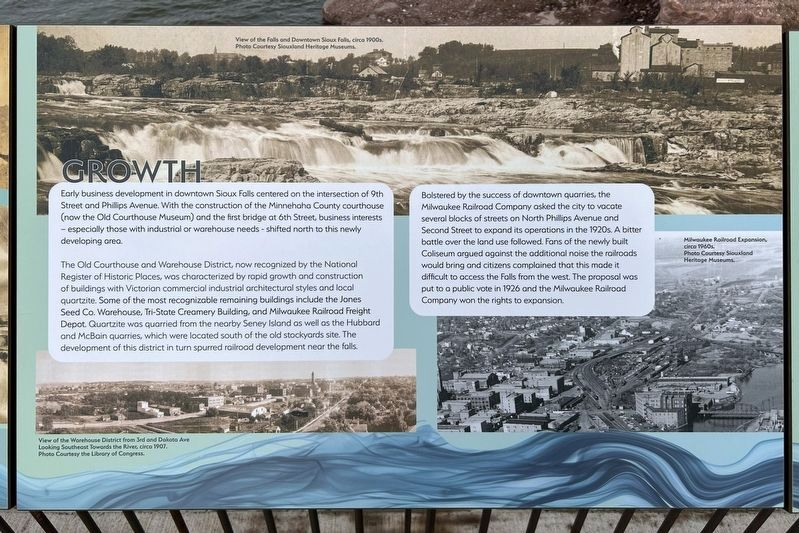
Early business development in downtown Sioux Falls centered on the intersection of 9th Street and Phillips Avenue. With the construction of the Minnehaha County courthouse (now the
October 18, 2025
2. Growth | Falls Park: Transformation Over Time Marker
The Old Courthouse and Warehouse District, now recognized by the National Register of Historic Places, was characterized by rapid growth and construction of buildings with Victorian commercial industrial architectural styles and local quartzite. Some of the most recognizable remaining buildings include the Jones Seed Co. Warehouse, Tri-State Creamery Building, and Milwaukee Railroad Freight Depot. Quartzite was quarried from the nearby Seney Island as well as the Hubbard and McBain quarries, which were located south of the old stockyards site. The development of this district in turn spurred railroad development near the falls.
Bolstered by the success of downtown quarries, the Milwaukee Railroad Company asked the city to vacate several blocks of streets on North Phillips Avenue and Second Street to expand its operations in the 1920s. A bitter battle over the land use followed. Fans of the newly built Coliseum argued against the additional noise the railroads would bring and citizens complained that this made it difficult to access the Falls from the west. The proposal was put to a public vote in 1926 and the Milwaukee Railroad Company won the rights to expansion.
View

October 18, 2025
3. Disrepair | Falls Park: Transformation Over Time Marker
View of the Warehouse District from 3rd and Dakota Ave Looking Southeast Towards the River, circa 1907. Photo Courtesy the Library of Congress.
Milwaukee Railroad Expansion, circa 1960s. Photo Courtesy Siouxland Heritage Museums.
Disrepair
As the hydroelectric plant and railroad network to the Falls expanded, the site became a dumping ground for trash. Shortly after the Milwaukee Railroad's expansion in the late 1920s, people began to complain about the burning rubber and gas smell coming from the site, as well as the crime and prostitution in the area. A concrete retaining wall was built near Seney Island to increase water flows for the hydroelectric plant. Over time, the channel around Seney Island was filled with garbage until the land was absorbed into the mainland making it no longer recognizable as an island.
In 1951, Pitts, Inc., a scrap metal recycler, purchased the land near former 3rd Street and Phillips Avenue from the bankrupt Milwaukee Railroad company. Pitts, Inc. opened a salvage and junkyard on the site along the shores of the Big Sioux River. A branch of I-29 Brick Co. was located just north of Pitts in the area now occupied by Jacobson Plaza. Homeless encampments arrived shortly afterwards with some using
October 18, 2025
4. Sioux Steel | Falls Park: Transformation Over Time Marker
By the 1960s, Falls Park was known as "Hobo Road". Overgrown with weedy vegetation and surging with pollution, the falls remained an underutilized and under appreciated park space for the next thirty years.
View of the Railroad Bridge with Seney Island and Concrete Retaining Wall in the Background in Center of Image, 1921. Photo Courtesy Siouxland Heritage Museums.
Aerial Photo of Falls Park, 1966. Photo Courtesy City of Sioux Falls.
Sioux Steel
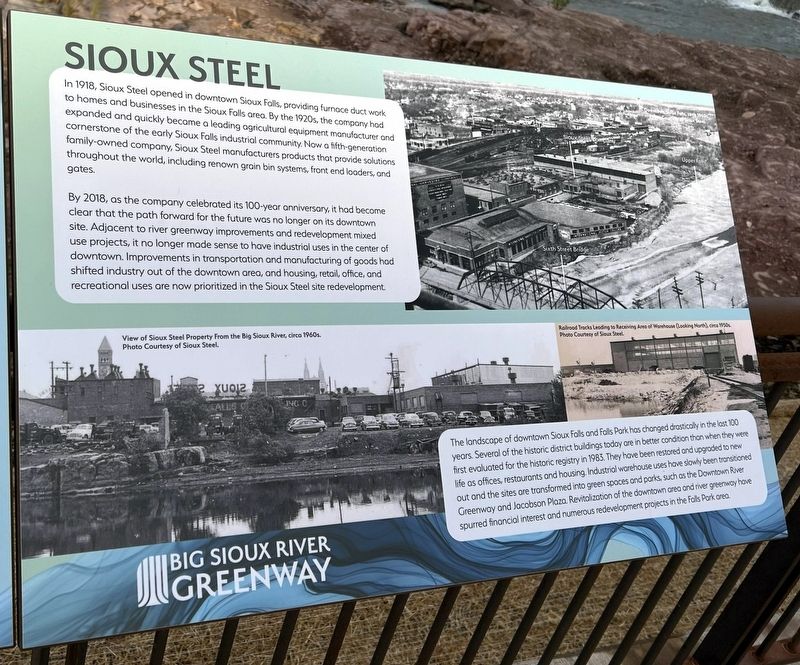
In 1918, Sioux Steel opened in downtown Sioux Falls, providing furnace duct work to homes and businesses in the Sioux Falls area. By the 1920s, the company had expanded and quickly became a leading agricultural equipment manufacturer and cornerstone of the early Sioux Falls industrial community. Now a fifth-generation family-owned company, Sioux Steel manufacturers products that provide solutions throughout the world, including renown grain bin systems, front end loaders, and gates.
By 2018, as the company celebrated its 100-year anniversary, it had become clear that the path forward for the future was no longer on its downtown site. Adjacent to river greenway improvements and redevelopment mixed use projects, it no longer made sense to have industrial uses in
October 18, 2025
5. Falls Park: Transformation Over Time Marker
The landscape of downtown Sioux Falls and Falls Park has changed drastically in the last 100 years. Several of the historic district buildings today are in better condition than when they were first evaluated for the historic registry in 1983. They have been restored and upgraded to new life as offices, restaurants and housing. Industrial warehouse uses have slowly been transitioned out and the sites are transformed into green spaces and parks, such as the Downtown River Greenway and Jacobson Plaza. Revitalization of the downtown area and river greenway have spurred financial interest and numerous redevelopment projects in the Falls Park area.
View of Sioux Steel Property From the Big Sioux River, circa 1960s. Photo Courtesy of Sioux Steel.
Downtown Sioux Falls, circa 1960s. Photo Courtesy of Sioux Steel.
Railroad Tracks Leading to Receiving Area of Warehouse (Looking North), circa 1950s. Photo Courtesy of Sioux Steel.
Erected 2025.
Topics. This historical marker is listed in these topic lists: Industry & Commerce
October 18, 2025
6. Falls Park: Transformation Over Time Marker
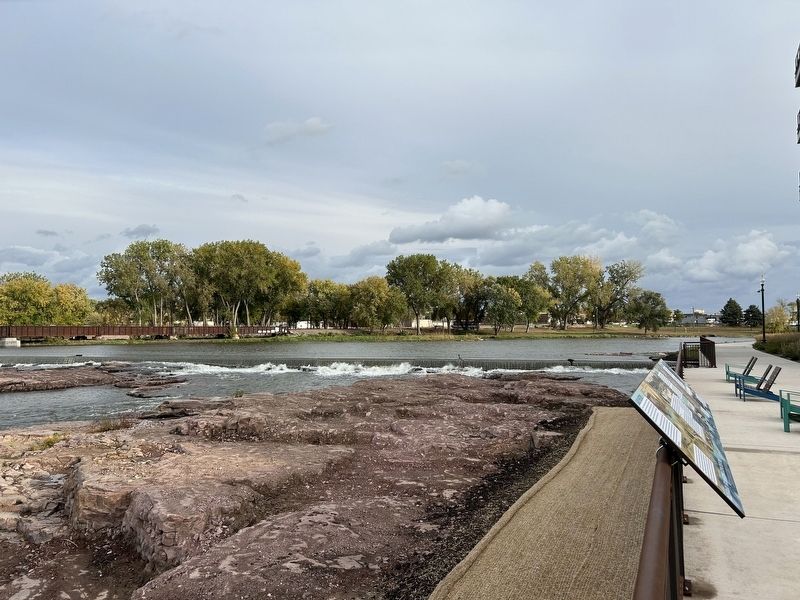
Location. 43° 33.272′ N, 96° 43.472′ W. Marker is in Sioux Falls, South Dakota, in Minnehaha County. It is in North End East. It can be reached from East 4th Place east of North Phillips Avenue. Located along the riverside walkway between Jacobson Plaza and Lloyd Landing. Touch for map. Marker is at or near this postal address: 120 E 4th Pl, Sioux Falls SD 57104, United States of America. Touch for directions.

Regionally, this marker is in East River. It is also in the American Midwest, in the Lewis & Clark Corridor, in the Corn Belt, on the prairies, and on the Northern Plains. Globally, it is in North America, the Western Hemisphere, the Western World, and the Anglosphere. Historically, it finds itself in what was once Rupert’s Land and also the Louisiana Purchase.
Other nearby markers. At least 8 other markers are within walking distance of this marker: A different marker also named Falls Park: Transformation Over Time (a few steps from this marker); Flandreau Colony (about 300 feet away, measured in a direct line); Remnants of Change: The Railroad Bridge (about 500 feet away); Remnants of Change: The Mill Race & Dam (about 500 feet away); Seney Island (about 500 feet away); The Lure of the Falls (about 600 feet away); Foundation of the City (about 600 feet away); Beginning of Great Changes (about 600 feet away). Touch for a list and map of all markers in Sioux Falls.
Credits. This page was last revised on November 11, 2025. It was originally submitted on November 11, 2025. This page has been viewed 68 times since then and 31 times this year. Photos: 1, 2, 3, 4, 5, 6. submitted on November 11, 2025.
