Fraser in Grand County, Colorado — The American Mountains (Southwest)
Frontier Infantry
Photographed by Cosmos Mariner, July 30, 2025
1. Frontier Infantry Marker
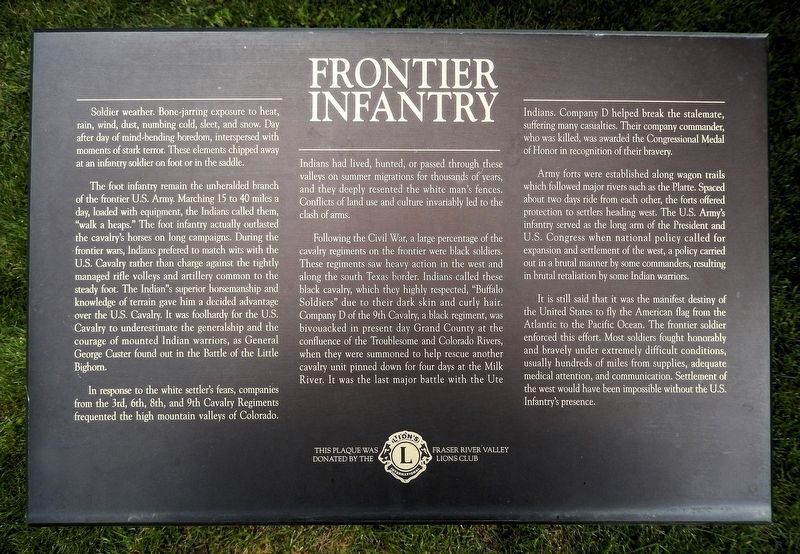
Soldier weather. Bone-jarring exposure to heat, rain, wind, dust, numbing cold, sleet, and snow. Day after day of mind-bending boredom, interspersed with moments of stark terror. These elements chipped away at an infantry soldier on foot or in the saddle.
The foot infantry remain the unheralded branch of the frontier U.S. Army. Marching 15 to 40 miles a day, loaded with equipment, the Indians called them, "walk a heaps." The foot infantry actually outlasted the cavalry's horses on long campaigns. During the frontier wars, Indians preferred to match wits with the U.S. Cavalry rather than charge against the tightly managed rifle volleys and artillery common to the steady foot. The Indian’s superior horsemanship and knowledge of terrain gave him a decided advantage over the U.S. Cavalry. It was foolhardy for the U.S. Cavalry to underestimate the generalship and the courage of mounted Indian warriors, as General George Custer found out in the Battle of the Little Bighorn.
In response to the white settler's fears, companies from the 3rd, 6th, 8th, and 9th Cavalry Regiments frequented the high mountain valleys of Colorado. Indians
this page online
Following the Civil War, a large percentage of the cavalry regiments on the frontier were black soldiers. These regiments saw heavy action in the west and along the south Texas border. Indians called these black cavalry, which they highly respected, "Buffalo Soldiers" due to their dark skin and curly hair. Company D of the 9th Cavalry, a black regiment, was bivouacked in present day Grand County at the confluence of the Troublesome and Colorado Rivers, when they were summoned to help rescue another cavalry unit pinned down for four days at the Milk River. It was the last major battle with the Ute Indians. Company D helped break the stalemate, suffering many casualties. Their company commander, who was killed, was awarded the Congressional Medal of Honor in recognition of their bravery.
Army forts were established along wagon trails which followed major rivers such as the Platte. Spaced about two days ride from each other,
Photographed by Cosmos Mariner, July 29, 2025
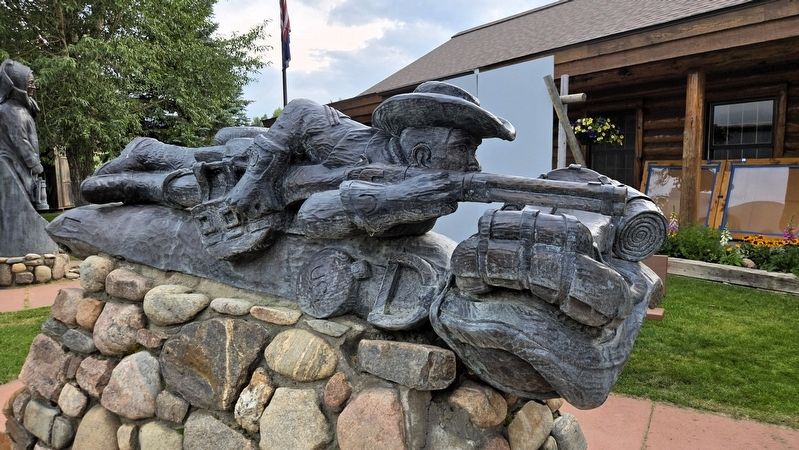
2. Frontier Infantry Sculpture
It is still said that it was the manifest destiny of the United States to fly the American flag from the Atlantic to the Pacific Ocean. The frontier soldier enforced this effort. Most soldiers fought honorably and bravely under extremely difficult conditions, usually hundreds of miles from supplies, adequate medical attention, and communication. Settlement of the west would have been impossible without the U.S. Infantry's presence.
This plaque was donated by the Fraser River Valley Lions Club
Erected 1995.
Topics and series. This historical marker is listed in these topic lists: African Americans • Indigenous Peoples and Communities • Settlements & Settlers • Wars, US Indian. In addition, it is included in the Medal of Honor Recipients series list. A significant historical date for this entry is September 29, 1879.
Location. 39° 56.745′ N,
Photographed by Cosmos Mariner, July 29, 2025
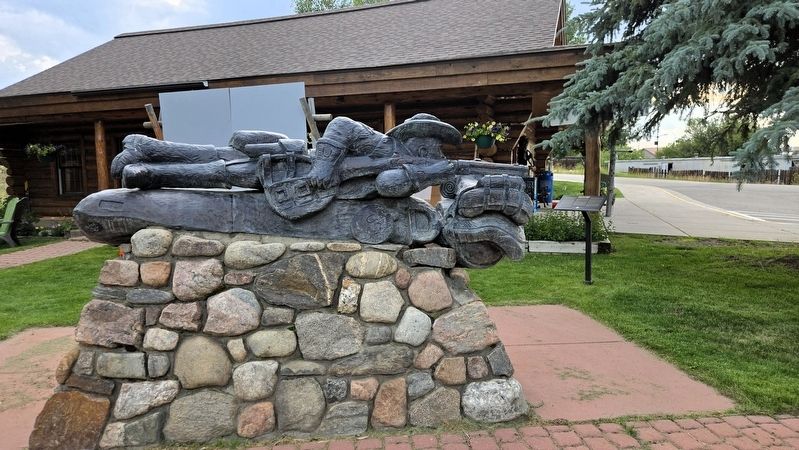
3. Frontier Sculpture & Marker
The historical marker is on the right, behind the sculpture. The Headwaters Trail Alliance Visitor Center is in the background.

Regionally, this marker is in the Colorado High Rockies and on the Continental Divide. It is also in the American Mountain West. Globally, it is in North America, the Rocky Mountains, the Western Hemisphere, the Western World, and the Anglosphere.
Other nearby markers. At least 8 other markers are within walking distance of this marker: Doc Susie (here, next to this marker); The Western Heritage Collection (a few steps from this marker); Sheriff Billy Cozens (a few steps from this marker); Jim Bridger (a few steps from this marker); Jeremiah (John) Johnson (a few steps from this marker); Indian and Eagle (within shouting distance of this marker); The Rancher

Photographed by Cosmos Mariner, July 29, 2025
4. J.M. Hoy Marker (nearby)
The sculptures and bronzes in Fraser's "Walk Through History Park" were gifted and created by J.M. Hoy whose artistic talent, passion and vision has linked our history with our present and future. Thanks, Jim — September, 1995
Related markers. Click here for a list of markers that are related to this marker. The Western Heritage Collection
Also see . . .
1. Francis Safford Dodge (1842-1908) (Wikipedia).
Excerpt: US Army officer with the rank of Brigadier General, who received the Medal of Honor for his actions during the Indian Wars.(Submitted on November 16, 2025, by Cosmos Mariner of Cape Canaveral, Florida.)
In July 1879 he was sent to what is now northwestern Colorado to “prevent any collusion between the settlers and Indians”; these Indians were known as White River Utes and Captain Dodge and his Company D regiment were posted to Fort Garland the following month, leaving on August 4 with orders to travel to Middle Park and “remain in that place to prevent disputes between the local settlers and the native peoples.”
By the 19th he and his men had established a camp some ten miles below Hot Sulphur Springs, leaving on the 27th to proceed to Peck’s crossing of the roads that led to Rawlins and the Indian Agency. Two days later, following notice that resupply rations were gone, Captain Dodge and his men were headed back to Fort Garland. En route, the Indian Agency sent a communication indicating they were to head to their office to assist in the arrest of Indians. It was on this return trip that a message written by Captain Payne commanding the besieged troops near White River was delivered by a courier named Mansfield from the Indian Agency, indicating they were surrounded and had forty wounded men. Immediately, Captain Dodge and his men set out to relieve the troops at White River, traveling approximately 11 miles, pitching camp and staying briefly, then riding all night to reach the besieged men at approximately 4 am. Dodge and the men of the 9th Cavalry spent the next several days holding off the Indian forces until on or around October 2, the survivors were escorted to Forts Steele and D.A. Russell by Captain Dodge and the men of the 9th Cavalry. It is these actions that resulted in Dodge being awarded the Medal of Honor.
2. Francis Safford Dodge (Congressional Medal of Honor Society).
Rank: Captain (Highest Rank: Brigadier General)(Submitted on November 16, 2025, by Cosmos Mariner of Cape Canaveral, Florida.)
Conflict/Era: Indian Campaigns
Unit/Command: Troop D, 9th U.S. Cavalry
Medal of Honor Action Date: September 29, 1879
Medal of Honor Action Place: White River Agency, Colorado, USA
Citation: With a force of 40 men rode all night to the relief of a command that had been defeated and was besieged by an overwhelming force of Indians, reached the field at daylight, joined in the action, and fought for three days.
3. Francis Safford Dodge (1842-1908) (Find A Grave).
(Arlington National Cemetery, Arlington, Arlington County, Virginia, USA) Excerpt: Indian Wars Medal of Honor Recipient. He served during the Indian Wars as Captain and commander of Troop D, 9th United States Regular Cavalry. His Medal was issued on April 2, 1898. After the onset of the Civil War, he enlisted as a Corporal in the 23rd Massachusetts Volunteer Infantry on October 9, 1861. He served with his unit in operations in North Carolina and southern Virginia until December 1863, when he accepted a commission of 1st Lieutenant in Company E, 2nd United States Colored Cavalry. Promoted to Captain, he served with his new unit until the end of the war, and remained in the Regular Army, being assigned to the Buffalo Soldiers of the 9th United States Cavalry. He was promoted up to Brigadier General during his long service and was retired in 1906. Bio by: RPD2(Submitted on November 16, 2025, by Cosmos Mariner of Cape Canaveral, Florida.)
4. The sculpture trail in Fraser Colorado (Quiltripping.com).
(by Rose Palmer) Excerpt: In Fraser, this trail is anchored by the “Walk Through History Park” with sculptures in bronze created and donated by J. M. Hoy. For Mr. Hoy these sculptures and the research into the stories of each character, were a labor of love. They were made as a part of his Western Heritage Collection as a means of inspiring young people to learn about America’s frontier.(Submitted on November 16, 2025, by Cosmos Mariner of Cape Canaveral, Florida.)Frontier Infantry
The army’s foot infantry have never gotten the same recognition that the cavalry has received when it came to settling the west. But, apparently, the foot infantry actually outlasted the horse cavalry in a long campaign. Both of these groups played a critical role in the expansion and settlement of the west, acting as the long arm of the president and congress, battling with the Indians in order to make the American expansion possible.
Credits. This page was last revised on November 17, 2025. It was originally submitted on November 11, 2025, by Cosmos Mariner of Cape Canaveral, Florida. This page has been viewed 55 times since then and 26 times this year. Photos: 1, 2, 3, 4. submitted on November 16, 2025, by Cosmos Mariner of Cape Canaveral, Florida.
