Near Fort Calhoun in Washington County, Nebraska — The American Midwest (Upper Plains)
Creating a Council Ceremony
Photographed by Barry Swackhamer, July 16, 2025
1. Creating a Council Ceremony Marker
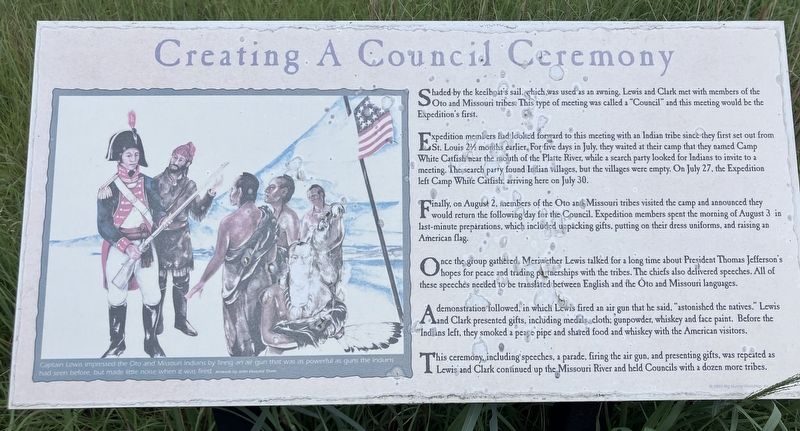
Caption: Captain Lewis impressed the Oto and Missouri Indians by firing an air gun that was as powerful as guns the Indians had seen before, but made little noise when it was fired.
Expedition members had looked forward to this meeting with an Indian tribe since they first set out from St. Louis 2 1/2 months earlier. For five days in July, they waited at their camp that they named Camp White Catfish near the mouth of the Platte River, while a search party looked for Indians to invite to a meeting. The search party found Indian villages, but the villages were empty. On July 27, the Expedition left Camp White Catfish, arriving here on July 30.
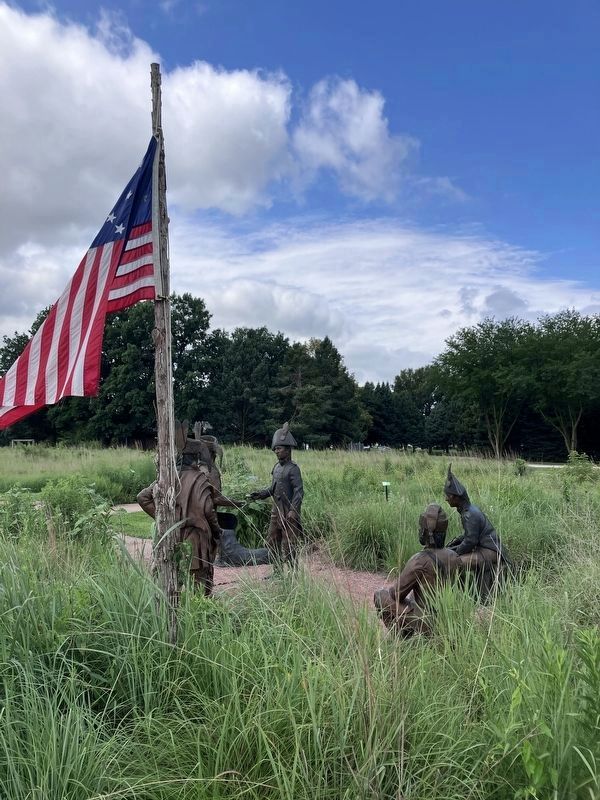
Finally, on August 2, members of the Ota and Missouri tribes visited the camp and announced they would return the following day for the Council. Expedition members spent the morning of August 3 in last-minute preparations, which included unpacking gifts, putting on their dress uniforms, and raising the American flag.
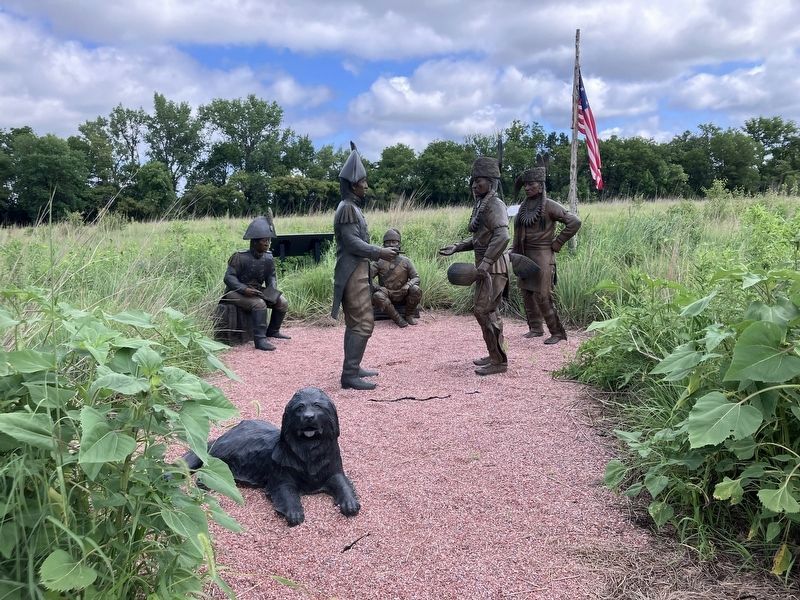
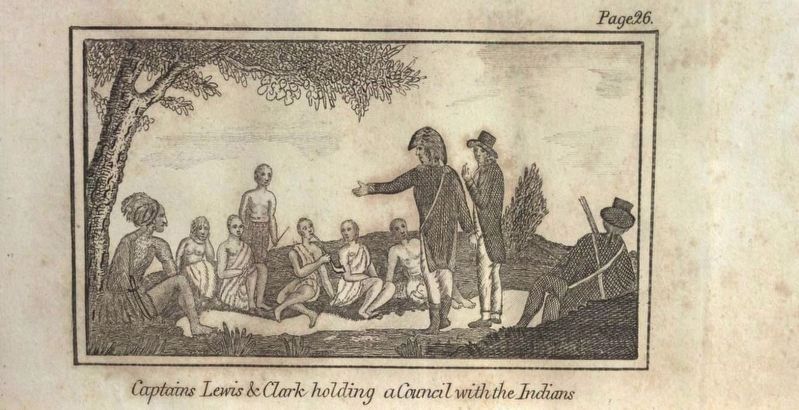
Once the group gathered, Meriwether Lewis talks for a long time about President Thomas Jefferson's hopes for peace and trading
this page online
A demonstration followed, in which Lewis fired an air gun that he said, "astonished the natives." Lewis and Clark presented gifts, including medals, cloth, gunpowder, whiskey and face paint. Before the Indians left, they smoked a peace pipe and shared food and whiskey with the American visitors.
This ceremony, included speeches, a parade, firing the air gun, and presenting gifts, was repeated as Lewis and Clark continued up the Missouri River and held Councils with a dozen more tribes.
Topics. This historical marker is listed in these topic lists: Indigenous Peoples and Communities • Notable Events. A significant historical date for this entry is August 3, 1804.
Location. 41° 27.349′ N, 96° 0.906′ W. Marker is near Fort Calhoun, Nebraska, in Washington County. It can be reached from South 7th Street near Monroe Street. The marker and sculpture are in Fort Atkinson State Historical Park. Touch for map. Marker is at or near this postal address: 201 South 7th Street, Fort Calhoun
Photographed by Barry Swackhamer, July 16, 2025
2. Creating a Council Ceremony Marker

Regionally, this marker is in Eastern Nebraska and in Greater Omaha. It is also in the American Midwest, in the Lewis & Clark Corridor, in the Corn Belt, and on the prairies. Globally, it is in North America, the Western Hemisphere, the Western World, and the Anglosphere. Historically, it finds itself in what was once the Louisiana Purchase.
Other nearby markers. At least 8 other markers are within walking distance of this marker: Essential Friends and Allies (here, next to this marker); Cultivating Friendship and Understanding (a few steps from this marker); The People the Expedition Met Here (within shouting distance of this marker); Lewis and Clark Campsite (about 300 feet away, measured in a direct line); The Fort Storehouse (about 300 feet away); A Grinding Operation (about 500 feet away); Fort Atkinson (approx. ¼ mile away); Fort Calhoun Schools at Washington Square (approx. 0.4 miles away). Touch for a list and map of all markers in Fort Calhoun.
Also see . . . Lewis and Clark -- The Otoe Missouria Tribe. [The] "meeting on August 3 was one of
Photographed by Barry Swackhamer, July 16, 2025
3. First Council Commemorative Bronze Sculptures
Photographed by Barry Swackhamer
4. Captains Lewis & Clark holding a Council with the Indians
Credits. This page was last revised on November 13, 2025. It was originally submitted on November 13, 2025, by Barry Swackhamer of Brentwood, California. This page has been viewed 55 times since then and 21 times this year. Photos: 1, 2, 3, 4. submitted on November 13, 2025, by Barry Swackhamer of Brentwood, California.
