Mexico in Audrain County, Missouri — The American Midwest (Upper Plains)
Mexico in the Civil War
Missouri's Civil War
| — | 1861-1865 | — |
Photographed by Jason Voigt, October 26, 2025
1. Mexico in the Civil War Marker
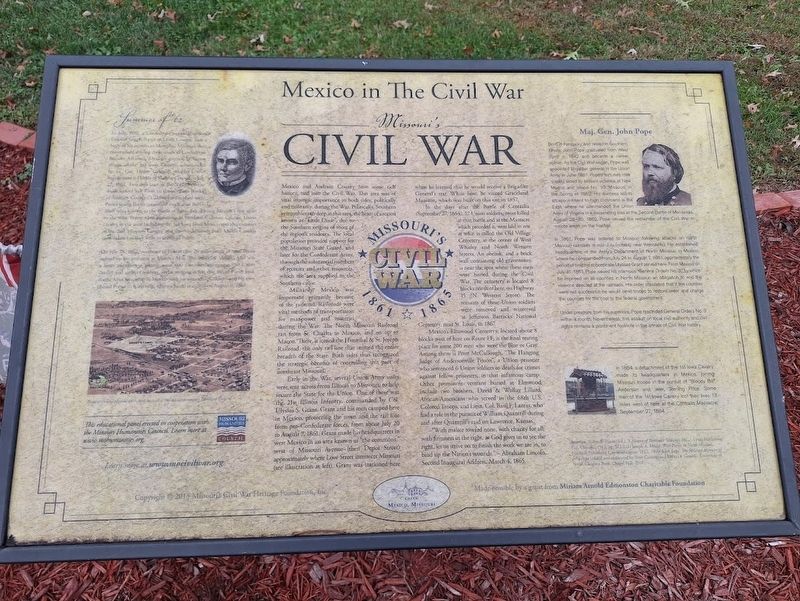
Mexico and Audrain County have some rich history, tied into the Civil War. This area was of vital strategic importance to both sides, politically and militarily, during the War. Politically, Southern sympathies ran deep in this area, the heart of a region known as "Little Dixie", due to the Southern origins of most of the region's residents. The local population provided support for the Missouri State Guard, and later for the Confederate Army, through the substantial numbers of recruits and other resources, which the area supplied to the Southern cause.
Militarily, Mexico was important primarily because of the railroad. Railroads were vital methods of transportation for manpower and material during the War. The North Missouri Railroad ran from St. Charles to Mexico, and on up to Macon. There, it joined the Hannibal & St. Joseph Railroad, the only rail line that crossed the entire breadth of the State. Both sides thus recognized the strategic benefits of controlling this part of northeast Missouri.
Early in the War, several Union Army units were sent across from Illinois to Missouri, to help secure the State for
this page online
In the days after the Battle of Centralia (September 27, 1864), 52 Union soldiers, most killed at that battle and at the Massacre which preceded it, were laid to rest at what is called the Old Village Cemetery, at the corner of West Whitley and North Western Streets. An obelisk, and a brick wall containing old gravestones, is near the spot where these men were buried during the Civil War. The cemetery is located 8 blocks north of here, on Highway 15 (N. Western Street). The remains of these Union soldiers were removed and reinterred at Jefferson Barracks National

Photographed by Jason Voigt, October 26, 2025
2. Mexico in the Civil War Marker
Mexico's Elmwood Cemetery, located about 8 blocks west of here on Route FF, is the final resting place for some 200 men who wore the Blue or Gray. Among them is Peter McCullough, "The Hanging Judge of Andersonville Prison", a Union prisoner who sentenced 6 Union soldiers to death for crimes against fellow prisoners, in that infamous camp. Other prominent veterans buried at Elmwood include two brothers, David & Walker Lillard, African-Americans who served in the 68th U.S. Colored Troops, and Lieut. Col. Basil F. Lazear, who had a role in the pursuit of William Quantrill during and after Quantrill's raid on Lawrence, Kansas.
"With malice toward none, with charity for all, with firmness in the right, as God gives us to see the right, let us strive on to finish the work we are in, to bind up the Nation's wounds."- Abraham Lincoln, Second Inaugural Address, March 4, 1865.
Summer of '62
In July 1862, a Confederate recruiting officer, Colonel Joseph Porter of Lewis County, took a body of his recruits to Memphis, Missouri, then commenced driving them south to Confederate lines in Arkansas. Mexico's
Photographed by Jason Voigt, October 26, 2025
3. Mexico in the Civil War Marker
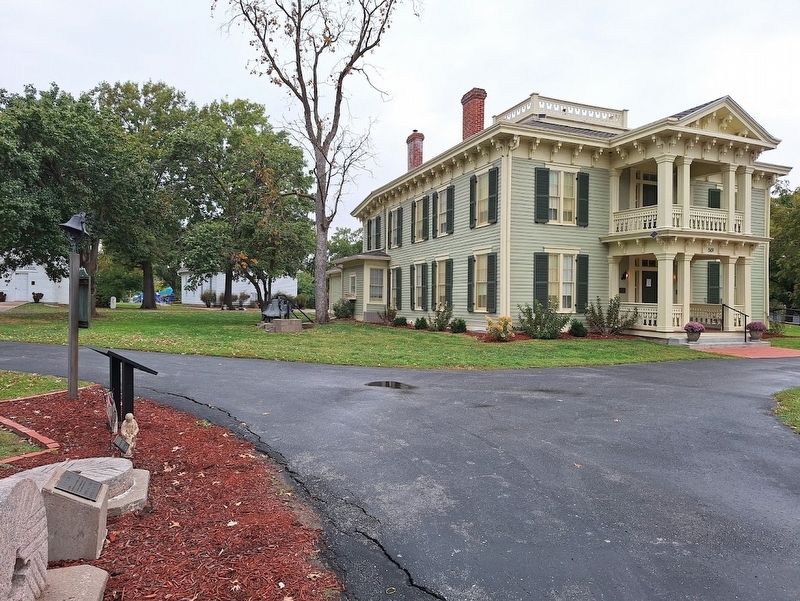
Marker is outside the Audrain County History Museum.
On July 28, 1862, northeast of Fulton (just 20 miles south of here) Porter turned up on his pursuers at Moore's Mill. The Battle of Moore's Mill was a fierce engagement putting some 400 Confederates against 750 Union cavalry and artillery soldiers, and a stinging defeat that forced Porter back north. After returning in Mexico with his wounded, Caldwell and his men chased Porter to Kirksville, where a battle occurred on August 6, 1862.
Maj. Gen. John Pope
Born in Kentucky and raised in Southern Illinois, John Pope graduated from West Point in 1842 and became a career soldier. As the Civil War began, Pope was appointed brigadier general in the Union Army in June 1861. Pope's fortunes rose quickly, aided by brilliant victories at New Madrid and Island No. 10, Missouri, in the Spring of 1862. His success led to an appointment to high command in the East, where he commanded the Union Army of Virginia in a devastating loss at the Second Battle of Manassas, August 28-30, 1862. Pope served the remainder of the Civil War in remote areas on the frontier.
In 1861, Pope was ordered to Missouri following attacks on north Missouri railroads in mid-July (notably near Wentzville). He established headquarters of the Army's Department of North Missouri in Mexico, where he commanded from July 24 to August 7, 1861, approximately the period of time his subordinate Ulysses Grant served here. From Mexico on July 31, 1861, Pope issued his infamous "General Orders No. 3," by which he imposed on all counties in North Missouri an obligation to end the violence directed at the railroads. His order stipulated that if the counties were not successful, he would send troops to restore order and charge the counties for the cost to the federal government.
Under pressure from his superiors, Pope rescinded General Orders No. 3 within a month, Nevertheless, this assault on local civil authority and civil rights remain a prominent footnote in the annals of Civil War history.
(aside:)
In 1864, a detachment of the 1st Iowa Cavalry made its headquarters in Mexico, joining Missouri troops in the pursuit of "Bloody Bill" Anderson and, later, Sterling Price. Some men of the 1st Iowa Cavalry lost their lives 13 miles west of here at the Centralia Massacre, September 27, 1864
Erected 2015 by City of Mexico, Missouri Humanities Council and Missouri's Civil War Heritage Foundation.
Topics and series. This historical marker is listed in these topic lists: African Americans • Cemeteries & Burial Sites • Railroads & Streetcars • War, US Civil. In addition, it is included in the Missouri’s Civil War series list. A significant historical date for this entry is March 4, 1865.
Location. 39° 10.095′ N, 91° 53.358′ W. Marker is in Mexico, Missouri, in Audrain County. It can be reached from Missouri Route 15. Marker is outside the Audrain County Historical Museum. Touch for map. Marker is in this post office area: Mexico MO 65265, United States of America. Touch for directions.

Regionally, this marker is in Little Dixie and in Mark Twain Country. It is also in the American Midwest, in the Lewis & Clark Corridor, and in the Corn Belt. Globally, it is in North America, the Western Hemisphere, the Western World, and the Anglosphere. Historically, it finds itself in what was once the territory of the Mississippian Culture, the Louisiana Purchase, and the Antebellum South.
Other nearby markers. At least 8 other markers are within walking distance of this marker: Old Stones (here, next to this marker); Hardin College Bell (a few steps from this marker); Old Courthouse Clock Bell (a few steps from this marker); Graceland (a few steps from this marker); Bean Creek German Evangelical Church and Littleby Methodist Church Bell (a few steps from this marker); Rex McDonald 833 (within shouting distance of this marker); Mexico (within shouting distance of this marker); Diaspore Boulder (about 300 feet away, measured in a direct line). Touch for a list and map of all markers in Mexico.
Credits. This page was last revised on November 15, 2025. It was originally submitted on November 15, 2025, by Jason Voigt of Glen Carbon, Illinois. This page has been viewed 279 times since then and 132 times this year. Photos: 1, 2, 3. submitted on November 15, 2025, by Jason Voigt of Glen Carbon, Illinois.
